W-Beam Highway Guardrail System 2-Wave Roadside Barrier
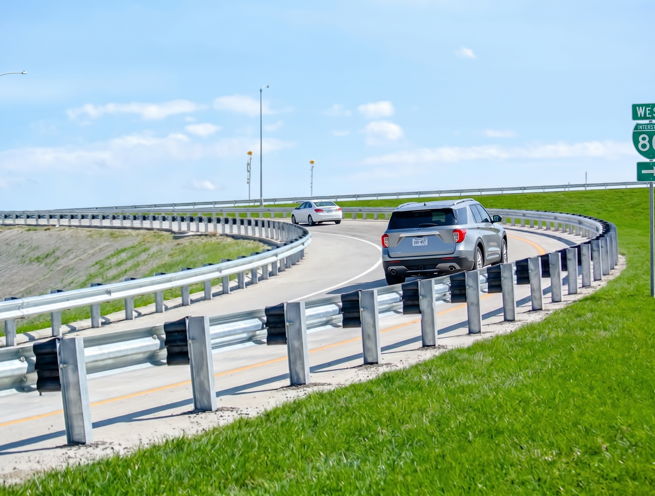
The Madoors USA W-Beam Highway Guardrail System is the trusted standard roadside safety barrier — manufactured from hot-dip galvanized high-strength steel to EN 1461 standard, EN 1317 crash test certified, and available in 4-meter standard sections at 2.5mm to 3mm thickness with sigma, C-post, or custom profile posts. The double-wave W profile absorbs and dissipates vehicle collision energy while guiding the vehicle back onto the carriageway in a controlled manner, preventing departure from the roadway at highways, expressways, bridge approaches and exits, intersections, ramps, sharp bends, dangerous curves, roadside drop-offs, embankments, urban and rural roads, industrial facility perimeters, and airport and seaport access roads. With high impact absorption performance, corrosion resistance for long outdoor service life, minimal maintenance cost, modular easy installation and replacement, and Madoors USA full lifecycle project support from design to installation, the W-Beam Guardrail is the ideal solution for both public infrastructure and private road projects.
TECHNICAL SPECIFICATIONS
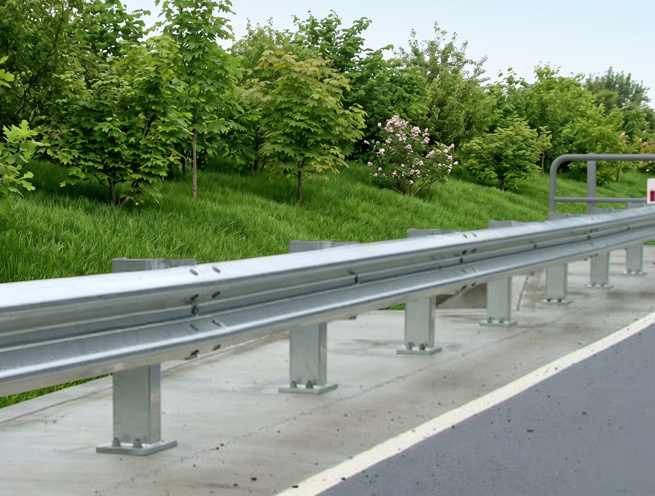
The Madoors USA W-Beam Guardrail uses a double-wave W profile — the two-wave corrugated cross-section provides the structural section modulus and bending resistance required for vehicle impact energy absorption and redirection at standard highway and road speeds. The W profile is the internationally established standard guardrail cross-section used on the majority of highways worldwide — its two-wave geometry provides the balance of impact performance, material efficiency, and installation simplicity that has made it the dominant roadside safety barrier specification for standard mixed-traffic roads.
Profile type — W double-wave corrugated. Material — hot-dip galvanized high-strength steel. Standard section length — 4 meters. Thickness — 2.5mm standard, 3mm heavy-duty option. Surface coating — hot-dip galvanized to EN 1461. Post options — sigma post, C-post, and custom profiles. Crash compliance — EN 1317.
The 4-meter standard section length is the universal modular unit for W-beam guardrail installation — standard post spacing, standard overlap at section joints, standard installation equipment, and standard crew procedures are all based on the 4-meter section. Post-accident maintenance uses standard 4-meter replacement sections installed with standard equipment. This universal standardization directly provides the fastest installation, the widest available supply chain, and the most economical maintenance of any highway barrier system.
Thickness options of 2.5mm and 3mm allow the structural performance to be matched to the traffic loading and impact energy of each specific application — 2.5mm for standard mixed-traffic rural and urban road applications, and 3mm for higher-volume highway applications and locations with elevated heavy vehicle proportions. Custom thickness is available for project-specific requirements.
Post type selection — sigma post for standard soil conditions providing high bending resistance, C-post for alternative structural requirements, and custom post for non-standard installation conditions — provides the foundation and structural flexibility to install the W-beam system on the complete range of soil types, sub-base conditions, and structural mounting situations encountered across the full range of application environments.
EN 1317 crash test certification confirms that the complete W-beam system — rail, posts, and fixings — has been independently tested against the European standard for road restraint systems, providing the regulatory compliance documentation required for national highway authority and government infrastructure procurement.
KEY FEATURES
Double-Wave W Profile — Impact Energy Absorption & Vehicle Redirection
The double-wave W profile is the engineering geometry that simultaneously provides impact energy absorption and vehicle redirection — the corrugated shape deforms progressively under vehicle impact loading, absorbing energy through plastic deformation of the rail section, while the continuous rail face redirects the vehicle along the barrier line and back toward the carriageway. This simultaneous absorption and redirection prevents the dangerous outcomes of barrier penetration — the vehicle leaving the road and hitting a hazard — and barrier rebound — the vehicle being deflected back into the traffic stream at a dangerous angle.
Hot-Dip Galvanized to EN 1461 — Long-Term Highway Service Life
The hot-dip galvanization to EN 1461 provides the zinc coating thickness and adhesion quality required for the 25 to 30-year design service life of permanent highway infrastructure — the galvanized coating resists the combined corrosion loading of weather exposure, road salt spray from winter de-icing operations, and the chemically aggressive highway environment throughout the full infrastructure design life without structural corrosion that would compromise the barrier's impact performance. This long-term corrosion resistance is the material specification requirement that makes hot-dip galvanized steel the standard construction for permanent highway safety barriers worldwide.
EN 1317 Certified — Highway Authority Procurement Compliance
The EN 1317 crash test certification provides the independent test documentation required for national highway authority, municipal road department, and government infrastructure procurement — the certification confirms that the W-beam system has been tested against the European standard vehicle impact conditions and meets the specified containment level, working width, and vehicle acceleration severity index requirements. This certification directly satisfies the regulatory compliance requirement for public highway infrastructure procurement.
Modular 4-Meter Sections — Universal Installation & Maintenance
The universal 4-meter section modularity provides the installation simplicity and maintenance efficiency that makes W-beam the most widely installed highway safety barrier in the world — any highway contractor with standard installation equipment can install and maintain the system, any local supply chain stocks the standard 4-meter replacement sections, and post-accident repair requires only the replacement of the damaged section without specialist equipment or materials. This universal modular standardization is the practical advantage that keeps the W-beam as the standard highway barrier specification despite the availability of alternative systems.
Sigma, C-Post & Custom — Any Foundation Condition
The three post type options — sigma, C-post, and custom — cover the complete range of soil, sub-base, and structural mounting conditions encountered across all W-beam application environments. Sigma posts are the standard high-performance option for typical highway embankment and verge soil conditions. C-posts provide an alternative for specific structural requirements. Custom post design accommodates the non-standard conditions of rock anchoring, bridge deck mounting, and reinforced concrete installation positions that standard post types cannot serve.
Complete Application Range — Highway to Industrial Access Road
The confirmed application range from national highways and expressways through bridge approaches, intersections, ramps, sharp bends, dangerous curves, drop-offs, urban and rural roads, and industrial and airport access roads confirms that the Madoors USA W-beam system provides the complete roadside safety solution for every road type and traffic environment from the highest-speed national highway through to the lowest-volume industrial access road. This universal application capability allows highway authorities and private developers to specify a single system for all road safety barrier requirements across a complete road network.
Visual Driver Guidance — Continuous Structured Form
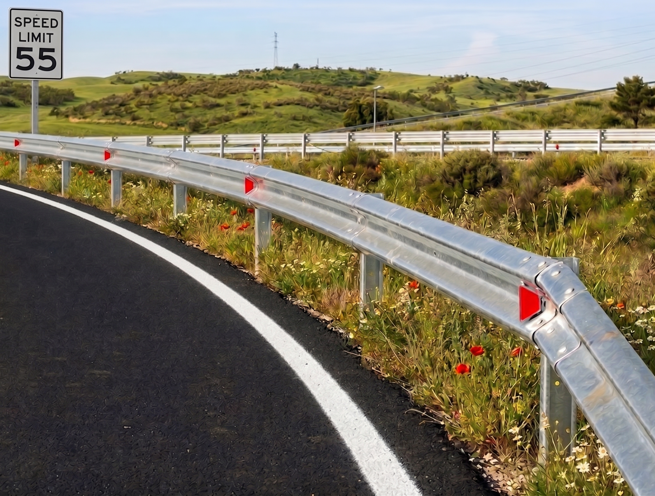
The continuous and structured form of the W-beam barrier along the road edge and median provides passive visual guidance to drivers — the continuous reflective galvanized steel line defines the road boundary and the curve geometry, directly guiding driver perception of the road ahead especially at night and in low-visibility conditions. This visual guidance function is the secondary safety benefit that operates continuously for every vehicle, every trip, in all lighting conditions — not only in collision scenarios.
Full Lifecycle Project Support — Design to Installation
The Madoors USA project-based solution with on-site support from design to installation provides the complete service required for highway authorities and private developers procuring W-beam guardrail for complete road sections — site survey and barrier layout design, performance class selection for each specific road section, installation supervision, and post-installation support. This full lifecycle support transforms the W-beam procurement from a product purchase into a complete roadside safety project delivery.
PRODUCT RANGE
Standard W-Beam 2.5mm — 4-meter sections, standard hot-dip galvanized to EN 1461. Rural and urban road standard specification. Sigma or C-post mounting.
Heavy-Duty W-Beam 3mm — 4-meter sections, 3mm thickness for higher impact loading. National highway and high-volume road specification.
W-Beam to Thrie Beam Transition — Transition sections from W-beam to Thrie Beam at heavy vehicle sections and bridge approaches.
Bridge Approach & Departure — Transition from flexible W-beam to rigid bridge parapet. Special terminal and approach design for the stiffness transition.
Back-to-Back Median Barrier — Double-sided W-beam for dual carriageway central reservation median barrier. Containment from both traffic directions.
End Treatments & Terminals — Crash-tested flared and non-flared terminal end treatments for the ends of all guardrail runs.
ASSEMBLY & INSTALLATION SEQUENCE
Site Survey & Performance Class Selection
Road geometry, design speed, traffic volume and composition, required EN 1317 performance class, post type and spacing, terminal positions, transition to bridge parapet or other barrier types, and median or roadside configuration are confirmed.
Terminal & End Treatment Installation
Crash-tested end treatments are installed at both ends of each guardrail run — the terminal sections are always installed before the intermediate sections to confirm the correct end treatment geometry and post spacing at the terminal positions.
Post Installation
Sigma or C-posts are driven to the specified embedment depth at the confirmed post spacing. Post level, alignment, and embedment depth are confirmed for consistent rail mounting height throughout the installation.
W-Beam Rail Installation & Section Overlap
4-meter W-beam sections are installed on the posts in the traffic-direction overlap sequence — each section overlaps the upstream face of the next section so that impacting vehicles do not snag on the section joint. Bolt installation at post connections and section-to-section splices is completed to the specified torque.
Transition Section Installation
W-beam to Thrie Beam or W-beam to bridge parapet transition sections are installed at the confirmed transition positions.
EN 1317 Certification & Handover
EN 1317 crash test certification for the specified performance class, EN 1461 galvanization certification, installation records, and maintenance guide for post-accident section replacement are compiled into the project handover package.
DEPLOYMENT SCENARIOS & USE CASES
Madoors USA W-Beam Highway Guardrail Systems are specified for any roadside safety barrier application requiring the standard international highway safety barrier with EN 1317 certification.
- National highway and expressway roadside barriers
- Dual carriageway central reservation median barriers
- Bridge approach and departure guardrail installation
- Motorway interchange ramp guardrail systems
- Dangerous curve and sharp bend roadside protection
- Roadside embankment and drop-off edge barriers
- Urban arterial road safety barrier installation
- Rural road dangerous section roadside barriers
- Industrial facility perimeter road safety barriers
- Airport internal road and perimeter guardrail
- Seaport and maritime terminal road barriers
- Logistics zone and warehouse road perimeter barriers
- Highway work zone temporary guardrail deployment
- Municipal road safety infrastructure programs
- Any road safety barrier application requiring EN 1317 certified hot-dip galvanized W-beam guardrail with full lifecycle project support