Please provide your technical specifications and project requirements for the Steel Wire Rope Highway Guardrail System. Our engineers will review your application and provide a detailed manufacturing quote, including exact pricing and lead times.
Steel Wire Rope Highway Guardrail System
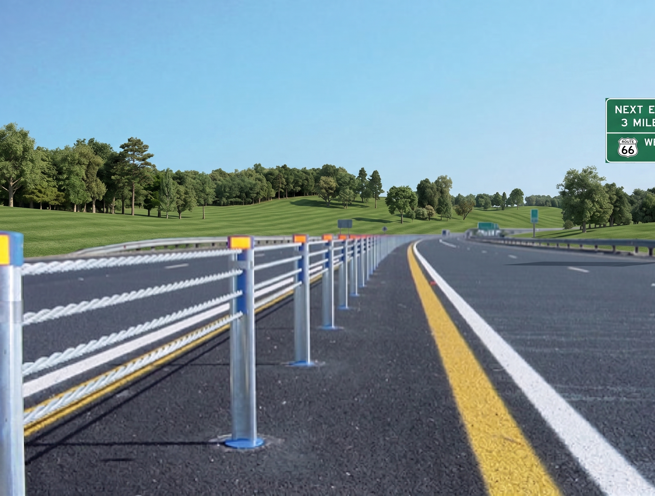
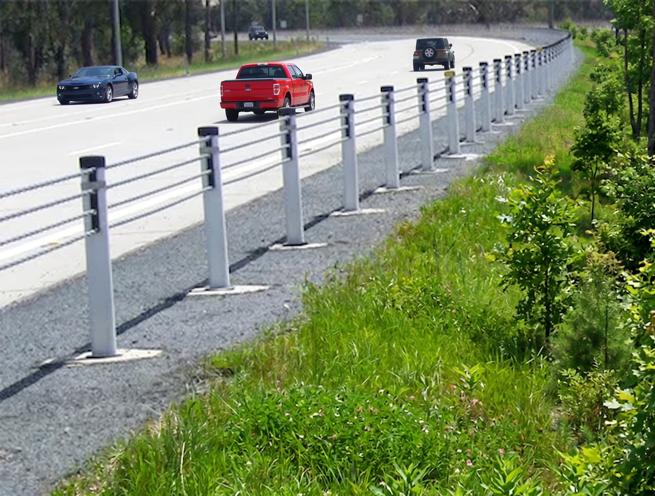
The Madoors USA Steel Wire Rope Highway Guardrail System is a flexible cable-based roadside safety barrier using high-tension galvanized steel wire ropes to absorb and dissipate collision energy while gently redirecting vehicles back to safety — designed for modern highways and high-speed traffic zones where controlled flexibility, minimal visual disruption, and dynamic energy absorption provide superior occupant protection compared to rigid barrier alternatives. Compliant with EN 1317, MASH, and NCHRP 350 crash safety standards, with 19mm galvanized high-tensile steel wire ropes on hot-dip galvanized steel posts at 2 to 4-meter spacing, the Madoors USA cable guardrail delivers fast modular installation, simple post-accident maintenance, high corrosion resistance, and the lowest lifecycle cost of any highway safety barrier system — for highway medians, shoulders, dangerous curves, slopes, environmentally sensitive routes, and any location where visual minimalism and landscape harmony are required alongside certified crash performance.
TECHNICAL SPECIFICATIONS
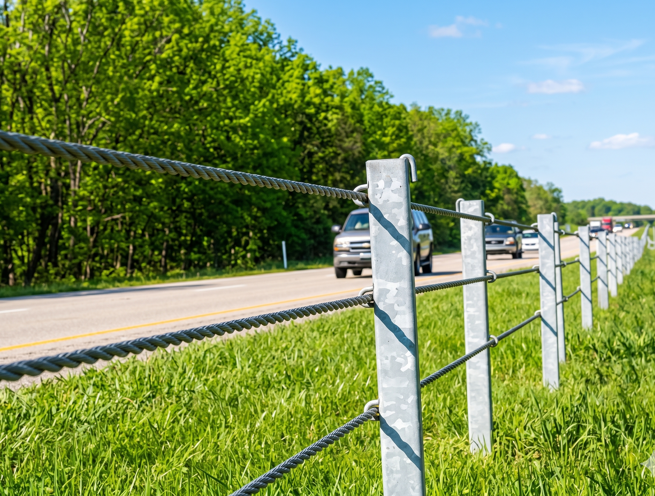
The Madoors USA Steel Wire Rope Guardrail System uses 19mm diameter high-tensile steel wire ropes as the primary barrier element — the wire rope diameter is the standard specification for certified cable guardrail systems, providing the tension capacity required for vehicle redirection at highway speeds while maintaining the flexibility that absorbs collision energy without the severe rebound of rigid systems. Custom cable diameters are available for specific performance requirements and regulatory compliance specifications.
The hot-dip galvanized steel support posts are engineered for tension distribution — the posts are designed to deflect and even disengage under the tension loading of a vehicle impact, transferring the impact energy along the cable run rather than concentrating it at a single post. This tension distribution mechanism is the engineering principle that allows the cable system to absorb and dissipate the collision energy over a longer distance than rigid barriers, directly reducing the peak deceleration force experienced by the vehicle occupants and minimizing vehicle damage.
Post spacing of 2 to 4 meters is the standard installation specification — the post spacing is selected based on the terrain, cable tension requirements, and performance class of the specific installation. Closer post spacing at 2 meters provides greater containment for the post-engagement phase of an impact, while wider spacing at 4 meters reduces installation cost and material quantity where the terrain and performance requirements allow.
Compliance with EN 1317 — the European road restraint system standard — MASH — Manual for Assessing Safety Hardware, the current US highway safety evaluation standard — and NCHRP 350 — the predecessor US standard still referenced for many existing specifications — provides the international multi-standard certification required for highway authority procurement across European and American-standard regulatory frameworks.
The galvanized steel rope and hot-dip galvanized posts provide the long-term outdoor corrosion resistance required for permanent highway installation in all climate zones — coastal salt spray, road de-icing salt, and all precipitation and temperature conditions throughout the design service life without structural degradation.
KEY FEATURES
Controlled Flexibility — Dynamic Energy Absorption
The controlled flexibility of the steel wire rope barrier is the fundamental performance advantage over rigid W-beam and concrete barriers — the cable deflects under vehicle impact, absorbing the collision kinetic energy progressively over the full deflection distance rather than transmitting it as an immediate deceleration shock through a rigid barrier. This energy absorption over distance directly reduces the peak deceleration force on vehicle occupants — the biomechanical injury mechanism — and minimizes vehicle damage by extending the collision duration. The controlled redirection back to the safe side of the barrier eliminates the dangerous rebound trajectory that rigid barriers can produce.
EN 1317, MASH & NCHRP 350 — Triple Standard Compliance
The triple crash safety standard compliance provides the broadest international regulatory acceptance of any single cable guardrail product — EN 1317 for European and internationally aligned highway authority procurement, MASH for current US federal highway program compliance, and NCHRP 350 for existing specifications and legacy regulatory frameworks. This triple compliance directly eliminates the standard-matching concern for international projects and multi-jurisdiction highway programs.
19mm High-Tensile Galvanized Steel Rope — Strength & Durability
The 19mm high-tensile galvanized steel wire rope provides the specific combination of tensile strength for vehicle containment and flexibility for energy absorption that defines the performance of cable guardrail systems. High-tensile steel provides significantly greater tensile strength per unit cross-section than standard steel, allowing the 19mm cable to provide the containment force required at highway vehicle speeds. Galvanization provides the corrosion resistance for the 25 to 30-year design service life of highway infrastructure without the structural degradation that unprotected steel rope would experience in outdoor service.
Low Visual Profile — Landscape & Environmental Harmony
The low visual profile of the wire rope system — multiple cables at post height without the continuous face of W-beam or the mass of concrete barriers — provides the minimal visual disruption required for environmentally sensitive routes, scenic highways, and urban development zones where road safety infrastructure must be visually compatible with the surrounding landscape. This visual minimalism is the specific aesthetic advantage that makes cable guardrail the preferred specification for forest roads, scenic drives, and urban boulevard medians where the barrier appearance is a design consideration alongside the safety performance.
Fast Modular Installation — Simple Post-Accident Maintenance
The modular cable and post system installs faster than rigid barrier alternatives — individual posts are driven or anchored at the specified spacing and the cable is strung and tensioned between anchor terminals without the heavy lifting equipment required for concrete barrier installation. Post-accident maintenance is equally straightforward — damaged posts are individually replaced and cable sections are re-tensioned or replaced without requiring the removal and re-installation of an entire barrier panel or concrete section. This maintenance simplicity directly reduces both the maintenance cost and the traffic management duration of barrier repair operations.
Lowest Lifecycle Cost — Minimal Replacement Parts
The combination of low initial installation cost from fast modular construction, minimal ongoing maintenance from the corrosion-resistant galvanized materials, simple post-accident repair from individual component replacement, and long design service life from the high-tensile galvanized rope and post specification directly provides the lowest lifecycle cost of any highway safety barrier alternative. This lifecycle cost advantage is the procurement argument that highway authorities with long-term infrastructure budget management responsibilities find most compelling.
Wide Application Range — Highway to Scenic Route
The confirmed application range from highway medians and shoulders through dangerous curves, slopes, high-frequency light vehicle traffic zones, and environmentally sensitive routes confirms that the Madoors USA cable guardrail serves the complete spectrum of road safety barrier applications — from the highest-speed highway median where vehicle containment performance is the primary requirement, through the scenic and environmentally sensitive route where visual minimalism is as important as safety performance.
INSTALLATION CONFIGURATIONS
Highway Median — Cable barrier along the central reservation of divided highways. Multiple cable rows for higher containment. Terminal anchors at median openings and cross-overs. EN 1317 or MASH performance class matched to highway design speed.
Highway Shoulder — Cable barrier at the road edge protecting against run-off road incidents. Single or dual cable rows depending on hazard severity. Hot-dip galvanized posts driven or anchored at 2 to 4-meter spacing.
Dangerous Curve & Slope — Enhanced cable tension and reduced post spacing for the higher deflection loading of curved road geometry. Terminal anchor design for the specific slope gradient and approach angle.
Bridge Approach Transition — Cable to rigid barrier transition sections connecting the cable guardrail run to the bridge parapet structure. Transition design manages the stiffness change between flexible cable and rigid concrete or steel parapet.
Median Openings & Terminals — Flared terminal sections at the end of cable barrier runs and at median emergency access openings. Terminal design absorbs the head-on impact of errant vehicles approaching the barrier end.
ASSEMBLY & INSTALLATION SEQUENCE
Site Survey & Barrier Layout
Road geometry, required containment class, post spacing for the terrain and performance requirement, terminal anchor positions, median opening locations, and transition to rigid barrier positions are confirmed to the EN 1317, MASH, or NCHRP 350 specification.
Terminal Anchor Installation
Terminal anchors at both ends of each cable run are installed first — the terminal anchors carry the full cable tension load and must be correctly installed before cable stringing. Foundation depth and anchor connection to the terminal post are confirmed.
Post Installation
Hot-dip galvanized steel posts are driven or anchored at the confirmed spacing along the barrier run. Post level and alignment are confirmed for consistent cable height throughout the run.
Cable Stringing & Tensioning
The 19mm galvanized high-tensile steel wire ropes are strung from terminal to terminal through the post brackets. Cable tension is applied using calibrated tensioning equipment to the specified design tension for the cable diameter and performance class.
Hardware & Bracket Installation
All post brackets, cable clips, and connection hardware are installed to the confirmed torque specification. Cable height at each post position is confirmed within the tolerance for the EN 1317 or MASH performance class.
EN 1317/MASH/NCHRP 350 Certification & Handover
Crash test certification documentation at the specified performance class, installation records, and maintenance guide for post-accident cable re-tensioning and post replacement are compiled into the project handover package.
DEPLOYMENT SCENARIOS & USE CASES
Madoors USA Steel Wire Rope Highway Guardrail Systems are specified for any road safety barrier application requiring flexible cable energy absorption with low visual profile.
- National highway median cable guardrail installation
- Highway shoulder run-off road protection barriers
- Dangerous curve outer edge cable guardrail
- Mountain road switchback curve cable barriers
- Bridge approach transition cable guardrail sections
- Forest road and environmentally sensitive route barriers
- Scenic highway and tourist route low-profile barriers
- Urban boulevard median cable guardrail systems
- Motorway service area approach barriers
- Highway work zone temporary cable barrier deployment
- Rural road dangerous curve protection barriers
- Coastal and estuarine road edge cable guardrail
- Airport perimeter road cable safety barriers
- Any road safety barrier application requiring EN 1317, MASH, or NCHRP 350 certified flexible cable guardrail with low visual profile and lifecycle cost efficiency
- Category: Highway Guardrails