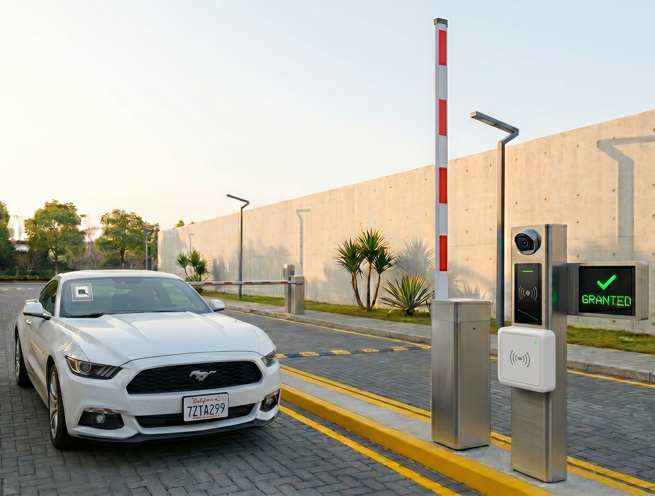
RFID Automatic Vehicle Identification and Access Systems
The Madoors USA RFID Automatic Vehicle Identification and Access System uses Radio Frequency Identification technology to automatically identify vehicles, objects, and persons at access control points — operating across Low Frequency 125 to 134 kHz, High Frequency 13.56 MHz, Ultra High Frequency 865 to 928 MHz, and Microwave 2.45 GHz bands with passive, semi-passive, and active RFID tag options. Integrated with parking automation systems, barrier gates, road blockers, and access control infrastructure, the Madoors USA RFID system provides high-speed, contactless vehicle identification for parking subscription entry and exit, fleet vehicle management, and any facility requiring automatic vehicle recognition without the delay of manual credential presentation or camera-dependent license plate reading.
TECHNICAL SPECIFICATIONS
The Madoors USA RFID Vehicle Identification System consists of three core hardware components — RFID tag, RFID antenna, and RFID reader — with each component selected and configured for the specific application operating conditions, reading range requirements, and frequency band of each installation.
The RFID tag is manufactured with an RFID chip of the appropriate capacity and operating frequency, adapted for the specific operating conditions of the vehicle access application — temperature variation, chemical exposure, mechanical impact from vehicle washing and road use, and the read range required for the specific barrier gate or access lane geometry. Tag construction uses a stronger antenna and stronger coating than standard RFID tags to withstand the harsh conditions of vehicle-mounted and outdoor access control deployment.
RFID antennas transmit the reader's radio frequency signal and receive the reflected signal from the tag's antenna — the antenna type is selected for the specific installation based on power, reading mode — linear or circular polarization — and reading area — far-field for long-range vehicle detection at barriers, near-field for close-range subscriber card reading at ticket machines. Antenna power output is adjustable at the reader to match the required reading distance precisely.
The RFID reader transfers the antenna signals to the application software layer according to the LLRP — Low Level Reader Protocol — standard. LLRP compliance is the critical future-proofing specification — an LLRP-compliant system can incorporate any LLRP-compatible reader from any manufacturer without application software changes, while proprietary protocol systems lock the installation to a single manufacturer's hardware for all future expansions. The Madoors USA system is designed in accordance with LLRP and EPCglobal Gen 2 standards, ensuring forward compatibility with all future RFID technology developments.
The three tag types provide different performance profiles for different application requirements. Passive tags — no internal power, powered by the reader signal — are the lowest cost option for standard parking subscription cards and vehicle tags at standard reading distances. Semi-passive tags — small internal battery providing faster response without powering the transmit circuit — provide larger reading area, higher reliability, and faster reader response for higher traffic facilities where read speed and consistency are operationally important. Active tags — internal power source operating the circuits and generating the response signal — provide the highest performance and longest reading range for the most demanding high-speed vehicle identification applications.
The UHF Class 1 Gen 2 specification provides reading speed above 1,600 tags per second in Advanced Dense Reader mode and 600 tags per second in European mode — confirming that even the highest-throughput vehicle access applications can be served without read latency at any traffic volume. Write speed exceeds 7 tags per second for enrollment and credential update operations.
KEY FEATURES
Multi-Frequency Operation — LF, HF, UHF & Microwave
The four frequency band options — 125 to 134 kHz LF, 13.56 MHz HF, 865 to 928 MHz UHF, and 2.45 GHz Microwave — provide the flexibility to match the operating frequency to the specific reading distance, interference environment, and regulatory compliance requirement of each installation. LF for short-range proximity card access at parking ticket machines and security doors. HF at 13.56 MHz for the globally standardized frequency used by Mifare subscription cards and building access cards. UHF for the long-range vehicle detection at parking barriers and vehicle lane access points. Microwave for the highest speed and longest range active tag applications.
Passive, Semi-Passive & Active Tags — Performance Matching
The three tag types allow the cost/performance balance to be matched to each application requirement — passive tags for cost-effective high-volume parking subscription cards, semi-passive for higher-reliability fleet vehicle management tags, and active for the long-range high-speed vehicle identification at high-security and high-throughput access control positions. This tag type flexibility allows a single Madoors USA RFID system to serve multiple access points with different performance requirements from the same infrastructure.
LLRP & EPCglobal Gen 2 Compliance — Future-Proof Architecture
The LLRP compliance and EPCglobal Gen 2 certification are the essential future-proofing specifications for any RFID access control system — LLRP compatibility allows any LLRP-compliant reader hardware to be added to or substituted in the system without software changes, and EPCglobal Gen 2 certification confirms compliance with the international standard governing UHF RFID globally. These compliance standards directly protect the long-term technology investment by eliminating proprietary vendor lock-in and ensuring compatibility with all future RFID developments.
1,600 Tags Per Second — High-Traffic Vehicle Processing
The UHF Gen 2 reading speed of over 1,600 tags per second in advanced mode directly confirms that vehicle identification does not create any access lane delay even at the highest traffic volumes — a vehicle carrying a UHF tag is identified and authorized in milliseconds as it approaches the barrier, allowing the barrier to begin opening before the vehicle reaches the stop position. This near-instantaneous identification is the operational quality that distinguishes RFID vehicle access from barcode and proximity card systems requiring the driver to stop and present a credential.
Adjustable Antenna Power — Precise Reading Zone Control
The independently adjustable power of each antenna connected to the reader allows the reading zone to be precisely shaped for the specific installation geometry — the reading distance is set to exactly the lane width and approach distance required for reliable vehicle identification without false reads from adjacent lanes or neighboring vehicles. This power adjustment directly prevents the cross-lane reading and multi-vehicle confusion that uncontrolled antenna power causes at multi-lane access control installations.
Parking Automation Integration — Barrier & Subscription Management
The direct integration of the RFID vehicle identification system with the Madoors USA Parking Automation Software, barrier gates, and subscription management database provides the complete automated parking access infrastructure — RFID-identified subscription vehicles enter and exit the parking facility without any ticket or card presentation at the barrier, with the access event automatically recorded in the subscription database. This seamless integration is the premium parking access experience that distinguishes subscriber parking from ticket-based visitor parking.
EPC Electronic Product Code — Universal Object Identification
The EPC Electronic Product Code system — the unique number identifying each specific item in the supply chain, applicable to pallets, cases, and individual units — extends the RFID identification capability beyond vehicle access to the complete range of supply chain, asset management, and inventory control applications. This EPC capability allows the same RFID infrastructure to serve vehicle access control and supply chain management from the same reader and antenna installation.
Global & Regional Frequency Compliance
The frequency range and power level compliance with European CEPT standards — 865 to 868 MHz with Listen Before Talk protocol and up to 2W — and EPCglobal Gen 2 certified reader import compliance confirms that Madoors USA RFID systems are regulatorily compliant for deployment in Turkey, Europe, and all EPCglobal framework countries without frequency or power level modification.
SYSTEM CONFIGURATIONS
Parking Subscription Access
UHF or HF tag on subscriber vehicle windscreen or Mifare card at ticket machine reader. Barrier control integration. Real-time subscription status check. Entry/exit event database recording.
Fleet Vehicle Management
UHF passive or active tags on all fleet vehicles. Long-range automatic vehicle identification at facility entry and exit. Fleet movement recording and reporting.
High-Security Vehicle Access
UHF active long-range tags on authorized vehicles. High-speed identification before vehicle reaches the barrier. Integration with road blockers, rising bollards, and crash-rated barriers for automatic authorized vehicle pass-through.
Multi-Lane High-Traffic
Multiple UHF antennas per lane with independently adjusted power for single-lane reading. High-throughput processing at busy facility entrances without lane segregation failure.
ASSEMBLY & INSTALLATION SEQUENCE
Application Assessment & Frequency Selection
Reading distance requirement, tag type — passive, semi-passive, or active — frequency band, number of lanes, access control integration, and EPCglobal Gen 2 compliance requirement are confirmed.
RFID Antenna Installation
Antennas are installed at the confirmed positions for each lane — overhead portal, side-mounted, or embedded. Antenna power is adjusted for the specific lane width and reading distance requirement.
RFID Reader Installation & LLRP Configuration
RFID reader is installed at the control room or equipment cabinet position. LLRP protocol is confirmed and configured. Antenna connections — up to 4 antennas per reader — are made and reading performance is verified.
Tag Enrollment & Database Setup
All authorized vehicle tags are enrolled in the RFID management database with vehicle identification, authorization level, and subscription status. Tag reading at the installed antennas is confirmed for all enrolled vehicles.
Access Control & Barrier Integration
RFID reader output is connected to the parking automation software, barrier gate controller, or access control system. Automatic barrier opening on authorized tag read and barrier closure after vehicle clearance are tested.
Reading Distance & Zone Calibration
Antenna power is fine-tuned to confirm consistent single-lane reading without cross-lane false reads. Reading distance at the vehicle approach speed is confirmed for the required identification timing relative to the barrier open sequence.
Operational Testing & Handover
Complete vehicle identification, barrier activation, subscription database recording, and multi-vehicle simultaneous reading performance are tested. Installation handover and system documentation are completed.
DEPLOYMENT SCENARIOS & USE CASES
Madoors USA RFID Automatic Vehicle Identification Systems are specified for any vehicle access control application requiring contactless automatic vehicle recognition.
- Parking facility subscription vehicle RFID access
- Corporate campus fleet vehicle automatic identification
- Military base vehicle authorization RFID control
- Government facility fleet and visitor vehicle management
- Airport employee and service vehicle RFID access
- Hospital staff vehicle automatic barrier access
- University campus vehicle fleet management
- Industrial facility vehicle entry RFID identification
- Hotel and hospitality staff and guest vehicle access
- Shopping center management vehicle RFID access
- Port and maritime terminal vehicle fleet identification
- Logistics center vehicle and truck RFID access management
- Gated residential community vehicle RFID access
- Toll and fee collection automatic vehicle identification
- Any vehicle access control application requiring long-range contactless automatic RFID vehicle identification