Please provide your technical specifications and project requirements for the Highway Safety Rolling Guardrail Barrier. Our engineers will review your application and provide a detailed manufacturing quote, including exact pricing and lead times.
Highway Safety Rolling Guardrail Barrier
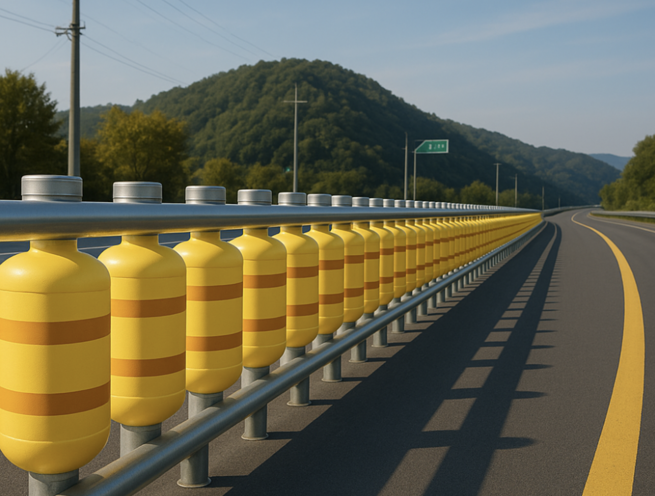
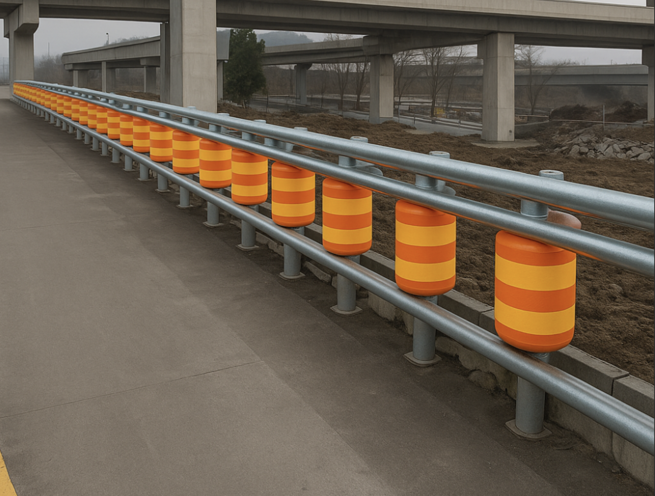
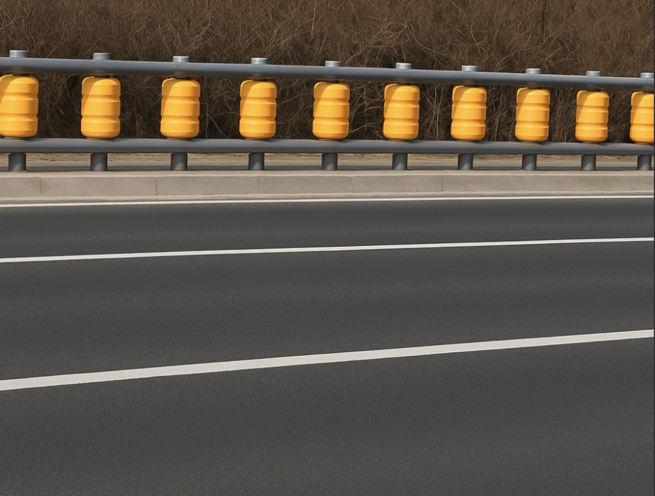
The Madoors USA Highway Safety Rolling Guardrail Barrier is a certified roller barrier system designed to provide high-level crash protection on highways, intersections, curved roads, bridge entrances, tunnel mouths, and median start points — absorbing and dispersing crash energy through rotating polyurethane or EVA barrel units integrated into a steel guardrail system that safely redirects the colliding vehicle rather than stopping it abruptly. Manufactured in accordance with TS EN 1317 standards with field-proven performance, bright yellow-orange coloring and reflective strips for maximum day and night visibility, modular design for quick installation and easy maintenance, and recyclable eco-friendly materials for long UV and weather-resistant service life, the Madoors USA Rolling Guardrail Barrier minimizes casualties and vehicle damage in the event of collision across the most hazardous road infrastructure positions.
TECHNICAL SPECIFICATIONS
The Madoors USA Rolling Guardrail Barrier operates on the kinetic energy absorption and vehicle redirection principle — when a vehicle makes contact with the barrier, the rotating barrel elements spin under the vehicle's impact force, absorbing the collision energy progressively through rotation rather than transmitting it as a sudden deceleration shock to the vehicle and occupants. The rotating action simultaneously redirects the vehicle back toward the roadway in a controlled trajectory, preventing the vehicle from penetrating the barrier, rolling over, or rebounding at a dangerous angle back into the traffic stream.
The barrel elements are manufactured from polyurethane or EVA — ethylene vinyl acetate — materials, both of which provide the combination of impact energy absorption, UV radiation resistance, weather durability, and long service life required for permanent outdoor road infrastructure. Polyurethane provides the highest available impact energy absorption per unit volume and the greatest resistance to permanent deformation under repeated impact loading. EVA provides excellent UV resistance and flexibility across the full ambient temperature range encountered in outdoor road service.
The barrel units are integrated into a steel guardrail system — the steel structure provides the permanent installation strength, foundation connection, and structural continuity along the barrier length that the barrel elements alone cannot provide. The steel guardrail carries the static load of the barrier system and the dynamic load of vehicle impact events, while the barrel elements provide the energy absorption and vehicle redirection function.
The system is designed and manufactured in accordance with TS EN 1317 — the European standard for road restraint systems that specifies the crash test performance, containment level, working width, and deflection criteria for guardrail and barrier systems used on European and internationally specified road projects. TS EN 1317 compliance provides the regulatory certification required for road authority and infrastructure project specification.
The modular design allows individual barrel and rail sections to be replaced independently after an impact event — without requiring the complete barrier system to be removed and replaced. This modular replaceability directly reduces the post-impact maintenance cost and road closure duration required for barrier restoration.
KEY FEATURES
Rotating Barrel Energy Absorption — Vehicle Redirection
The rotating barrel mechanism is the fundamental engineering innovation of the roller barrier over conventional rigid guardrail systems — the energy absorption through rotation reduces the peak deceleration force transmitted to vehicle occupants during a collision, and the redirection trajectory prevents the secondary hazards of rollover and dangerous rebound that rigid barriers cause. This energy absorption and controlled redirection combination directly reduces both the severity of occupant injury and the likelihood of secondary collision from a rebounded or overturned vehicle.
TS EN 1317 Certified — Field-Proven Performance
TS EN 1317 certification confirms independently tested crash performance at the specified containment level, working width, and vehicle impact conditions — providing road authorities, infrastructure project engineers, and road safety auditors with the standardized performance documentation required for barrier specification on public road projects. Field-proven performance in actual road service supplements the certification test results with real-world impact event evidence of the barrier's effectiveness at preventing vehicle penetration, rollover, and dangerous rebound.
Polyurethane or EVA Barrels — UV, Weather & Impact Resistant
The polyurethane and EVA barrel material options provide long-service outdoor durability — UV resistance preventing the brittleness and cracking that sunlight exposure causes in non-UV-stabilized polymers, weather resistance maintaining performance through rain, snow, ice, and temperature cycling, and impact resistance maintaining the energy absorption function across multiple impact events without permanent deformation that would reduce subsequent performance. This material durability directly extends the service life of the roller barrier between replacement cycles.
Yellow-Orange Color & Reflective Strips — Day & Night Visibility
The bright yellow-orange coloring of the barrel elements and reflective strips on the steel guardrail provide the maximum available passive visual warning to approaching drivers — both in daylight where the high-contrast yellow-orange color is immediately distinctive against the road environment, and at night where the retroreflective strips return the headlight beam to the driver's eyes as a bright warning marker. This dual visibility system directly reduces the collision rate with the barrier by providing the maximum warning distance for driver recognition and avoidance response.
Modular Design — Quick Installation & Easy Replacement
The modular construction allows the complete barrier system to be assembled from standard section lengths in the field — reducing the installation time and specialized equipment required compared to pre-assembled barrier alternatives. Individual damaged sections and barrel elements can be replaced after an impact event without disturbing the adjacent undamaged sections — reducing the post-impact repair time, material waste, and traffic management duration of barrier maintenance operations.
Eco-Friendly Recyclable Materials
The recyclable polyurethane and EVA barrel materials support the environmental sustainability objectives of road infrastructure projects — the materials can be recycled at end of service life rather than disposed of as solid waste. This recyclability, combined with the long service life of the UV and weather-resistant materials, directly reduces the environmental impact of the rolling guardrail barrier system over its full lifecycle compared to single-use or non-recyclable barrier alternatives.
Highest-Risk Road Position Applications
The specific application list — highways, secondary road junctions, curved roads, bridge entrances and exits, tunnel mouths, and median and barrier start points — covers the highest-risk positions on the road network where the consequences of a vehicle leaving the carriageway are most severe. Bridge entrances and exits, tunnel mouths, and curved roads are positions where a vehicle leaving the road faces the highest probability of catastrophic collision with a fixed structure or fall from the road surface — the roller barrier's redirection capability is most valuable at exactly these positions.
PRODUCT RANGE
Standard Highway Roller Barrier — For open highway median and roadside applications. Standard section lengths for rapid installation along extended highway runs.
Curved Road Roller Barrier — Sections configured for curved road geometry — providing continuous barrier coverage around the curve without the straight-section gap that creates unprotected positions on curved road alignments.
Bridge Entrance Roller Barrier — Transition section connecting the standard roadside guardrail to the bridge parapet — providing continuous containment through the transition zone where the road structure changes from embankment to bridge deck. This transition is one of the most hazardous locations on the road network for errant vehicle containment.
Tunnel Mouth Roller Barrier — Portal section for installation at tunnel entrance and exit positions where vehicles transitioning between open road and tunnel conditions face increased collision risk with the tunnel portal structure.
Median Barrier Roller System — Central median configuration for dual carriageway highways — providing cross-median containment to prevent errant vehicles from crossing into the opposing traffic stream.
ASSEMBLY & INSTALLATION SEQUENCE
Site Survey & Barrier Layout
Road geometry, required barrier containment level, installation positions — highway median, roadside, bridge approach, tunnel mouth — section lengths, and connection to adjacent barrier systems are confirmed to TS EN 1317 specification requirements.
Foundation Preparation
Steel guardrail post foundation positions are marked and post holes are prepared — driven, drilled, or cast-in-concrete foundation method selected for the specific road base conditions. Post spacing is confirmed to the TS EN 1317 specification for the containment level.
Steel Guardrail Post & Rail Installation
Steel posts are installed at the confirmed foundation positions and spacing. Steel guardrail sections are connected between posts — rail height, horizontal alignment, and connection bolt torque are verified.
Barrel Unit Installation
Polyurethane or EVA barrel units are installed on the steel rail at the specified intervals — barrel rotation freedom, mounting security, and alignment with the guardrail centerline are verified. Barrel color and reflective strip orientation are confirmed for maximum approach visibility.
Section Connection & Continuity Verification
All section-to-section connections along the complete barrier length are verified for structural continuity and barrel coverage continuity — confirming no unprotected gap in the roller barrier face that a vehicle could contact without barrel energy absorption.
Visibility Inspection
Yellow-orange barrel color and reflective strip retroreflectivity are inspected at day and simulated night conditions — confirming maximum visibility at the driver's approach distance for the specific road speed limit.
TS EN 1317 Certification Documentation & Handover
TS EN 1317 compliance certification, installation records, and maintenance guide for post-impact barrel and section replacement are compiled into the project handover package.
DEPLOYMENT SCENARIOS & USE CASES
Madoors USA Highway Safety Rolling Guardrail Barriers are specified for any road infrastructure position requiring EN 1317-certified crash energy absorption and vehicle redirection.
- Highway median central reservation roller barriers
- Highway roadside embankment roller guardrails
- Secondary road junction approach roller barriers
- Curved road outside lane roller barrier installation
- Bridge approach and departure transition barriers
- Bridge parapet connection transition roller sections
- Tunnel entrance and exit portal roller barriers
- Highway median start and end point transition barriers
- Mountain road hairpin curve outer edge barriers
- Urban expressway median roller barrier systems
- Toll plaza approach roller barrier installation
- Highway work zone temporary roller barrier deployment
- Rest area and service station approach barriers
- Emergency access road junction roller barriers
- Any road infrastructure position requiring TS EN 1317 certified rotating barrel crash energy absorption
- Category: Highway Guardrails