Please provide your technical specifications and project requirements for the Vault Door Safe Door. Our engineers will review your application and provide a detailed manufacturing quote, including exact pricing and lead times.
Vault Door Safe Door
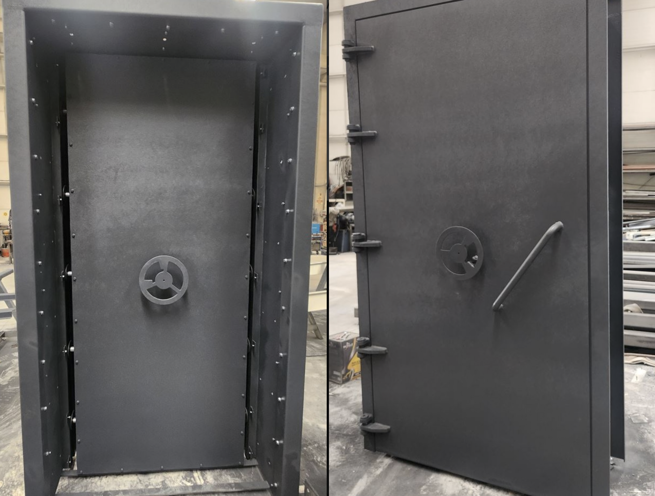
The Madoors USA Vault Door and Safe Door range provides fire-rated, burglar-resistant, and ballistic steel safe room and vault door solutions — manufactured on modern equipment using the latest technologies to withstand diamond drill attacks, explosions, disc cutters, gunfire, and all other methods of unauthorized forced entry. Constructed from hardened steel and concrete walls — a serious obstacle to any unauthorized access — with locking bolts extending fully into the door and safe wall, combination locks, and alarm system connection capability, Madoors USA safe and vault doors reliably protect cash, currency, precious metals, and valuables in bank vaults, commercial safe rooms, residential panic rooms, and institutional security installations across a full range of protection levels to suit every requirement.
TECHNICAL SPECIFICATIONS
Madoors USA Safe Doors and Vault Doors are manufactured to minimum ASTM RC5 certification — the American standard for residential and commercial safe and vault door resistance, confirming independently tested performance against forced entry attack methods including diamond drilling, disc cutting, explosives, and impact tools. RC5 represents a high level of burglar protection suitable for commercial vault and safe room applications where significant-value assets require the highest available certified forced entry resistance.
Door thickness is a minimum of 15mm and is specified in composite and concrete-mix insulation construction — not plasterboard or air space fill that would provide structural thickness without corresponding burglar or fire resistance. The specification of hardened steel and concrete wall construction directly addresses the most common misleading construction in the vault door market — where thick doors are filled with materials that provide dimensional bulk without structural resistance to forced entry tools.
Ballistic steel construction is available — providing certified bullet resistance in addition to forced entry protection for panic room and safe room applications where the door must withstand both ballistic and mechanical attack simultaneously. The use of bulletproof materials in high-technology construction provides the combined protection profile required for the most demanding residential panic room and commercial vault applications.
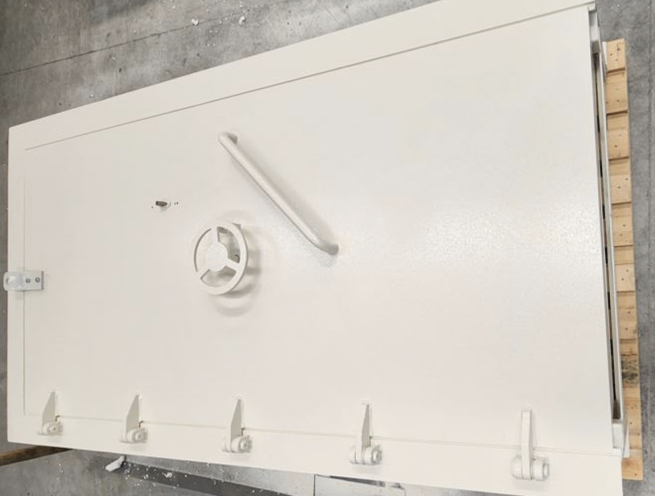
Locking bolts extend fully through the door into the safe wall — distributing the locking engagement force across multiple bolt positions around the full door perimeter rather than concentrating load at a single central lock point. This distributed bolt engagement is the primary structural engineering feature that prevents the door from being levered or forced open at the frame perimeter under attack. Combination lock systems and alarm system connection space are standard — providing both the access control security of mechanical combination locking and the monitored security of integrated alarm system connectivity.
KEY FEATURES
Hardened Steel & Concrete Construction — Multi-Attack Resistance
The combination of hardened steel and concrete in the door wall construction provides resistance against the full range of forced entry attack methods — diamond drills cannot penetrate the hardened steel without excessive time and noise exposure, disc cutters are defeated by the concrete mass and embedded steel, explosive attacks are absorbed by the combined concrete and steel energy dissipation, and gunfire is stopped by the ballistic steel layer. This multi-attack resistance profile addresses the complete spectrum of professional theft and unauthorized access methods — not just the single attack vector that lower-specification safe doors are designed to resist.
ASTM RC5 Minimum Certification — Third-Party Validated Protection
The minimum ASTM RC5 certification requirement ensures that every Madoors USA safe door carries independently verified forced entry resistance documentation — not manufacturer-claimed protection levels that cannot be verified without third-party testing. Third-party certification is the essential selection criterion that distinguishes genuinely protective safe doors from those that present the appearance of protection without independent performance verification.
Locking Bolts Extending Fully to Door and Safe Wall
The locking bolt engagement extending fully into both the door and the surrounding safe wall distributes the locking force across the full bolt length — preventing bolt shear, pull-out, and frame separation under the leverage and impact forces applied by professional forced entry attacks. Full-depth bolt engagement is the mechanical engineering requirement that makes the combined door and frame system more resistant to forced entry than the door panel alone.
Fire Door & Safe Door Combined Specification
The critical guidance embedded in the Madoors USA safe door specification — that fire doors alone provide very little protection against burglars and that safe doors require both fire rating and forced entry resistance — reflects the industry knowledge that many installations specify fire doors as vault doors without understanding that these two protection functions require fundamentally different construction. Madoors USA composite concrete-mix insulated construction provides genuine fire resistance alongside burglar resistance — not the fire board or plasterboard fill that satisfies fire testing while offering no resistance to mechanical attack.
Minimum 15mm Door Thickness — Composite Construction
The minimum 15mm thickness requirement combined with the specification of composite or composite-faced construction prevents the misleading specification of thick but poorly constructed doors — where air space or plasterboard fill provides visual thickness without structural resistance. The Madoors USA construction specification requires that every millimeter of door thickness contributes to the protective performance — hardened steel and concrete fill provide resistance proportional to their thickness, unlike non-structural fill materials.
Ballistic Steel Option — Panic Room Application
Ballistic steel construction provides certified bullet resistance for panic room applications where the primary threat is armed intrusion — the occupants must be protected from gunfire through the closed door as well as from mechanical forced entry. The combination of ballistic bullet resistance and ASTM RC5 forced entry resistance in a single door specification provides the complete protection profile required for residential panic rooms, executive protection facilities, and high-security commercial installations where both attack types must be addressed.
Combination Lock — Alarm System Connection
Mechanical combination lock systems eliminate the electronic vulnerability of keypad and electronic lock systems — providing reliable access control that cannot be compromised by power failure, electronic attack, or lock bypass methods that defeat electronic credentials. Allocated space for alarm system connection allows the vault door to be integrated with the facility's monitored security system — providing real-time alert capability for door opening, forced entry attempts, and tampering events.
Customizable to Application — Bank Vault, Safe Room & Panic Room
The full Madoors USA vault door range adapts to the specific requirements of bank vault and financial institution applications — requiring maximum certified burglar resistance for cash and precious metal storage — commercial safe room applications — balancing burglar resistance, fire protection, and access management — and residential panic room applications — emphasizing ballistic protection, forced entry resistance, and safe room habitability. Domestic safe room door modifications allow the vault door to become an integrated element of a residential panic room while maintaining full protection performance.
Modern Equipment & Latest Technology Manufacturing
Madoors USA vault doors are manufactured on modern equipment using the latest construction technologies — providing consistency of hardened steel and concrete construction quality, dimensional accuracy of locking bolt engagement geometry, and material specification compliance that cannot be achieved with older manufacturing processes. Modern manufacturing technology directly ensures that the certified protection performance of each door is consistently achieved across production.
PROTECTION LEVEL GUIDANCE
Fire Rating — Composite & Concrete Mix Insulation
For fire protection, specify composite or composite-faced doors with concrete mix insulation — not fire board or plasterboard fill. Composite concrete mix construction provides genuine fire resistance alongside structural integrity. Fire rating alone — without forced entry resistance — is appropriate only for fire archive protection, not for safe room or vault applications.
Burglar Resistance — ASTM RC5 Minimum
For burglar protection, specify a minimum ASTM RC5 certified door with third-party validated forced entry resistance testing. Avoid doors without specific third-party certification — the absence of RC certification is a reliable indicator of inadequate construction quality for genuine safe room applications.
Combined Fire & Burglar — Composite Construction
For combined protection, specify composite construction with concrete mix insulation achieving both fire rating and ASTM RC5 burglar resistance. This combined specification is the correct selection for all bank vault, commercial safe room, and residential safe room applications.
Ballistic & Burglar — Panic Room
For panic room applications where ballistic protection is required alongside forced entry resistance, specify ballistic steel construction meeting both the applicable ballistic protection standard and ASTM RC5. This highest specification addresses the full combined threat profile of an armed intruder attempting both ballistic and mechanical door defeat simultaneously.
ASSEMBLY & INSTALLATION SEQUENCE
Application Assessment & Protection Level Selection
The application — bank vault, commercial safe room, or residential panic room — required protection level — fire rating, ASTM RC5 burglar resistance, and ballistic protection — door dimensions, hinge direction, locking bolt configuration, combination lock specification, and alarm system interface requirements are confirmed with the customer.
Structural Opening Preparation
The structural opening in the safe room, vault, or panic room wall is prepared to the confirmed door frame dimensions. The surrounding wall construction — concrete, masonry, or steel — is verified for adequate structural strength to receive the full locking bolt engagement force under maximum forced entry attack loading.
Frame Installation & Bolt Engagement Positions
The vault door frame is installed and anchored to the surrounding structural wall at all specified positions. Locking bolt receiver positions in the frame are verified for full bolt extension depth engagement from the door leaf through the frame and into the wall structure.
Door Leaf Hanging & Hinge Installation
The vault door leaf — hardened steel and concrete construction, at minimum 15mm thickness — is hung on the specified hinges. Hinge direction is confirmed as specified by the customer at the time of manufacture. Door leaf alignment, swing arc clearance, and seal contact in the closed position are verified.
Locking Bolt System Installation & Testing
All locking bolts are installed and tested for full extension into the frame receiver positions. Bolt engagement depth, retraction force, and distribution around the door perimeter are verified. Combination lock installation and initial combination setting are completed.
Alarm System Connection
The alarm system connection infrastructure within the door and frame is connected to the facility's monitored security system. Door status sensing — open, closed, and forced entry attempt — is tested and verified.
Certification Documentation & Handover
ASTM RC5 certification documentation, fire rating certification where applicable, ballistic protection certification for ballistic steel construction, and installation records are compiled into the project handover package. Combination lock operating instructions and initial combination are provided securely to the authorized customer representative.
DEPLOYMENT SCENARIOS & USE CASES
Madoors USA Vault Doors and Safe Doors are specified for any application requiring certified forced entry resistance, fire protection, and optional ballistic protection.
- Bank vault and financial institution cash storage doors
- Safe room and valuables storage commercial vault doors
- Currency and precious metals storage vault doors
- Residential panic room safe room door installation
- Executive protection and VIP residential panic room doors
- Government secure document and asset storage vault doors
- Embassy and diplomatic mission classified storage vault doors
- Military installation secure storage vault doors
- Casino and gaming facility cash counting room vault doors
- Jewelry store and precious goods safe room vault doors
- Data center and server room physical security vault doors
- Legal and notarial document storage vault doors
- Pharmaceutical controlled substance storage vault doors
- Museum and art collection secure storage vault doors
- Corporate headquarters executive secure room vault doors
- Category: Personnel Doors