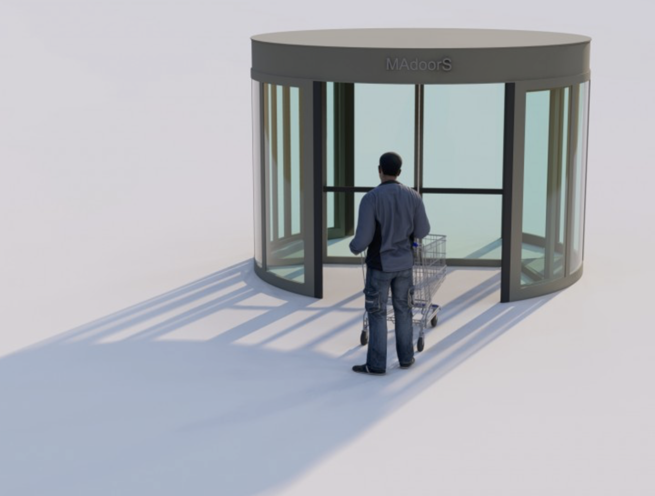
Please provide your technical specifications and project requirements for the Two Wing Automatic Revolving Door. Our engineers will review your application and provide a detailed manufacturing quote, including exact pricing and lead times.
Two Wing Automatic Revolving Door
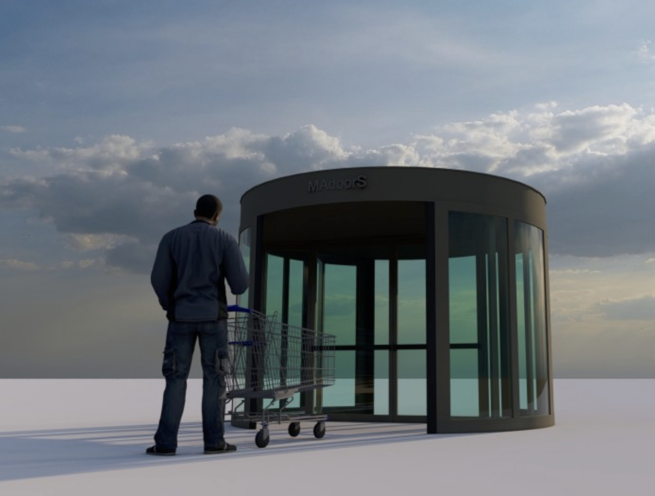
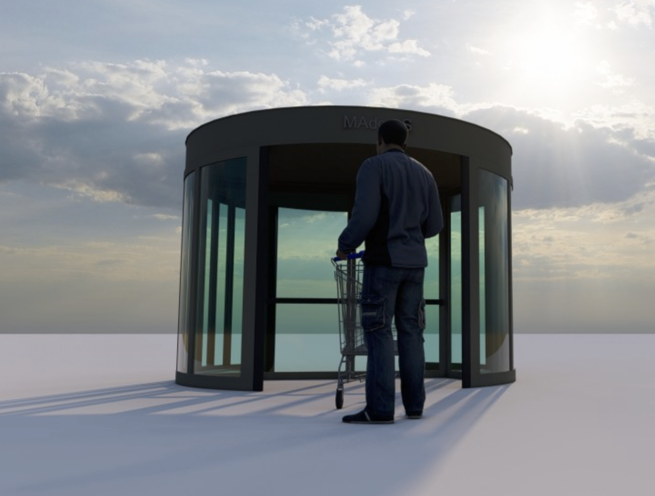
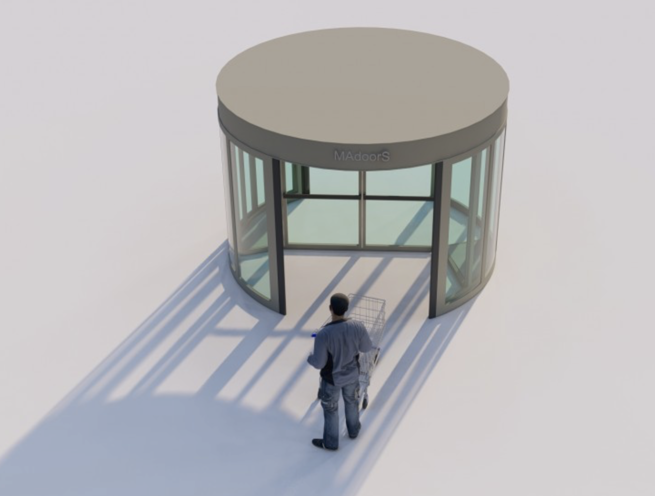
The Madoors USA Two Wing Automatic Revolving Door is a double-winged motorized automatic revolving door system with integrated photocell glass sliding door capability — operating as a standard two-wing revolving door under normal conditions and switching to photocell sliding door mode for heavy traffic periods or emergency situations, with PLC control enabling fully programmable operation for any usage requirement. Available in diameters from 3,000mm to 5,400mm, with panic mode providing 90-degree wing break-open emergency egress from both inside and outside, showcase configuration with display volume scaling proportionally to door diameter, and back-to-back dual door PLC interconnection for synchronized operation, the Madoors USA Two Wing Automatic Revolving Door is the definitive entrance solution for high-traffic commercial, hospitality, and institutional buildings requiring the flexibility of multiple operational modes in a single door system.
TECHNICAL SPECIFICATIONS
The Madoors USA Two Wing Automatic Revolving Door is available in five standard diameters — R = 3,000mm, 3,600mm, 4,200mm, 4,800mm, and 5,400mm — covering the full range of commercial building entrance dimensions from standard hotel and office building entrances through to high-capacity retail, airport, and public building entrances.
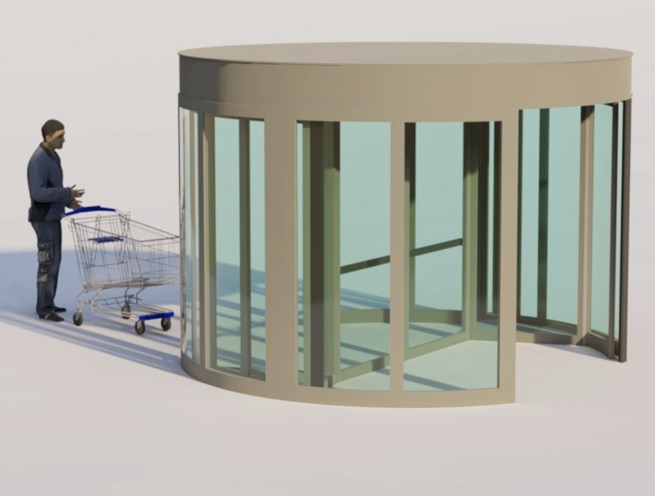
The system operates in three distinct modes selectable from the control panel. Standard revolving door mode — both wings rotate continuously driven by the motorized radar detection system, providing the thermal insulation, draught exclusion, and controlled pedestrian throughput of conventional revolving door operation. Photocell sliding door mode — the revolving wings lock in the fixed position perpendicular to the entrance axis and the automatic glass sliding door in the center of the drum activates for unrestricted pedestrian passage — providing maximum throughput for heavy traffic periods without the rotation speed constraint of the revolving mode. Console dual-door mode — combining the two-wing motorized radar revolving door with the central photocell glass sliding door in a coordinated operation where the revolving door and sliding door work simultaneously for different traffic flows.
The panic mode provides emergency egress from both directions — wings open outward from the inside with a certain applied force for occupant-initiated evacuation, and wings release from their pins to open inward from the outside under external emergency pressure. Both release mechanisms are independent of the motorized drive and electrical supply — providing guaranteed emergency egress capability regardless of system power status.
PLC control systems provide fully programmable operation — all operational parameters including rotation speed, mode switching thresholds, photocell sensitivity, panic release force, and access control interfaces are programmed through the PLC for the specific usage requirements of each installation. Back-to-back dual door configurations interconnect the PLC units of both doors — enabling synchronized, coordinated operation between the two doors where the second door's response is governed by the first door's status and vice versa.
The showcase configuration scales display volume proportionally with door diameter — larger diameter doors provide proportionally larger showcase areas within the central column structure, allowing bigger products and more elaborate display installations within the revolving door structure.
KEY FEATURES
Three Operational Modes — Revolving, Sliding & Console
The three-mode operational capability of the Madoors USA Two Wing Automatic Revolving Door provides unprecedented flexibility for managing the full range of traffic conditions and operational scenarios at a building entrance from a single door installation. Standard revolving mode for normal operation provides thermal insulation and controlled throughput. Photocell sliding mode for heavy traffic periods provides maximum unrestricted throughput when revolving door rotation speed becomes the throughput limiting factor. Console mode for coordinated combined operation provides simultaneous controlled and unrestricted passage for different user groups — such as shoppers exiting through the revolving door while deliveries pass through the sliding door simultaneously.
Wings Lock Perpendicular — Center Sliding Door Activates
The photocell mode transition — wings locking perpendicular to the entrance axis and center sliding door activating — is the critical engineering feature that transforms the revolving door into a high-capacity sliding door entrance without requiring a separate door installation alongside the revolving door. The locked wing position creates fixed side panels on both sides of the sliding door opening — maintaining the thermal and wind enclosure of the entrance while the sliding door provides the full clear opening width for unrestricted pedestrian flow.
Panic Mode — 90-Degree Wing Break-Open — Both Directions
The 90-degree panic wing break-open provides emergency egress from both the inside — occupant-initiated outward opening under applied force — and the outside — emergency responder initiated inward opening under pin release pressure. Both directions of panic opening are independent of electrical supply and motor drive — providing guaranteed emergency egress and access regardless of power status. The 90-degree opening angle provides the maximum clear width available within the drum structure for emergency evacuation flow.
PLC Control — Fully Programmable Operation
The PLC control system provides complete programmability of all operational parameters — enabling the door behavior to be precisely matched to the specific usage profile of the building across different time periods, traffic conditions, and operational scenarios. Programmable parameters include automatic mode switching based on traffic volume, time-of-day scheduled mode changes, rotation speed adjustment for different wind conditions, and integration with building access control and security management systems.
Back-to-Back Dual Door PLC Interconnection — Synchronized Operation
Back-to-back dual door configurations — two revolving doors installed in series at the same building entrance — benefit from PLC interconnection that allows both doors to communicate and coordinate their operation. Synchronized operation prevents simultaneous rotation in opposite directions that would impede pedestrian flow, coordinates mode switching between the inner and outer doors, and provides the airlock functionality required at climate-critical building entrances where both doors should never be fully open simultaneously.
Motorized Radar Detection — Approach-Activated Operation
The motorized radar detection system detects approaching pedestrians and initiates door rotation before the user arrives at the drum — eliminating the hesitation and bunching at the door entrance that occurs with slower-responding sensor systems. Radar detection provides reliable approach detection at all ambient lighting levels and in all weather conditions, providing consistent automatic operation that does not depend on infrared beam interruption or pressure mat activation.
Showcase Configuration — Diameter-Proportional Display Volume
The showcase configuration integrates a display volume within the central column structure — with display volume scaling proportionally to door diameter. At the maximum 5,400mm diameter, the showcase provides a significantly larger display area than at the minimum 3,000mm diameter — allowing the display of large retail products, seasonal decorative installations, and brand identity elements at larger-diameter installations. This scaling relationship between diameter and showcase volume allows the display requirement to inform the diameter selection beyond the throughput capacity consideration alone.
Available Diameters 3,000mm to 5,400mm
The five standard diameters cover the full range of commercial building entrance dimensions — 3,000mm for standard residential and small commercial entrances, 3,600mm for standard hotel and office building entrances, 4,200mm for medium commercial and retail entrances, 4,800mm for high-capacity retail and institutional entrances, and 5,400mm for the highest-capacity commercial and public building applications. Diameter selection is governed by throughput capacity requirement, architectural scale, and showcase display volume requirement.
OPERATIONAL MODE COMPARISON
Standard Revolving Mode — Both wings rotate continuously. Thermal insulation maintained. Controlled individual pedestrian throughput. Motorized radar activation. Suitable for normal traffic conditions at all building types.
Photocell Sliding Mode — Wings locked perpendicular. Center sliding door active. Maximum throughput — unrestricted pedestrian flow. Thermal insulation partially maintained by locked wing side panels. Suitable for peak traffic periods, large group arrivals, and any scenario where revolving door rotation speed limits throughput.
Console Dual-Door Mode — Two-wing revolving door and center sliding door operate simultaneously. Different user flows accommodated simultaneously — individual revolving door users and group or mobility aid users through the sliding door. PLC coordination prevents operational conflicts between the two door elements.
Panic Mode — Wings break open 90 degrees. Inside — outward opening under applied force. Outside — inward opening under pin release pressure. Full emergency egress width provided. Electrical supply independent. Immediately available under any system power status.
ASSEMBLY & INSTALLATION SEQUENCE
Diameter Selection & Mode Configuration
Building entrance opening dimensions, required diameter, showcase configuration requirement, back-to-back dual door configuration, PLC programming requirements, and surface finish specification are confirmed.
Floor Preparation & Bottom Ring Installation
Floor opening for the bottom ring is prepared to the confirmed diameter. Stainless steel or specified finish bottom ring is installed and leveled. Floor mat and threshold finish are completed.
Center Column, PLC & Drive System Installation
The center column with PLC control unit, motorized rotation drive, and photocell sliding door mechanism is installed at the confirmed center position. Drive system parameters are pre-configured for the confirmed operational mode settings.
Wing Leaf & Drum Wall Installation
Two wing leaves are installed on the rotation mechanism with radar detection sensors integrated. Drum wall panels are installed around the drum perimeter. Thermal seals at all wing-to-drum-wall contacts are verified for continuous insulation.
Center Sliding Door Installation
The automatic photocell glass sliding door is installed in the center of the drum on the center column. Sliding door travel, photocell detection, and opening speed are calibrated.
Panic Mode Testing Both inside outward and outside inward panic wing opening functions are tested under the specified applied force and pin release pressure. 90-degree opening angle and clear egress width are verified.
PLC Programming & Dual Door Interconnection
All operational modes — revolving, photocell, console, and panic — are programmed and tested. For back-to-back configurations, PLC interconnection between both door units is completed and synchronized operation is tested across all mode combinations.
Showcase Installation & Handover
Showcase display area is fitted within the central column as specified. Complete operational testing across all modes is conducted. Installation documentation and 2-year guarantee records are compiled into the project handover package.
DEPLOYMENT SCENARIOS & USE CASES
Madoors USA Two Wing Automatic Revolving Doors are specified for any high-traffic commercial, institutional, or public building entrance requiring multi-mode revolving and sliding door operational flexibility.
- Hotel and luxury hospitality property lobby entrance doors
- Shopping center and retail mall main entrance revolving doors
- Airport terminal passenger entrance two-wing systems
- Corporate headquarters and office building entrance doors
- Hospital and healthcare facility main entrance revolving doors
- University and educational institution landmark entrance doors
- Government and civic building public entrance revolving doors
- Museum and cultural institution entrance revolving doors
- Convention center and exhibition hall entrance doors
- Luxury residential apartment building lobby revolving doors
- Bank and financial institution branch entrance doors
- Pharmaceutical and research facility entrance revolving doors
- Transport hub and railway station entrance revolving doors
- Stadium and arena VIP entrance revolving door systems
- Any high-traffic building requiring multi-mode revolving door capability
- Category: Revolving Door