Please provide your technical specifications and project requirements for the Surface Mounted Hydraulic Road Blocker. Our engineers will review your application and provide a detailed manufacturing quote, including exact pricing and lead times.
Surface Mounted Hydraulic Road Blocker
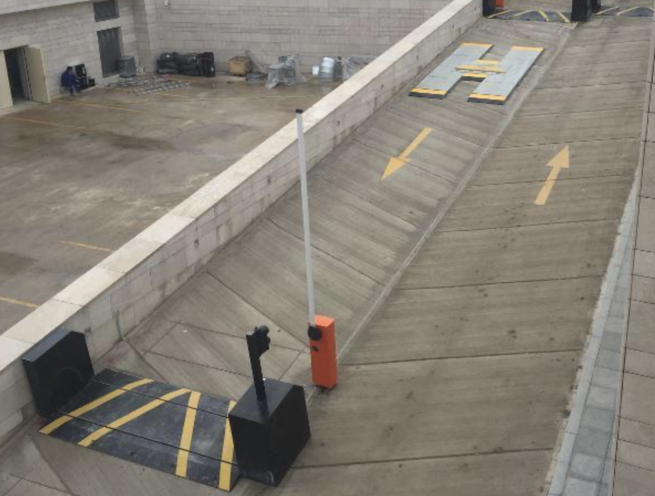
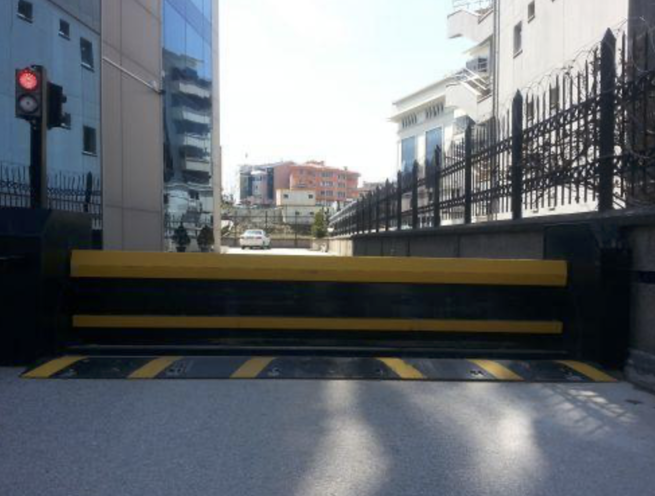
The Madoors USA Surface Mounted Hydraulic Road Blocker is a K12-standard electro-hydraulic road blocker system that installs directly on the road surface — requiring no excavation, no civil works, and no groundworks beyond a single channel across the road for the hydraulic hose — bolted to any suitable road surface for immediate deployment without the construction timeline, underground service conflicts, and site disruption of conventional embedded road blockers. Designed to K12 standards with finite element model analysis available on request, the surface-mounted blocker stops high-tonnage vehicles at high speeds by damaging the vehicle's front end, wheels, and underside — and when lowered, the two heavy-duty hinged steel plates form a slight speed hump that doubles the barrier as a vehicle speed control device.
Built-in LED traffic lights on raised posts on both sides, high-visibility red finish with reflective striping on control enclosures, PLC control integrating with card readers, biometric readers, radio controls, and key switches, 3-second standard raise and lower cycle time, 1.5-second emergency response, and manual hand pump backup for power failure make the Madoors USA Surface Mount Road Blocker the most rapidly deployable certified K12 road blocker solution available — equally suitable for high-security military and government installations and discrete automated access control at car parks, golf clubs, schools, and commercial facilities.
TECHNICAL SPECIFICATIONS
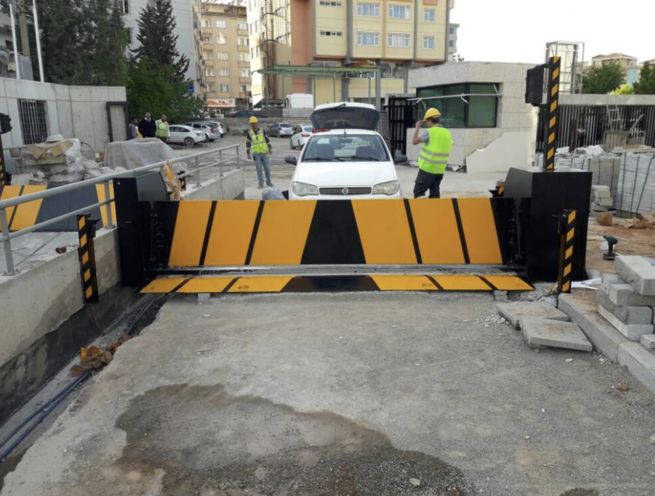
The Madoors USA Surface Mounted Road Blocker consists of two heavy-duty hinged steel plates that are brought together by a hydraulic power pack — rising from the flat road surface position to form a raised, impassable barrier across the full road width when actuated. Typical weight is 2 to 2.5 tons depending on the specific blocker configuration — providing the structural mass required for K12-standard vehicle stopping performance at the surface-mounted installation depth.
Installation is achieved by bolting the blocker unit to the road surface — with only a single small channel cut across the road required to accommodate the hydraulic hose connecting the hydraulic power pack to the blocker mechanism. No pit excavation, no foundation concrete, no underground service coordination, and no road surface cutting beyond the hydraulic hose channel are required. This installation simplicity reduces installation time from days or weeks for embedded blockers to hours for the surface-mounted type.
The electro-hydraulic drive provides standard 3-second raise and lower cycle times with emergency operation capable of 1.5 seconds. Manual hand pump operation maintains access management capability during power failure. PLC control integrates with the full range of access control interfaces. Safety accessories including photocells, inductive loop detectors, flashing lights, and red/green traffic lights integrate directly into the system control.
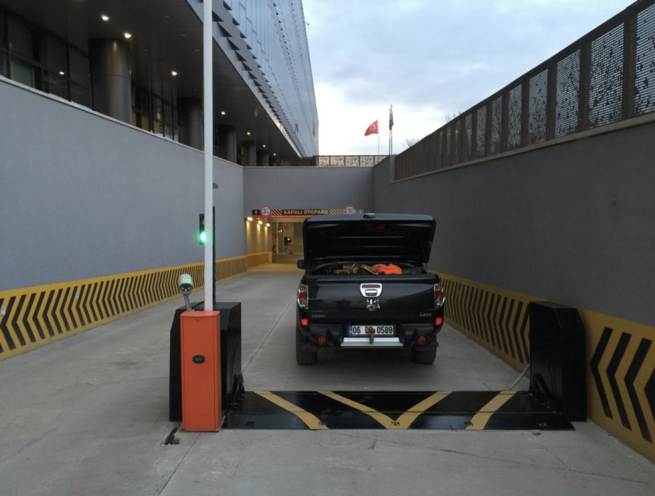
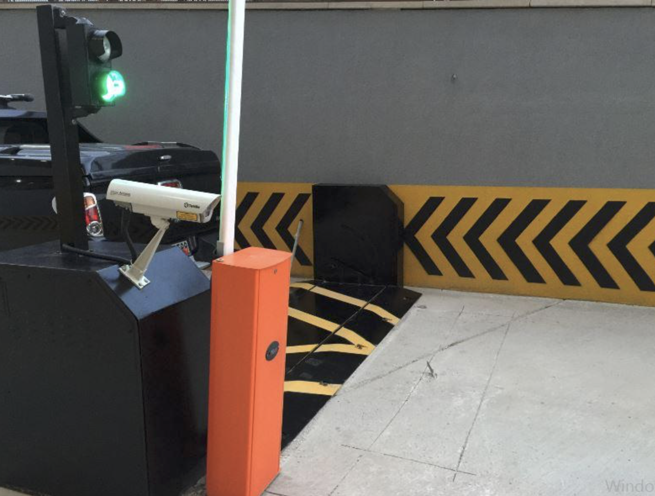
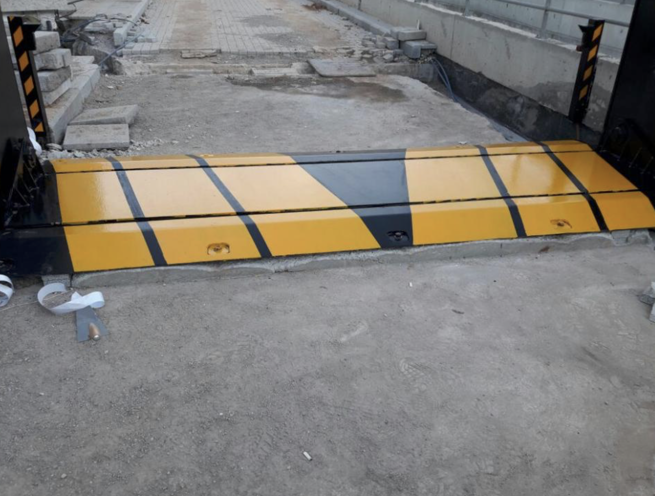
When in the lowered position, the two hinged steel plates rest at a slight angle — forming a low speed hump across the road that slows approaching vehicles to a safe speed for the access control point, combining the security function of a hostile vehicle mitigation barrier with the traffic management function of a speed control device in a single installation.
KEY FEATURES
No Excavation — Bolt-to-Road Installation
The complete absence of excavation and civil works requirements — beyond a single hydraulic hose channel — is the defining installation advantage of the surface-mounted road blocker over all embedded road blocker alternatives. Bolt-to-road installation eliminates underground service conflicts, road surface reconstruction, foundation concrete curing time, and the construction management overhead of an excavation project — reducing the total installation process to a bolt-down and hydraulic connection operation achievable within a single working day.
Suitable for Underground Utility Locations
Because no excavation is required beneath the road surface, the surface-mounted road blocker is the only practical road blocker solution for locations where underground utilities, services, and structures prevent the excavation required for embedded road blockers. This utility-safe installation capability brings certified K12 road blocker protection to the widest possible range of installation locations including historic paved surfaces, utility-dense urban streetscapes, and locations where any road surface penetration would risk damage to buried infrastructure.
K12 Standard Design — Finite Element Analysis Available
The surface-mounted blocker is designed to K12 standards — with finite element model analysis available on request confirming the structural performance under the dynamic loading of a K12 hostile vehicle impact event. K12 standard design provides the structural basis for certified hostile vehicle mitigation performance against the highest available vehicle threat classification, satisfying the most demanding government and military security procurement specifications for surface-mounted road blocker systems.
Two Heavy-Duty Hinged Steel Plates — 2 to 2.5 Ton Mass
The two-plate hinged steel construction provides the structural mass — 2 to 2.5 tons — required for K12-standard vehicle stopping performance in the surface-mounted configuration. The hinged plate mechanism allows both plates to rise from the flat road surface position and lock in the raised barrier configuration, and to lower back to the speed hump position after authorized vehicle passage. Heavy-duty steel construction ensures structural integrity under the repeated loading of authorized vehicle drive-over in the speed hump position and under hostile vehicle impact in the raised barrier position.
Dual Function — Barrier & Speed Hump
When lowered, the hinged steel plates form a slight speed hump across the road — reducing approaching vehicle speeds to the controlled levels required for safe access management at the barrier position. This dual function combines the primary security barrier capability with a permanent vehicle speed management function that operates continuously regardless of whether the barrier is actively deployed, providing enhanced approach speed control that improves the overall effectiveness of the access control point.
Built-In LED Traffic Lights — High Visibility Installation
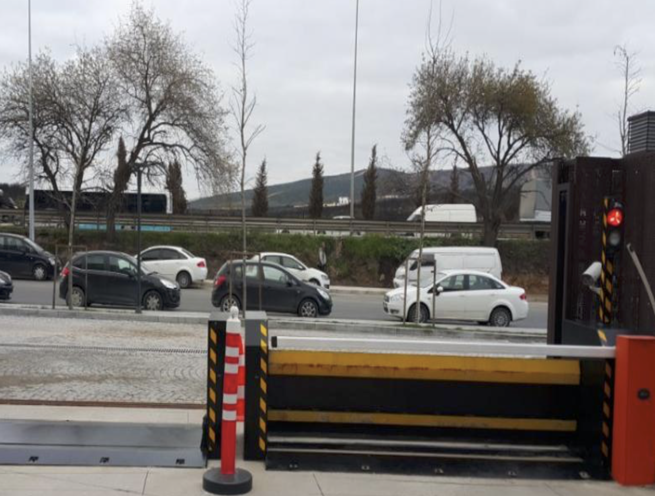
LED traffic lights built into raised posts on both sides of the blocker provide clear visual access control signals to approaching vehicles — red for barrier raised/access denied and green for barrier lowered/access permitted — without requiring separate traffic light installation. The high-visibility red finish and reflective striping on the control enclosures provide conspicuous visual identification of the barrier position at all times of day and night, satisfying the safety marking requirements for road-placed access control devices.
Electro-Hydraulic Drive — 3-Second Standard, 1.5-Second Emergency
The electro-hydraulic drive provides reliable, high-force barrier actuation with standard 3-second cycle times for normal access control operation and emergency 1.5-second response for immediate threat scenarios. Hydraulic actuation force output is consistent across ambient temperature extremes and contamination conditions encountered at outdoor access control installations — providing reliable barrier performance throughout all weather and seasonal conditions.
PLC Control — Universal Access Control Integration
PLC control integrates with card readers, biometric readers — fingerprint and hand shape — radio controls, on/off key switches, photocells, inductive loop detectors, and flashing lights and traffic signals. Universal access control interface compatibility allows the surface-mounted road blocker to be integrated into any existing or new facility security management infrastructure without requiring bespoke control system engineering.
Manual Hand Pump Backup — Power Failure Operation
Manual hand pump provides continued raise and lower capability during mains power failure — maintaining security barrier function and authorized vehicle access management without electrical supply. Power failure backup ensures that the access control point remains fully operational during the power outages that may accompany security incidents or severe weather events.
Popular for Discrete Automated Access Control
The surface-mounted configuration is specifically noted as a popular discrete automated access control solution for car parks, golf clubs, schools, and commercial facilities — where the compact, bolt-down installation, speed hump dual function, and automated access control integration provide a practical and visually unobtrusive access management solution without the institutional appearance of conventional road blocker installations.
Quick Installation — Temporary & Semi-Permanent Applications
The bolt-to-road installation and absence of civil works make the surface-mounted road blocker suitable for temporary and semi-permanent installations — the blocker can be unbolted, relocated, and reinstalled at a new position when access control requirements change, providing a relocatable K12-standard hostile vehicle mitigation barrier capability that permanent embedded systems cannot match.
ASSEMBLY & INSTALLATION SEQUENCE
Road Surface Assessment & Position Marking
The installation position is confirmed on a suitable road surface capable of carrying the 2 to 2.5-ton blocker weight and the anchor bolt loads from K12 impact events. Bolt positions are marked on the road surface. Hydraulic hose channel route across the road is confirmed.
Hydraulic Hose Channel Cutting
A single narrow channel is cut across the road surface along the hydraulic hose routing path — the only road surface work required for the complete installation. Channel depth and width accommodate the hydraulic hose diameter with minimal road surface disruption.
Anchor Bolt Installation
Anchor bolt holes are drilled at the marked positions on the road surface. Anchor bolts are installed and set to the specified embedment depth and torque for the blocker weight and impact loading requirements.
Blocker Unit Placement & Bolting
The surface-mounted road blocker unit is positioned on the road surface over the installed anchor bolts and bolted down securely. Blocker alignment perpendicular to the vehicle approach direction and level seating on the road surface are verified.
Hydraulic Power Pack Connection
The hydraulic hose is routed through the cut channel and connected between the hydraulic power pack and the blocker mechanism. The system is filled, bled, and pressure-tested through multiple raise and lower cycles.
PLC, Traffic Light & Safety System Installation
PLC control system, built-in LED traffic lights, and access control interfaces are connected and commissioned. Photocell and inductive loop detector positions are installed and calibrated. Traffic light green/red sequencing relative to barrier position is programmed and verified.
Emergency Response & Manual Pump Testing
Emergency 1.5-second raise and lower capability is tested and timed. Manual hand pump operation under simulated power failure is tested and verified.
Operational Testing & Handover
Complete operational testing across all access control inputs, safety sensor responses, traffic light sequencing, emergency operation, and manual pump backup is conducted. K12 standard design documentation and finite element analysis records are compiled into the project handover package.
DEPLOYMENT SCENARIOS & USE CASES
Madoors USA Surface Mounted Hydraulic Road Blockers are specified for any vehicle access control point where surface mounting without excavation is required alongside K12-standard hostile vehicle mitigation performance.
- Car park entrance and exit surface-mounted vehicle barriers
- Golf club vehicle access control surface road blockers
- School and educational facility vehicle entrance barriers
- Commercial facility vehicle access speed and security control
- Historic paved surface locations without excavation capability
- Underground utility-dense urban locations
- Temporary event security vehicle access control
- Government facility temporary or semi-permanent barriers
- Military installation supplementary surface-mounted barriers
- Hotel and hospitality facility vehicle access control
- Shopping center car park vehicle access management
- Hospital and healthcare facility vehicle entrance barriers
- Corporate campus and business park vehicle control
- Retail park and commercial development vehicle access
- Any location where road excavation is not feasible or permitted
- Category: Road Blocker