Please provide your technical specifications and project requirements for the Shipyard Door. Our engineers will review your application and provide a detailed manufacturing quote, including exact pricing and lead times.
Shipyard Door
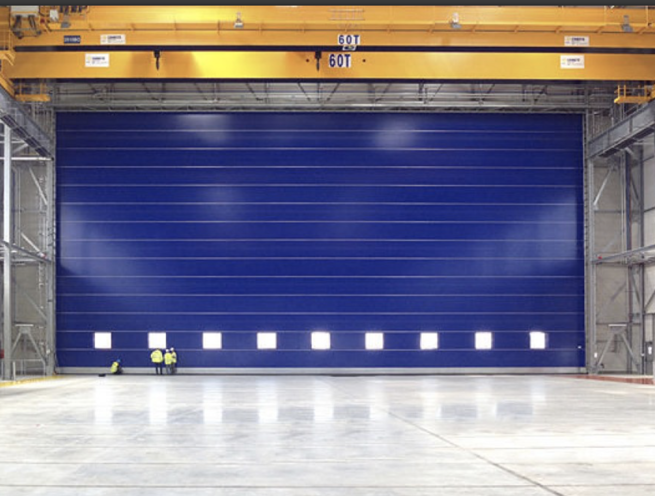
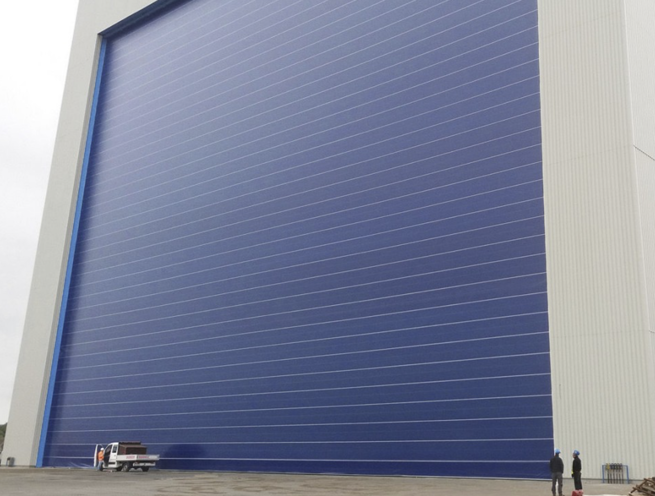
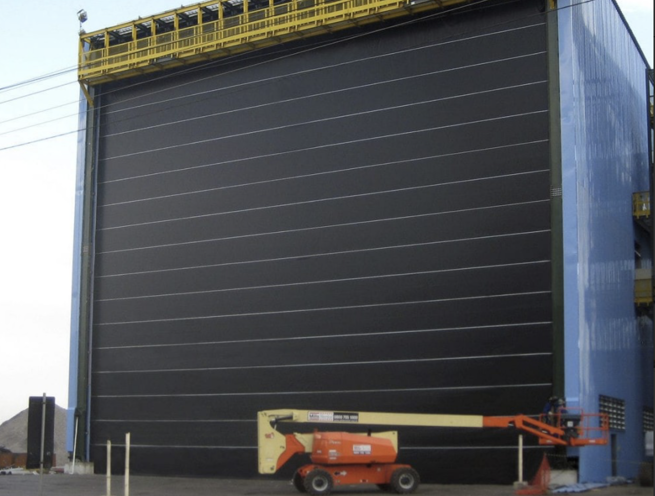
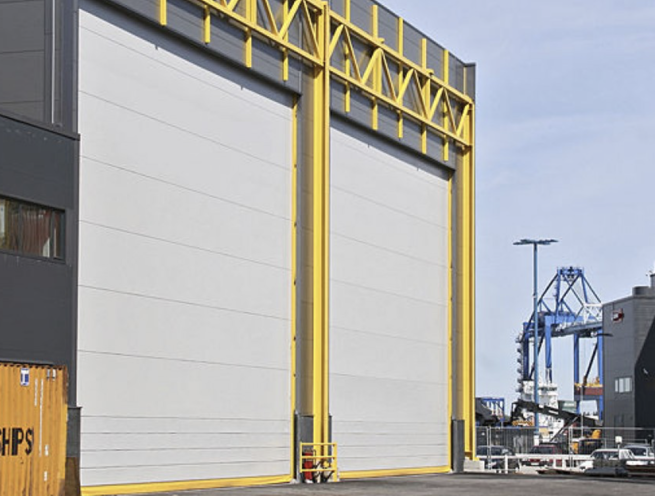
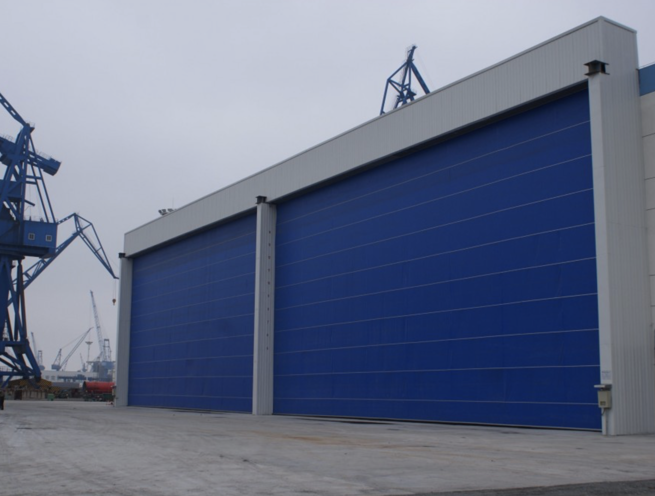
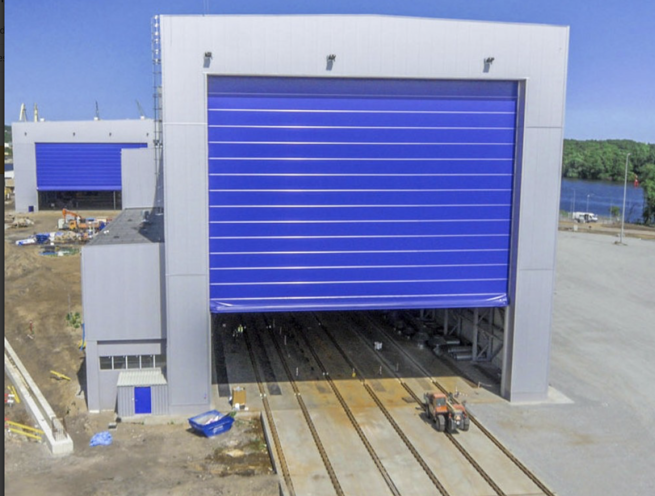
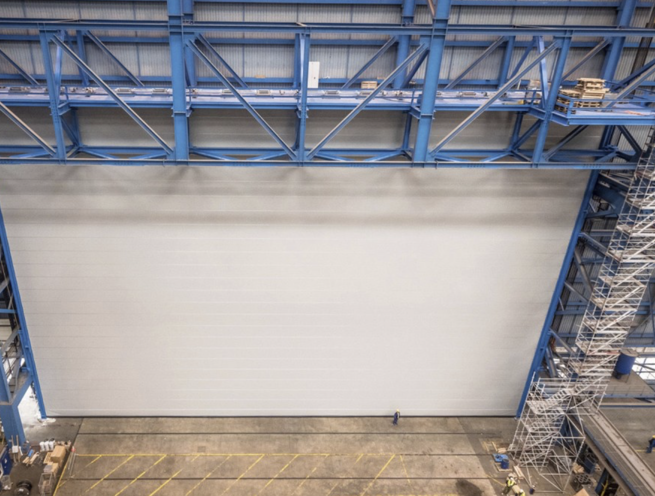
The Madoors USA Shipyard Door is a vertically lifting, fabric fold-up door system engineered for shipyard blasting and painting facilities, port buildings, and large industrial structures requiring full-width and full-height access without side pockets or bottom tracks — manufactured in one piece up to 50 meters wide by 30 meters high from German-made 900 g/m² fire and UV-resistant fabric that provides years of trouble-free service. Built to CE standards and complying with all current European Safety Directives with double-redundant design and components, standard doors withstand wind gusts of 140 km/h with special design options available for hurricane wind resistance of 230 km/h.
The vertically opening door stores above the building opening — requiring no side pockets on the building edges and no bottom tracks that would fill with abrasive material in shipyard blasting environments — providing complete indoor/outdoor atmosphere separation through internal seals that maintain temperature, humidity, dust exclusion, and contaminant control regardless of the specific environmental requirement of the facility. A simple press of a button opens, closes, or stops the door at any intermediate position from the control panel.
TECHNICAL SPECIFICATIONS
The Madoors USA Shipyard Door is manufactured in one piece up to 50 meters wide by 30 meters high — the largest available single-piece industrial door specification, covering the full range of shipyard blasting and painting chamber widths, port building vehicle access openings, and large industrial facility entrances without requiring multi-panel or segmented door constructions that introduce intermediate joints, potential leak paths, and mechanical complexity.
Fabric construction uses German-made 900 g/m² material with fire resistance and UV damage resistance — providing the fabric weight, structural integrity, and long-term durability required for sustained outdoor installation and daily operational cycling in the chemically aggressive, UV-exposed, and physically demanding environment of shipyard and port facilities. The 900 g/m² weight provides the body and stiffness required for wind resistance at the largest door dimensions while maintaining the light weight that enables fast vertical operation.
Standard doors are engineered to withstand wind gusts of 140 km/h — satisfying the wind load requirements at the majority of coastal and inland shipyard and port locations worldwide. Special design configurations provide hurricane wind resistance of 230 km/h for installations in tropical storm, hurricane, and typhoon zones where maximum wind speeds exceed the standard specification.
The door is manufactured to CE standards and complies with all current European Safety Directives — with double-redundant design and components ensuring safe operation across all failure scenarios. Double redundancy in the drive and control systems means that a single component failure does not result in uncontrolled door movement or loss of the ability to operate the door safely.
Internal seals provide complete indoor/outdoor atmosphere separation in the closed position — maintaining temperature differentials for heated or climate-controlled facilities, excluding dust, sand, abrasive grit, and dirt from clean or controlled environments, and maintaining relative humidity levels in humidity-sensitive coating and preservation facilities. The sealing integrity addresses the full range of environmental control requirements encountered at shipyard and industrial facility applications without requiring facility-specific seal customization.
Maintenance requirements are minimal — the drive systems and door assembly require only annual inspection and lubrication to maintain full operational performance, with no consumable components requiring regular replacement between annual service events.
KEY FEATURES
No Side Pockets — Maximum Building Space Utilization
The vertically lifting door stores above the building opening — requiring no side pockets cut into the building edges alongside the opening to receive the opened door panels. The elimination of side pockets saves several meters of building floor space on each side of the opening that would otherwise be consumed by conventional side-sliding or bi-parting doors — providing usable floor space for ship section positioning, scaffolding, equipment storage, and personnel movement directly adjacent to the opening without obstruction.
No Bottom Tracks — Critical for Abrasive Shipyard Environments
The absence of bottom tracks in the door travel path is the most operationally critical advantage of the vertical fold-up door for shipyard blasting and painting facilities — where steel grit, sand abrasive, paint particulate, and chemical residue would rapidly fill and jam conventional bottom-track sliding door systems, causing track damage, drive system overload, and operational failure. The vertically lifting fabric door eliminates the track maintenance, clearing, and damage problem entirely — the door path is above the working floor, completely clear of the abrasive and chemical contamination of the blasting and painting environment.
Full Width & Full Height Access
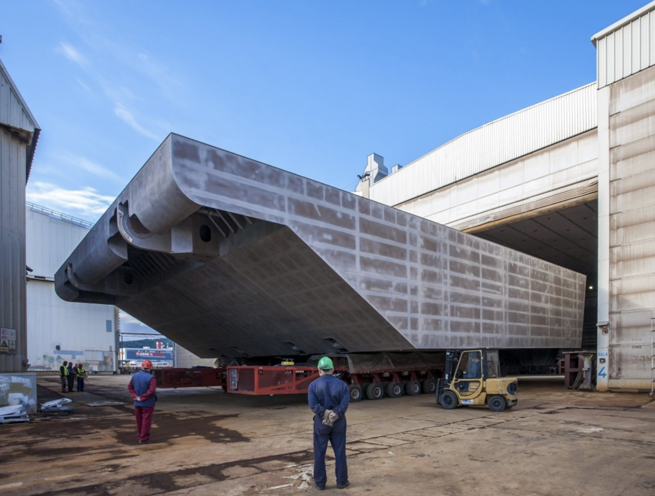
The vertically lifting door provides complete, unobstructed access across the full width and full height of the opening — with no door hardware, intermediate posts, or structural elements within the clear opening when the door is fully raised. This full clear opening is essential for shipyard operations where large ship sections, offshore modules, and oversized port equipment must be moved through the opening without dimensional constraint from intermediate door structural elements.
Up to 50m Wide × 30m High — Single-Piece Construction
Single-piece construction up to 50 meters wide by 30 meters high covers the largest shipyard blasting and painting chamber openings, the widest port building vehicle and equipment access openings, and the largest industrial facility entrance dimensions — without requiring multi-panel construction that would introduce intermediate joints, potential leak points, and additional mechanical complexity. Single-piece construction maintains uniform environmental seal integrity across the full door area without the perimeter sealing challenges of multi-panel systems.
German-Made 900 g/m² Fabric — Fire & UV Resistant
German-manufactured 900 g/m² fabric provides the weight, structural integrity, fire resistance, and UV resistance required for long-term reliable service at shipyard and port facilities — where the combination of direct sunlight UV exposure, chemical atmosphere from blasting and painting operations, elevated temperatures from painting curing processes, and potential fire exposure from welding and cutting operations creates a demanding long-term material performance environment. Fire resistance directly addresses the ignition risk from shipyard hot work operations near the door.
140 km/h Standard Wind Resistance — 230 km/h Hurricane Option
Standard 140 km/h wind gust resistance satisfies the wind load requirements at the majority of shipyard and port facility locations worldwide — including exposed coastal sites where cross-wind conditions at large door openings create significant wind loading on the fabric door surface. The 230 km/h hurricane-rated special design provides the wind resistance required at tropical storm, hurricane, and typhoon zone installations where maximum design wind speeds exceed the standard specification, extending the Madoors USA shipyard door range to the most climatically challenging global locations.
CE Standard & European Safety Directive Compliance
CE standard manufacture and European Safety Directive compliance provide the regulatory documentation required for installation at European facilities and for procurement programs requiring CE-marked industrial door products. Compliance with all current European Safety Directives confirms that the door meets the machinery safety, electromagnetic compatibility, and low-voltage electrical directive requirements applicable to powered industrial door systems.
Double-Redundant Design & Components — Safe Operation
Double-redundant design in drive systems and critical components ensures that no single component failure can result in uncontrolled door movement or loss of safe operation capability. Redundant drive systems maintain controlled door motion under single drive failure. Redundant control components maintain door position holding and safe stop capability under single control component failure. This double-redundant architecture is the engineering basis of CE safety directive compliance for industrial doors of this scale.
Internal Seals — Complete Atmosphere Separation
Internal seals across the full door perimeter provide complete indoor/outdoor atmosphere separation in the closed position — maintaining temperature differentials for heated and climate-controlled facilities, excluding dust, abrasive grit, sand, and dirt from controlled environments, and maintaining relative humidity for humidity-sensitive coating, preservation, and storage facilities. The sealed closed position directly supports the productivity and quality of blasting, painting, and preservation operations by maintaining the controlled atmospheric conditions specified for each surface treatment process.
Push-Button Stop-Anywhere Control
Simple push-button control from the control panel opens, closes, and stops the door at any intermediate position — providing operational flexibility for partial opening for personnel access, ventilation management, and equipment pass-through at any required intermediate door height. Stop-anywhere capability eliminates the operational constraint of full-open and full-close positions only, supporting the variable access management requirements of active shipyard and port operations.
Lightweight, Wind-Resistant & Fast Operating
The lightweight 900 g/m² fabric construction provides the minimum door mass consistent with the required wind resistance and structural performance — enabling fast vertical operation speed that minimizes the time required to open or close the door for each operational access cycle. Fast operation reduces the exposure of the controlled interior atmosphere to external conditions during each opening and closing event, directly supporting the environmental control performance of the sealed facility.
Annual Inspection & Lubrication Only — Low Maintenance
The annual inspection and lubrication maintenance requirement is the lowest available scheduled maintenance interval for industrial doors of this scale — with no consumable components requiring regular replacement between annual service events. Low maintenance directly reduces the total operating cost of the door system across its service life and minimizes the operational downtime of the facility during scheduled maintenance events.
ASSEMBLY & INSTALLATION SEQUENCE
Opening Assessment & Door Specification
Opening width and height, required environmental sealing specification, wind zone classification — standard 140 km/h or hurricane 230 km/h — control panel position, and power supply requirements are confirmed. Single-piece dimensions up to 50m × 30m are confirmed within the available building structure headroom.
Overhead Structure & Drive System Mounting
The overhead structure — header beam, drive unit mounting points, and fabric storage drum positions — is installed above the building opening at the confirmed heights. Structural load capacity for the door fabric weight, wind loading, and drive system forces is verified.
Drive System Installation & Redundancy Verification
Primary and redundant drive systems are installed at the specified overhead mounting positions. Drive system mechanical and electrical connections are made. Double-redundant component installation is verified — confirming that independent failure of any single drive or control component does not result in loss of safe door operation.
Fabric Door Assembly & Drum Loading
The 900 g/m² fabric door is assembled to the confirmed dimensions and loaded onto the overhead drum system. Fabric folding geometry, drum engagement, and uniform fabric tension across the full door width are verified.
Internal Seal Installation & Perimeter Verification
Internal seals are installed at the full door perimeter — head, both side jambs, and floor threshold contact positions. Seal continuity and compression contact across the full perimeter in the closed position are verified for complete atmosphere separation.
Control Panel Installation & Push-Button Commissioning
The control panel is installed at the specified operator position. Open, close, and stop-anywhere functions are commissioned and tested. Emergency stop function and redundant drive switchover are tested.
Wind Load Testing & CE Compliance Verification
Door operation under simulated wind loading conditions is verified. CE standard compliance and European Safety Directive documentation are confirmed and compiled into the project certification package.
Annual Maintenance Schedule & Handover
Maintenance schedule — annual inspection and lubrication points, inspection checklist, and drive system service procedure — is documented. Installation handover documentation including CE certificate, wind resistance specification, and drive system documentation are compiled into the project handover package.
DEPLOYMENT SCENARIOS & USE CASES
Madoors USA Shipyard Doors are specified for any large-format industrial opening requiring vertical lifting fabric door systems with full-width clear access, no bottom tracks, and environmental sealing for controlled atmosphere facilities.
- Shipyard blasting and grit blasting chamber entrance doors
- Ship painting and coating facility chamber doors
- Shipyard preservation and treatment facility doors
- Port building large equipment and vehicle access doors
- Offshore module fabrication facility entrance doors
- Dry dock facility entrance and internal zone doors
- Ship repair and refurbishment facility hangar doors
- Submarine and naval vessel maintenance facility doors
- Large format industrial painting and coating facility doors
- Steel fabrication and surface treatment facility doors
- Aerospace component treatment and coating facility doors
- Wind turbine component manufacturing facility doors
- Rail vehicle maintenance and painting facility doors
- Heavy equipment manufacturing facility large access doors
- Mining equipment maintenance and refurbishment facility doors
- Category: Hangar Doors