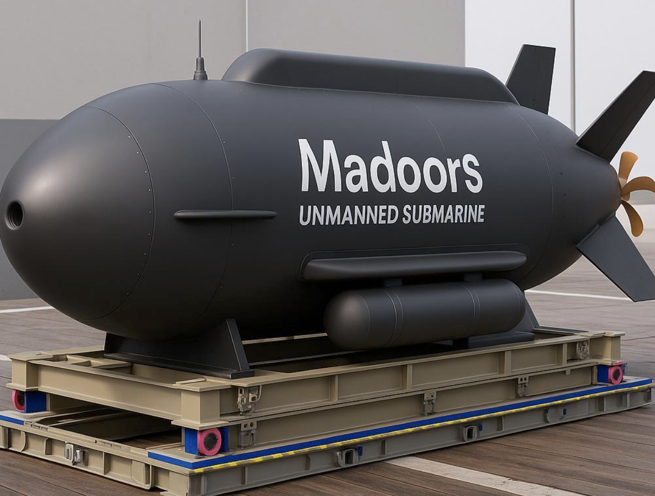
Satellite Controlled Autonomous Underwater Vehicle
The Madoors USA Satellite-Controlled Autonomous Underwater Vehicle is a fully domestically manufactured unmanned submarine platform engineered for military, industrial, and scientific research applications — providing worldwide real-time control via global satellite communication, encrypted long-range data transfer, multi-directional thruster system for precise navigation, high-capacity lithium battery for extended mission duration, and a pressure-resistant corrosion-protected hull for deep-sea missions. With a compact portable modular structure adaptable for different mission payloads — high-resolution sonar and camera systems, environmental sensors, and optional manipulator arm — and a silent low-acoustic-signature propulsion system, the Madoors USA AUV represents cutting-edge domestic technology in the satellite-controlled underwater vehicle class.
TECHNICAL SPECIFICATIONS
The Madoors USA Satellite-Controlled AUV uses SATCOM — global satellite communication — for real-time control from any location worldwide. The encrypted satellite communication protocol provides secure command and data transfer that prevents interception and signal spoofing — critical for military reconnaissance and defense applications where communication security is operationally essential. Long-range data transfer via satellite eliminates the distance limitation of conventional radio-frequency and acoustic underwater communication systems — the AUV can be deployed anywhere in the world's oceans and controlled from any surface or land-based station with satellite access.
The multi-directional thruster system provides precise navigation in all axes — forward, reverse, lateral, vertical, and rotational — allowing the AUV to navigate complex underwater environments, maintain precise station-keeping at inspection positions, and execute controlled approach maneuvers for manipulator arm operations. This multi-directional maneuverability is the navigation capability required for the confined underwater infrastructure environments of harbor security, pipeline inspection, and deep-sea research.
The modular mission structure allows the payload configuration to be changed between deployments — the same AUV platform serves sonar survey missions, camera inspection missions, environmental sensing missions, and manipulator arm intervention missions through the exchange of mission-specific payload modules. This modular adaptability eliminates the requirement for separate specialized vehicles for each mission type.
High-resolution sonar and camera systems provide the primary sensor payload for inspection and reconnaissance missions — sonar for wide-area mapping, obstacle detection, and target location in low-visibility conditions, and camera for close-range visual inspection and evidence documentation. Environmental sensors for temperature, pressure, and salinity provide the oceanographic data collection capability required for scientific research and mission planning.
The high-capacity lithium battery provides extended mission duration — sufficient for long-distance transit to the mission area, extended on-station inspection or surveillance time, and return transit to the recovery position. The deep-sea pressure-resistant hull and corrosion-protected coating provide structural integrity and material durability throughout the full operational depth range and extended underwater deployment periods.
The silent propulsion system with low acoustic signature is the critical military stealth characteristic — minimizing the acoustic detection signature of the vehicle during harbor reconnaissance, underwater surveillance, and any mission where detection by adversary acoustic sensors would compromise the mission or the vehicle.
KEY FEATURES
Worldwide Satellite Control — Unlimited Operational Range
The SATCOM real-time control capability with encrypted satellite communication provides unlimited operational range — the AUV can be deployed and controlled from any ocean location worldwide from a single satellite-connected control station. This worldwide control range is the defining operational advantage over acoustic and radio-frequency controlled underwater vehicles — the control signal is available at any depth and any distance from the surface station without the range limitations of alternative communication methods.
Encrypted Communication — Military-Grade Signal Security
The encrypted satellite communication protocol provides the signal security required for military and sensitive industrial applications — unauthorized parties cannot intercept the control commands or mission data, and the encrypted protocol prevents signal injection attacks that could compromise vehicle control. This communication security is the essential operational requirement for military reconnaissance and defense applications where mission and vehicle compromise would have significant consequences.
Modular Mission Design — Multi-Role Platform
The modular design that allows different mission payloads to be integrated for different applications transforms the AUV from a single-purpose tool into a multi-role platform — the same vehicle serves harbor security surveillance, pipeline inspection, oceanographic research, and search and rescue missions through payload exchange. This modularity directly maximizes the operational value and cost efficiency of the AUV investment across the full range of application requirements.
Low Acoustic Signature — Silent Propulsion
The silent propulsion system with low acoustic signature provides the stealth characteristic required for military harbor and base security missions — the AUV can approach and survey a harbor, inspect vessel hulls, and conduct underwater reconnaissance without generating the acoustic signature that would alert passive acoustic monitoring systems. This silent operation is also valuable for scientific research applications where acoustic disturbance would affect marine life behavior during ecosystem observation missions.
Deep-Sea Pressure-Resistant Hull — Extended Depth Capability
The pressure-resistant hull provides structural integrity at the operational depths required for deep-sea research, deep pipeline inspection, and any mission requiring access to the deeper ocean zones beyond the 150-meter range of the UWI-500 inspection robot. The corrosion-protected coating directly extends the service life of the hull structure in the chemically aggressive saltwater environment of continuous underwater deployment.
High-Resolution Sonar & Camera — Comprehensive Sensing
The combination of high-resolution sonar for wide-area mapping and target detection and high-resolution camera for close-range visual inspection provides comprehensive sensing coverage across the full range of mission requirements — sonar identifies targets and maps the operational environment in low visibility conditions, and the camera provides the detailed visual evidence required for inspection reporting, target identification, and mission documentation.
Optional Manipulator Arm — Active Intervention Capability
The optional manipulator arm extends the AUV from a passive inspection platform to an active intervention vehicle — capable of operating valves, attaching sensors, recovering objects, clearing obstacles, and conducting light maintenance tasks on underwater infrastructure. This intervention capability directly expands the operational scope of the AUV beyond observation-only missions to active subsea work.
APPLICATION MISSIONS
Defense — Harbor & Base Security
Autonomous patrol of harbor approaches and base perimeters — detecting unauthorized underwater vehicles, diver activity, and unauthorized attachment of devices to vessel hulls and harbor infrastructure. Encrypted satellite communication maintains operational security throughout the surveillance mission.
Defense — Underwater Reconnaissance & Surveillance
Long-range underwater reconnaissance missions beyond harbor limits — surveying underwater terrain, mapping potential adversary underwater infrastructure, and collecting intelligence on underwater activity in denied or contested areas. Silent propulsion minimizes detection risk during reconnaissance operations.
Scientific Research — Oceanography & Deep-Sea Ecosystem
Long-duration environmental data collection missions — temperature, pressure, salinity, and biological sensor data collection for oceanographic research, deep-sea ecosystem study, and climate monitoring programs. Extended battery life and satellite data transfer provide continuous data collection without surface support vessel attendance.
Industrial — Pipeline & Infrastructure Inspection
Remote visual and sonar inspection of subsea pipelines, cables, and offshore infrastructure — replacing expensive surface vessel support with satellite-controlled autonomous inspection that reduces operational cost and inspection program duration. Manipulator arm option extends to valve operation and light maintenance intervention.
Search & Rescue — Lost Vessel & Cargo Recovery
Sonar and camera search of defined ocean areas for lost vessels, aircraft, cargo, and missing persons — the AUV's extended mission duration, worldwide deployment capability, and deep-sea operational depth provide search coverage that surface vessels and conventional ROVs cannot match.
Underwater Cargo Transport
Long-distance cargo transport via underwater routes — the AUV's capacity for defined payload transport combined with the stealth of underwater transit provides a cargo transport capability suitable for sensitive or high-value material delivery through hostile or contested surface environments.
DEPLOYMENT SCENARIOS & USE CASES
Madoors USA Satellite-Controlled Autonomous Underwater Vehicles are deployed across the full range of military, scientific, and industrial underwater missions.
- Military harbor security autonomous underwater patrol
- Naval base perimeter underwater surveillance missions
- Military underwater reconnaissance and intelligence
- Subsea pipeline and cable long-range inspection
- Offshore platform underwater infrastructure inspection
- Oceanographic data collection research missions
- Deep-sea ecosystem monitoring and research
- Search and rescue lost vessel and cargo operations
- Port security underwater vehicle detection missions
- Underwater cable route inspection and fault detection
- Environmental monitoring and pollution detection
- Offshore wind farm foundation inspection missions
- Hydrocarbon reservoir and seabed survey operations
- Military special operations underwater vehicle support
- Any deep-sea or long-range underwater mission requiring satellite-controlled autonomous operation