Please provide your technical specifications and project requirements for the Robotic Ballistic Shield. Our engineers will review your application and provide a detailed manufacturing quote, including exact pricing and lead times.
Robotic Ballistic Shield
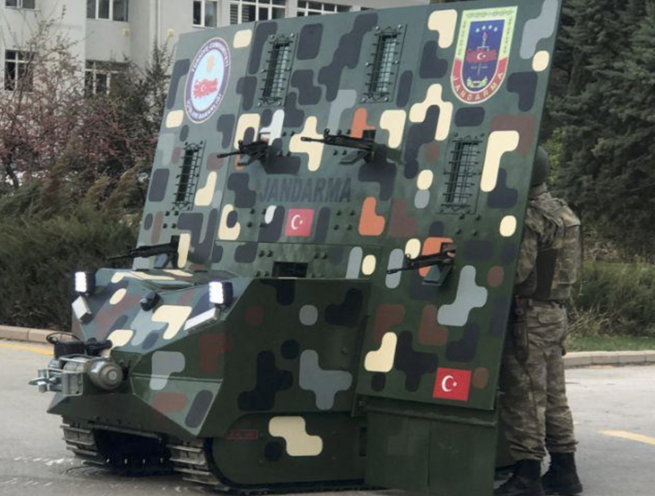
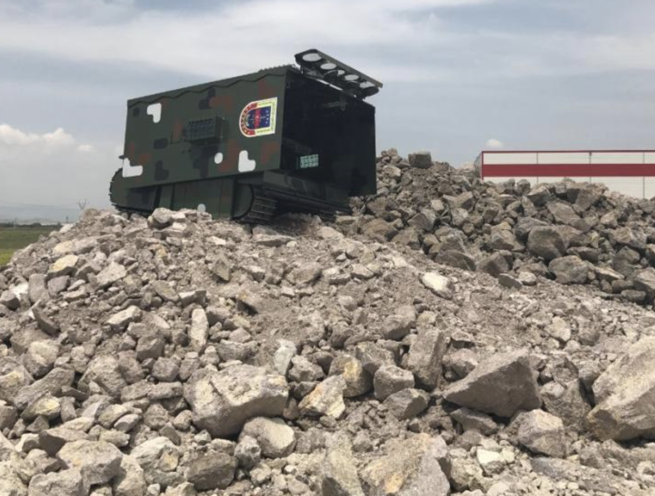
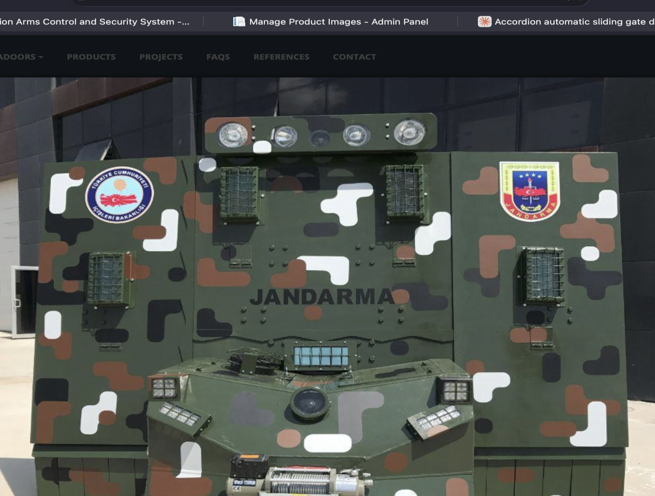
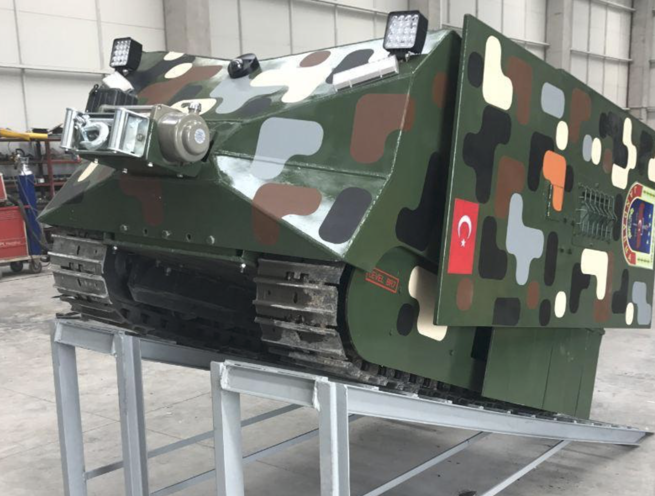
The Madoors USA Robotic Ballistic Shield is a patented, remotely controlled tracked armored robot system manufactured from Comet 500 / Milux 500 ballistic steel at BR6 and BR7 protection levels — providing military and police security personnel with real BR6/BR7 armored protection in operations without requiring personnel to be physically present behind the shield. The complete robot body is armored, the shield opens and closes automatically in 15 seconds, and the system is controllable by remote control, satellite, or the operator's wrist-mounted control device — with auto-disable capability that locks and disables the robot immediately if it falls into enemy hands.
With a 37HP twin 997cc engine, 2,850 kg weight, 1,500 kg carrying capacity, 5,000 kg towing capacity, 5,500 kg electric steel cable winch, 4 cameras including 2 night vision IP cameras, 360-degree self-rotation, crane system for vehicle recovery, weapon mounting capability for unmanned armed engagement, and mine and IED detection function, the Madoors USA Robotic Ballistic Shield is the most capable tracked armored robot shield available for urban warfare, residential area operations, force protection, and all-terrain military and police security operations. Five robot shields deployed together create an upper conditioning zone over the conflict area by opening their shields simultaneously.
TECHNICAL SPECIFICATIONS
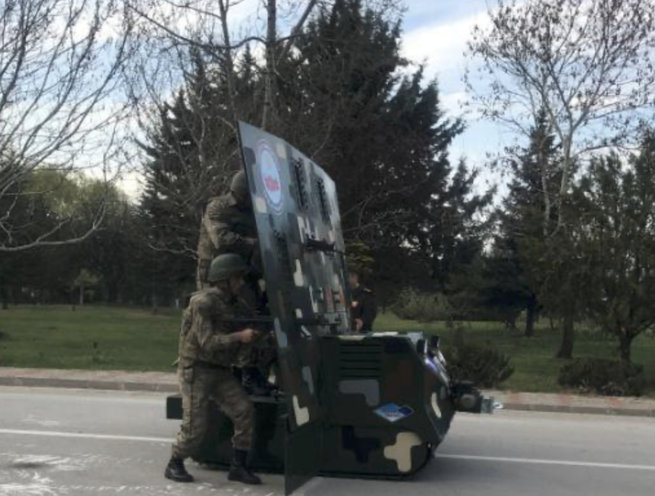
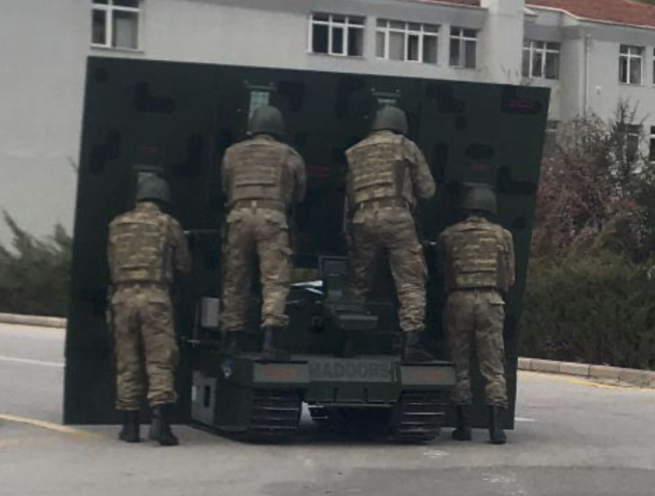
The Madoors USA Robotic Ballistic Shield is manufactured from Comet 500 / Milux 500 ballistic steel at BR6 and BR7 protection levels — resistant to armor-piercing steel bullets at 7.62×51 and 7.62×39 AP calibers and resistant to hand grenades including Mod 41-51. The complete robot body is covered with armor — no unprotected surfaces are present on any external face of the robot structure. The non-combustible paint coating eliminates fire propagation risk from incendiary attack. Weapon firing ports are incorporated in the shield — allowing soldiers to fire weapons through the shield without exposing themselves to the threat environment on the shield's exposed face.
Shield dimensions: closed — 1,500mm × 2,500mm × 1,350mm. Open — 3,500mm × 2,200mm × 2,500mm. Shield opening and closing time is 15 seconds. The shield opens to provide the maximum protected working area in the conflict position and closes for transit through confined spaces and narrow terrain.
Power system: 37 HP twin 997cc gasoline engine with 40-liter tank providing up to 240 hours maximum operation time. Electrical system: 12V to 24V. Hydraulic drive system powers the tracked movement, shield actuation, winch, and crane systems. Track width is 250mm in standard steel tracks with optional rubber track available. The robot can rotate 360 degrees on its own axis — providing the complete directional flexibility required for urban warfare and confined space operations. Safe operating angle is 30 degrees in the closed configuration and 22 degrees in the open configuration. Fast-slow mode operation with infinite speed control provides precise movement management in all terrain conditions.
Carrying capacity is 1,500 kg — sufficient for significant equipment payload or weapon system mounting. Towing capacity is 5,000 kg for vehicle and equipment recovery in conflict areas. The electric steel cable winch provides 5,500 kg of pull force for the most demanding recovery operations.
Control is via GPS, WiFi, and PMI communication systems — operable by remote control at close range, by satellite at unlimited range, and by the wrist-mounted soldier control device that allows the assigned soldier to maintain robot control hands-free during operations. If the soldier's wrist device stops transmitting — captured, incapacitated, or out of range — the robot locks immediately and becomes disabled, preventing enemy forces from operating the robot against the unit that deployed it.
KEY FEATURES
BR6/BR7 Ballistic Protection — Complete Body Armor
BR6 and BR7 are the highest available European ballistic protection standards for armored vehicles and shields — resistant to armor-piercing rifle caliber rounds that defeat lower protection levels. The complete body armor coverage — every external surface of the robot body — means that no aspect of the robot structure is vulnerable to ballistic penetration at the BR6/BR7 level. This comprehensive protection allows the robot to be advanced to the most exposed positions in the threat environment without the risk of system disablement from weapons fire that would affect lower-protected robot systems.
Automatic Shield — 15-Second Open/Close
The automatic shield opening and closing in 15 seconds provides rapid configuration change between the compact transit configuration and the fully deployed protection configuration — from the closed 1,500 × 2,500 × 1,350mm transit size to the open 3,500 × 2,200 × 2,500mm deployed protection area. The 15-second transition time allows the robot to adapt to changing tactical requirements during an active operation without extended vulnerability during the configuration change.
Five Shields — Upper Conditioning Zone Creation
Five Madoors USA Robotic Ballistic Shields deployed together and opened simultaneously create an upper conditioning zone over the conflict area — the overlapping open shield coverage of five units provides a continuous ballistic protection overhead structure for military personnel operating beneath. This five-shield zone capability transforms the individual robot from a single-position protective barrier into a collective force protection system that provides coverage for multiple personnel across a defined operational area.
Wrist-Mounted Control — Auto-Disable on Capture
The wrist-mounted soldier control device provides hands-free robot management during active operations — the soldier controls the robot from the wrist device while maintaining full use of both hands for weapons handling. The critical safety feature is the auto-disable — if the robot detects that the wrist device has stopped transmitting, it immediately locks and becomes disabled, ensuring that enemy forces cannot use the robot against the soldiers who deployed it. This auto-disable is the essential operational security requirement for robot systems deployed in direct enemy contact environments.
Satellite & Remote Control — Unlimited Range Operation
Satellite control provides unlimited operational range — the robot can be controlled from any distance with satellite communication, allowing the robot to be deployed into denied areas, operate ahead of the main force, and conduct missions at distances beyond direct radio communication range. Close-range remote control provides precise manual navigation in confined spaces, narrow terrain, and urban environments where the satellite control response latency would be operationally limiting.
Night Vision IP Cameras — 24-Hour Operation
The 4-camera system with 2 standard night vision IP cameras provides complete surveillance coverage in all lighting conditions — day and night operation capability without any reduction in situational awareness as ambient light decreases. High-resolution imaging and intelligence gathering capability allow the robot to conduct reconnaissance and surveillance missions in addition to its primary protection function — extending the operational value of each deployed unit beyond the direct shield protection role.
Weapon Mounting — Unmanned Armed Engagement
The weapon mounting structure allows the robot to be armed for unmanned combat — engaging enemy positions, vehicles, and personnel from the robot platform without exposing military personnel to direct fire risk. Combined with the satellite control unlimited range capability, armed robot operation allows military forces to engage threats at standoff distances that would otherwise require direct personnel exposure to enemy fire.
5,000 kg Towing & 5,500 kg Winch — Vehicle Recovery
The combined 5,000 kg towing capacity and 5,500 kg electric steel cable winch provide substantial vehicle and equipment recovery capability — extracting disabled military vehicles from conflict areas, recovering equipment left in enemy contact zones, and clearing road obstructions during urban operations. The crane system supplements the winch for lift recovery operations where towing or pulling is not the appropriate extraction method.
Mine & IED Detection — Pre-Clearance Capability
The mine and IED detection function allows the robot to precede personnel and vehicles into potentially mined or booby-trapped areas — detecting explosive hazards before the human element enters the danger zone. This pre-clearance capability directly prevents personnel casualties from mines and IEDs in areas where the presence of explosive hazards cannot be confirmed before entry.
360-Degree Rotation & All-Terrain Tracked Mobility
The 360-degree self-rotation capability and tracked drive system provide the mobility required for urban warfare and confined terrain operations — moving through low, narrow, and rough places where wheeled vehicles cannot enter, rotating to face threat directions without repositioning, climbing ramps and obstacles within the safe operating angle range, and traversing the full range of terrain conditions encountered in residential area operations.
Helicopter & Military Vehicle Transport
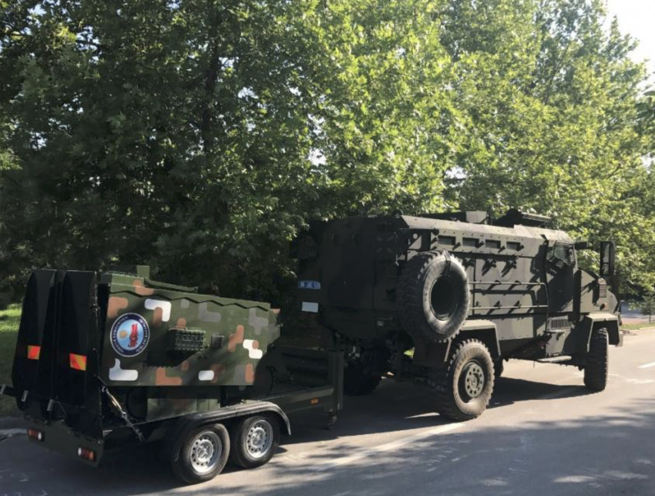
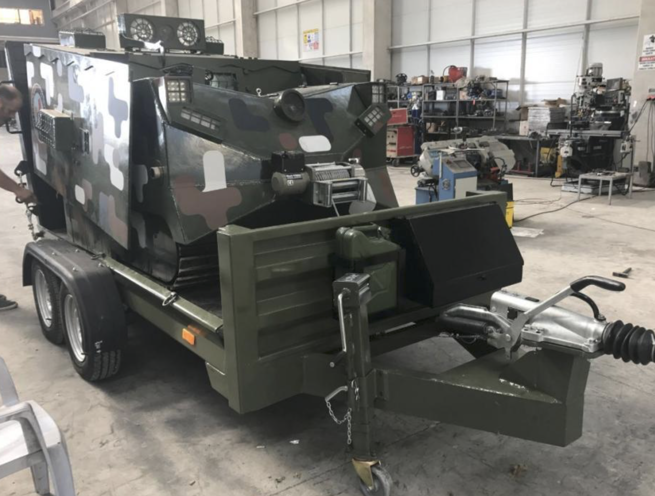
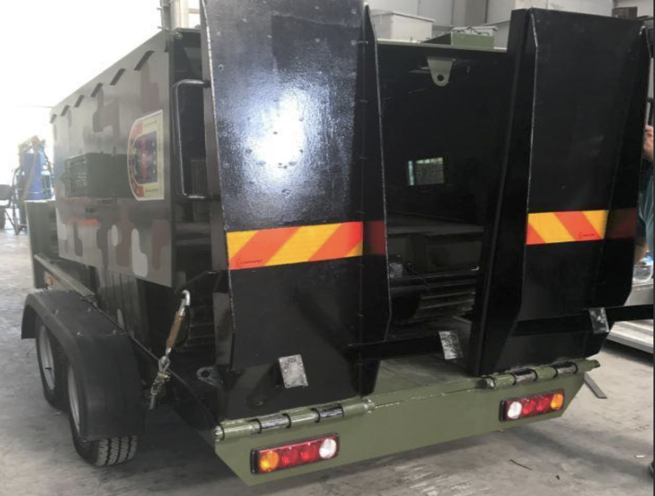
Helicopter transportability and compatibility with Kirpi, Ejder, and other military vehicles via the special tow trailer allow rapid deployment of the Robotic Ballistic Shield to any operational area — air deployment for operations in areas without road access, vehicle towing for rapid road movement to the operational sector, and back-of-vehicle mounting for forward positioning during convoy operations.
ASSEMBLY & DEPLOYMENT SEQUENCE
Transport to Operational Area
The robot is transported by helicopter, towed by military vehicle via the special trailer, or mounted to the vehicle rear for rapid forward deployment to the operational area.
Operator Wrist Device Initialization
The soldier operator's wrist control device is initialized and communication link with the robot is confirmed. Auto-disable function is tested — robot lock on wrist device signal interruption is verified.
Satellite & Remote Control Activation
Satellite control link is established for unlimited range operation. Close-range remote control is verified as backup. GPS, WiFi, and PMI communication channels are confirmed active.
Shield Configuration & Deployment
The robot is advanced to the operational position under remote or satellite control. Shield is opened to the deployed configuration in 15 seconds for the operational protection requirement or maintained closed for transit through confined terrain.
Camera System & Night Vision Activation
All 4 cameras are confirmed active. Night vision IP camera operation in the ambient lighting conditions of the operational area is verified. Intelligence gathering and reconnaissance function from the camera feeds is confirmed at the operator control position.
Five-Shield Zone Configuration (Where Specified)
For the five-shield upper conditioning zone, all five robots are positioned and shields are opened simultaneously to create the continuous overhead ballistic protection zone for personnel operating beneath.
Weapon Mounting (Where Specified)
Weapon system is mounted on the robot weapon mount and remote firing control is verified. Unmanned armed engagement capability is confirmed from the satellite control position.
Mine/IED Detection & Operational Advance
Mine and IED detection system is activated before advancing into areas with confirmed or suspected explosive hazard. Robot precedes personnel and vehicles in the advance.
DEPLOYMENT SCENARIOS & USE CASES
Madoors USA Robotic Ballistic Shields are deployed across the full range of military and police security operations requiring BR6/BR7 protected unmanned ground capability.
- Urban warfare residential area force protection operations
- Military assault operations with robotic shield advance
- Police counter-terrorism operation robotic protection
- Hostage rescue operation protected robot advance
- Mine and IED clearance precursor robot deployment
- Military checkpoint and patrol base protection
- Unmanned armed conflict engagement operations
- Vehicle and equipment recovery in conflict areas
- Intelligence gathering and surveillance robot deployment
- Military convoy protection robotic advance element
- Five-shield upper zone creation for personnel protection
- Night operations with night vision robot shield advance
- Confined and narrow terrain military robot operations
- Special forces operation robot shield support
- Any operation requiring BR6/BR7 unmanned ground protection
- Category: Bomb Disposal Robotics