Please provide your technical specifications and project requirements for the Road Blocker. Our engineers will review your application and provide a detailed manufacturing quote, including exact pricing and lead times.
Road Blocker
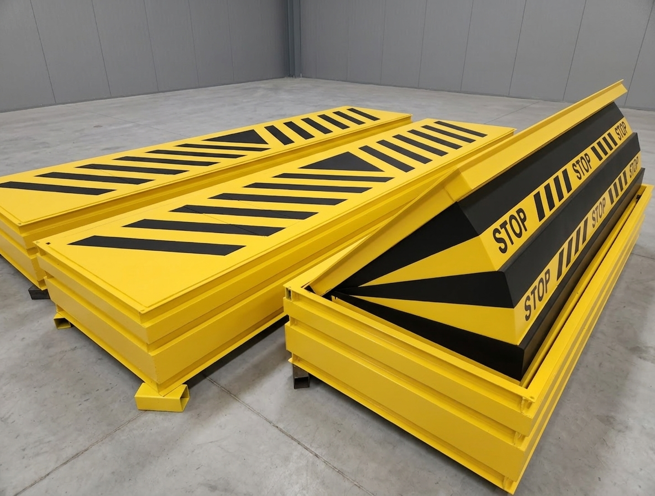
The Madoors USA Road Blocker is a high-security anti-terrorist barrier system engineered to stop, control, or completely prevent vehicle passage at military facilities, airports, ports, shopping centers, stadiums, consulates, diplomatic missions, and any location requiring certified hostile vehicle mitigation. Certified to ASTM F2656-07, PAS 68, IWA-14-1:2013, and K4, K8, K12, and ASTM M50 impact resistance classifications, the Madoors USA road blocker provides proven crash-tested vehicle stopping performance against high-speed vehicle-borne attacks — backed by 25 years of barrier system experience and full in-house capability for design, supply, installation, commissioning, and ongoing maintenance.
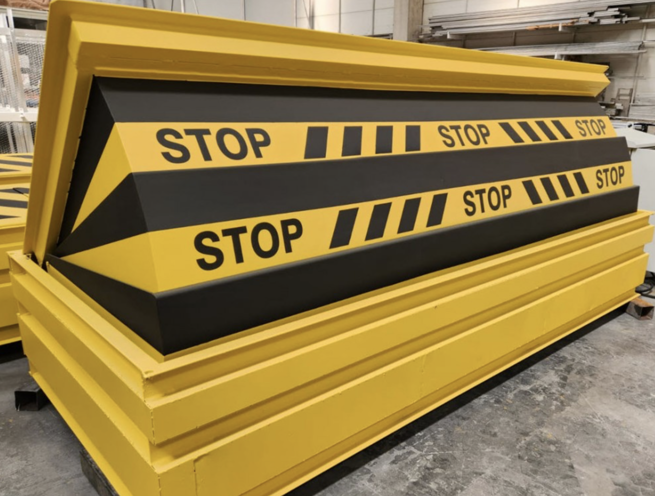
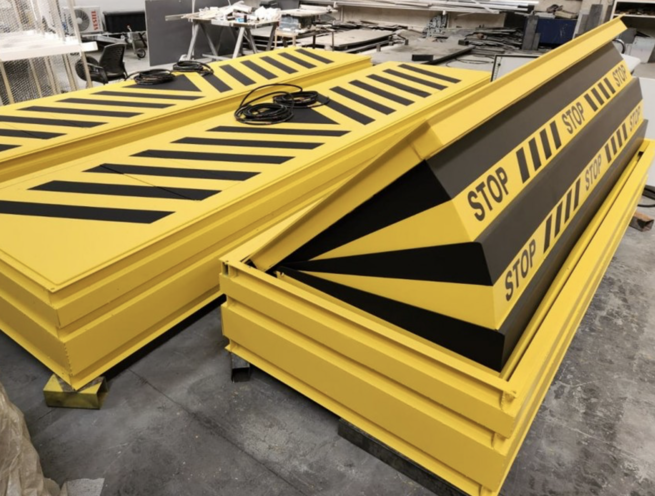
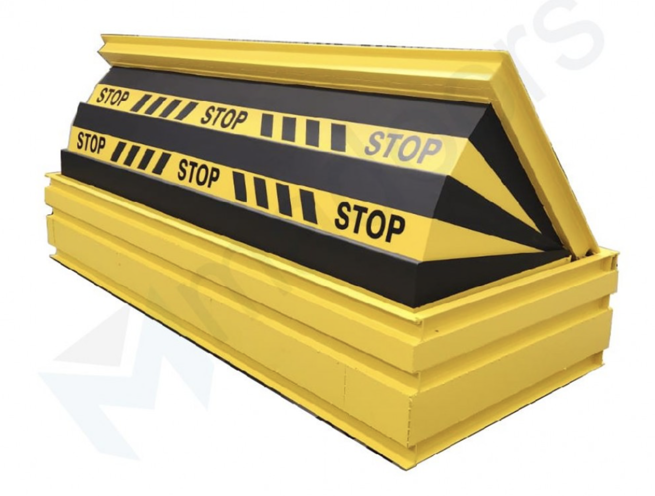
Manufactured in standard lengths of 2 to 4 meters with custom lengths up to 5, 5.5, and 6 meters available for special project requirements, the road blocker system consists of a durable steel frame body, hydraulic actuation system, electronic control panel, vehicle detection sensors, LED warning lights, and special lock systems — all assembled and commissioned by professional installation teams following the manufacturer's specifications.
TECHNICAL SPECIFICATIONS
Madoors USA Road Blocker systems are designed and manufactured to the following internationally recognized vehicle security barrier standards. ASTM F2656-07 — Standard Test Method for Vehicle Crash Testing of Perimeter Barriers, the primary American standard for crash-tested hostile vehicle mitigation barriers. PAS 68 — the UK Publicly Available Specification for vehicle security barriers, widely adopted internationally as a benchmark crash test standard. IWA-14-1:2013 — the International Workshop Agreement Vehicle Security Barrier Performance Standard. K4, K8, and K12 / ASTM M50 impact resistance classifications — covering vehicle stopping performance at the specified kinetic energy levels corresponding to K4 (15 mph), K8 (30 mph), and K12 (50 mph) for a 15,000 lb test vehicle.
Standard barrier lengths range from 2 to 4 meters for most applications, with custom lengths of 5, 5.5, and 6 meters available for wider road closures and special project requirements. Custom sizing beyond standard dimensions is available for project-specific road width and security zone requirements.
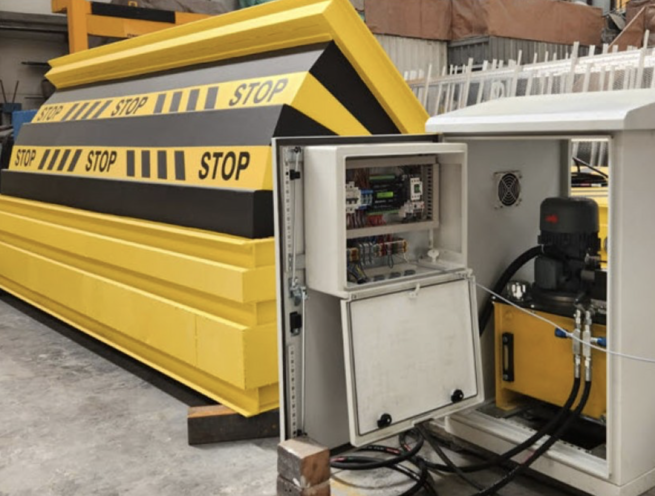
The road blocker system incorporates the following primary components. The road blocker frame — the main structural body — is manufactured from durable high-strength steel providing the impact resistance required for crash-rated hostile vehicle mitigation performance. The hydraulic system consists of hydraulic cylinders, hydraulic pump, hydraulic oil reservoir, hydraulic hoses, and control valves that raise and lower the barrier plate between the operational blocked position and the lowered pass-through position. The electronic control panel manages vehicle transitions, user access settings, sensor inputs, and fault condition monitoring. Vehicle detection sensors detect vehicle approach and departure, enabling automated barrier operation. LED warning lights provide visible indication of barrier status to approaching vehicle operators. Special lock systems secure the barrier in the raised position under hostile vehicle attack loading, preventing barrier depression by vehicle impact force.
KEY FEATURES
K4, K8 & K12 — ASTM M50 Crash Tested
Madoors USA road blockers are available with certified crash test ratings to K4, K8, and K12 — ASTM M50 classifications corresponding to vehicle stopping performance at 15 mph, 30 mph, and 50 mph respectively for a 6,800 kg test vehicle. Crash test certification provides independently verified hostile vehicle mitigation performance documentation satisfying government, military, and institutional security procurement specifications. Madoors USA specifically does not offer non-crash-tested barrier products — all high-capacity road blocker systems carry approved crash test certification.
PAS 68 & IWA-14-1 Certified In addition to ASTM crash test ratings, Madoors USA road blockers are certified to PAS 68 and IWA-14-1:2013 — providing international standard coverage across the UK, European, and global vehicle security barrier procurement frameworks used by government and defense authorities worldwide.
Hydraulic Actuation System
The hydraulic system provides the high-force actuation required for rapid, reliable raising and lowering of the heavy steel barrier plate — operating consistently across temperature extremes, contamination, and the high-cycle operational demands of active security checkpoints. Hydraulic actuation delivers the force output and reliability profile required for barrier systems that must perform on demand at security-critical vehicle control points without failure.
Electronic Control Panel — Access Management
The electronic control panel manages all barrier operational functions — vehicle transition authorization, user access level settings, sensor inputs, manual override, and fault condition monitoring and reporting. The control panel provides the interface between the road blocker and the facility's wider access control, CCTV, and security management infrastructure.
Vehicle Detection Sensors
Inductive loop and other vehicle detection sensors detect vehicle presence at the barrier position — enabling automated barrier operation that responds to approaching vehicles without requiring manual operator activation for every vehicle pass. Sensor integration supports both fully automated access flow management and operator-supervised access control depending on the security protocol of the specific installation.
LED Warning Lights
Flashing LED lights fitted to the barrier provide visible indication of barrier status — raised or lowered — to approaching vehicle operators, reducing the risk of vehicle collision with a raised barrier by alerting drivers to the barrier position before they reach the stopping distance. LED warning lights are an essential safety component for road blocker installations at vehicle access control points where multiple vehicles may approach simultaneously.
Special Lock System — Hostile Vehicle Impact Resistance
Special lock systems secure the road blocker barrier plate in the raised position against the lateral and vertical forces generated by a vehicle impact at crash-test rated speeds. Without a reliable lock system, the impact force of a hostile vehicle could depress the barrier before the structural stopping mechanism engages — the lock system ensures that the barrier remains in the raised, crash-rated position throughout the full vehicle impact event.
2 to 4 Meter Standard Length — Custom to 6 Meters
Standard lengths of 2 to 4 meters cover the full range of standard lane widths encountered at military base vehicle control points, airport perimeter access roads, port terminal vehicle gates, and shopping center vehicle entrances. Custom lengths up to 5, 5.5, and 6 meters are available for wider road closures and special project requirements where standard lengths would leave unprotected gaps in the barrier line.
25 Years of Barrier System Experience
Madoors USA brings 25 years of experience in barrier system design, supply, installation, and maintenance to every road blocker project — providing clients with the confidence of a proven, experienced supplier capable of delivering the correct certified barrier specification for any security requirement and supporting the installed system throughout its operational service life.
SYSTEM COMPONENTS
Road Blocker Frame
The main structural body of the barrier system — manufactured from high-strength steel providing the crash-rated impact resistance required to stop a hostile vehicle at the specified K4, K8, or K12 / M50 rating. The frame houses the hydraulic cylinder, connects to the foundation anchorage, and carries the barrier plate through the full raise and lower travel cycle.
Hydraulic System
Hydraulic cylinders, hydraulic pump, hydraulic oil reservoir, hydraulic hoses, and control valves — providing the high-force actuation for raising and lowering the barrier plate. The hydraulic system is dimensioned for the specific barrier plate weight and required actuation speed to achieve the operational cycle time specification for each application.
Electronic Control Panel
The primary operator and management interface — controlling vehicle transition authorization, user access settings, sensor data processing, fault monitoring, and remote management system interface. The control panel is the integration point between the road blocker and the facility security management infrastructure.
Vehicle Detection Sensors
Inductive loop detectors and/or other sensor types detecting vehicle presence and position at the barrier — enabling automated barrier response to approaching vehicles and providing vehicle counting and traffic management data for the control panel.
LED Warning Lights
Flashing LED warning lights providing visible barrier status indication to approaching vehicle operators — an essential active safety component for all road blocker installations at vehicle access control points.
Special Lock Systems
Mechanical and electro-mechanical lock systems securing the barrier plate in the raised position against hostile vehicle impact forces — maintaining crash-rated stopping performance throughout the full impact event.
ASSEMBLY & INSTALLATION SEQUENCE
Installation Location Determination & Ground Assessment
The barrier installation position is determined based on the security zone layout and vehicle access control requirements. Ground conditions — soil type, bearing capacity, water table depth, and buried services — are assessed to confirm the foundation design requirements.
Excavation
The pit or channel required for the below-grade components of the road blocker — foundation, hydraulic cylinder housing, and cable conduit routing — is excavated to the specified dimensions and depth.
Foundation Construction
The reinforced concrete foundation is constructed within the excavated pit, with anchor bolt positions, hydraulic cylinder mounting provisions, and electrical conduit penetrations cast into the concrete. Foundation concrete achieves full design strength before barrier installation proceeds.
Barrier Steel Frame Installation
The steel frame body of the road blocker is installed on the cast foundation anchor bolts and secured. Frame alignment, level, and structural connection integrity are verified.
Hydraulic System, Motor & Electronic Component Installation
Hydraulic cylinders, pump, reservoir, hoses, and control valves are installed and connected within the barrier frame assembly. The hydraulic system is filled, bled, and pressure-tested. Electronic control panel, sensor wiring, LED light wiring, and power supply connections are completed.
Operational Testing
The barrier is tested through multiple complete raise and lower cycles at the specified operational speed. Sensor detection, LED light sequencing, control panel operation, lock system engagement, and emergency stop functions are all tested and verified.
Electronic Systems Commissioning
Access control interfaces, remote management system connections, user access programming, fault monitoring configuration, and integration with the facility security management infrastructure are completed and verified.
Certification Documentation Handover
Crash test certification documentation — ASTM F2656-07, PAS 68, IWA-14-1, and K4/K8/K12/M50 ratings as applicable — is compiled into the project handover package alongside installation records, commissioning test results, and maintenance schedule documentation.
DEPLOYMENT SCENARIOS & USE CASES
Madoors USA Road Blockers are specified for any vehicle access control point where certified hostile vehicle mitigation, controlled vehicle passage, and anti-terrorism protection are required.
- Military base and installation main vehicle access control
- Airport perimeter and airside vehicle access road blockers
- Port and maritime terminal vehicle access control points
- Shopping center and retail mall vehicle entrance road blockers
- Stadium and arena event vehicle access control
- Embassy and diplomatic mission vehicle entrance barriers
- Government building and ministry main road access control
- Nuclear facility and power station vehicle perimeter barriers
- Petrochemical plant and refinery vehicle access road blockers
- Prison and correctional facility vehicle entrance control
- Border crossing and checkpoint hostile vehicle mitigation
- Hotel and hospitality facility vehicle entrance control
- University and educational campus vehicle access road blockers
- VIP compound and protected residence vehicle barriers
- Critical infrastructure facility main road access control
- Category: Road Blocker