Please provide your technical specifications and project requirements for the Pneumatic Road Blocker Barrier. Our engineers will review your application and provide a detailed manufacturing quote, including exact pricing and lead times.
Pneumatic Road Blocker Barrier
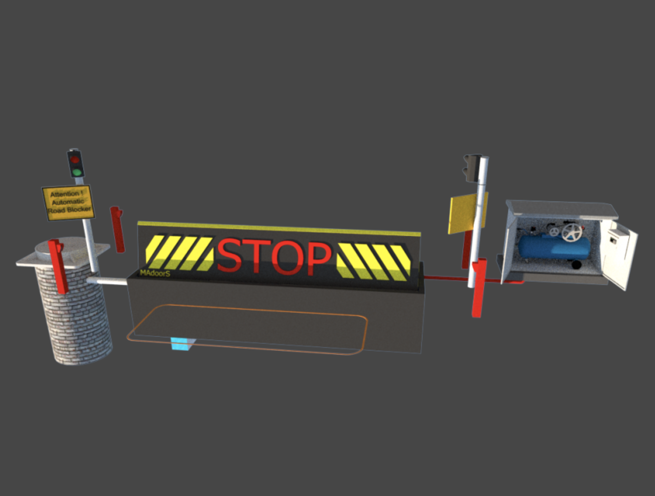
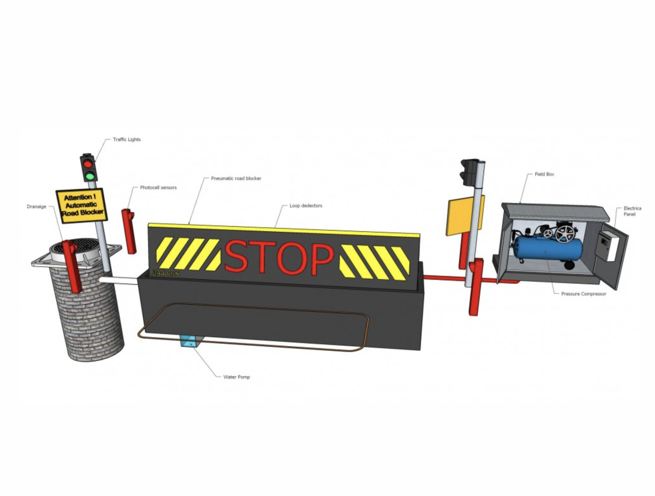
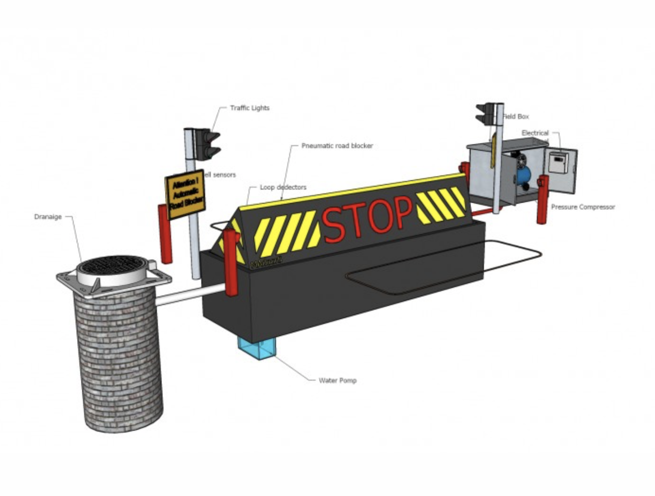
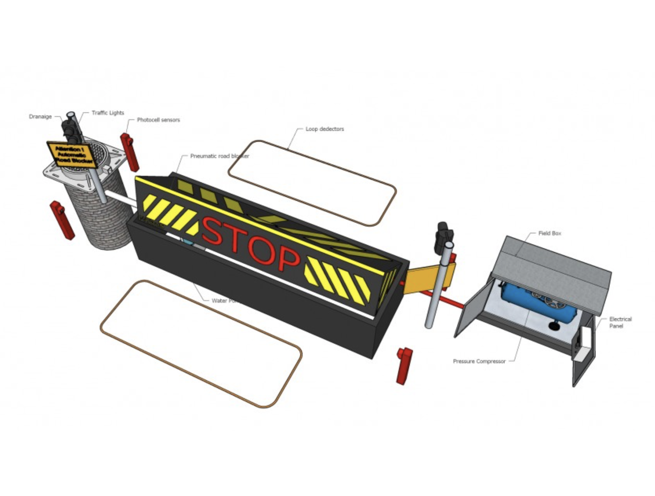
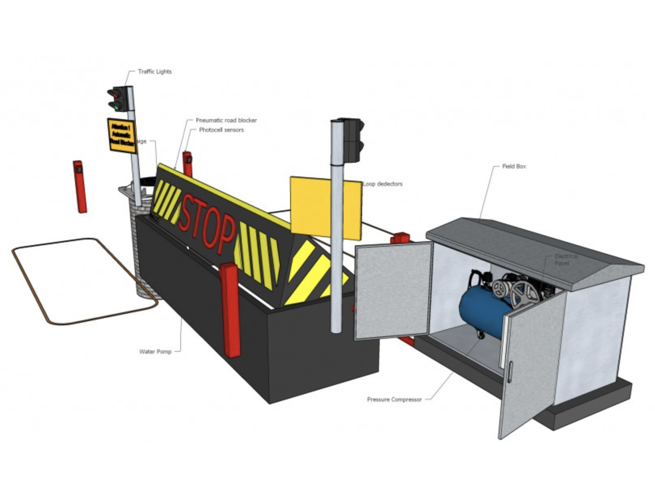
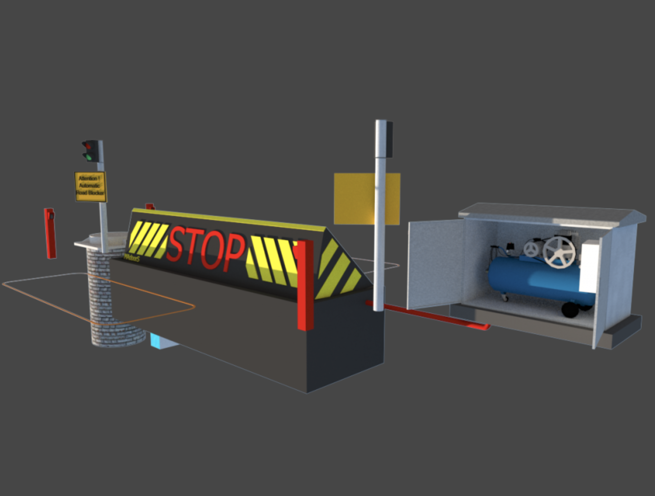
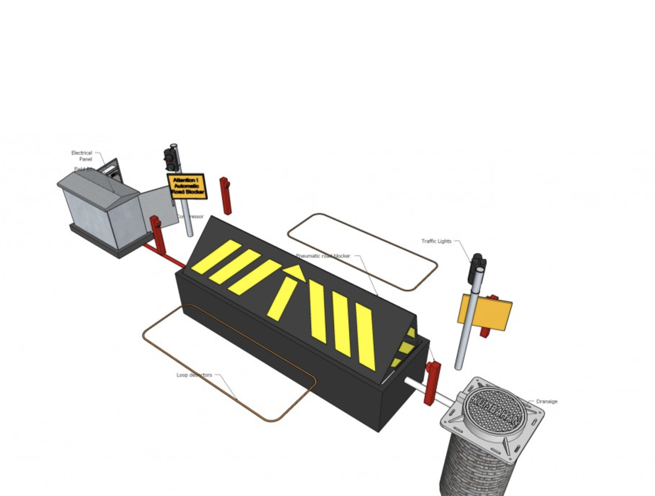
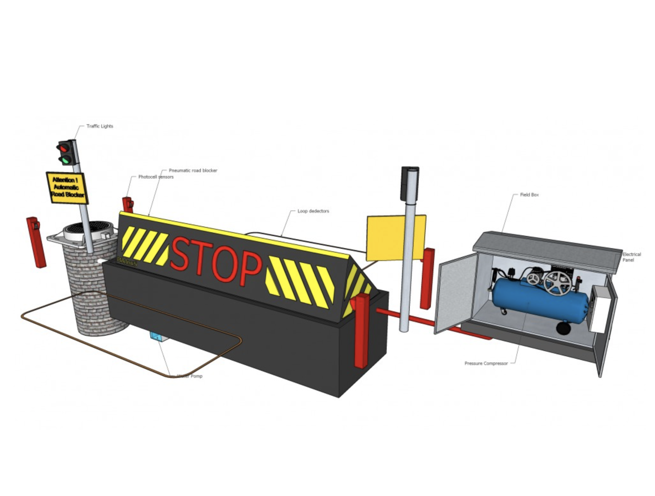
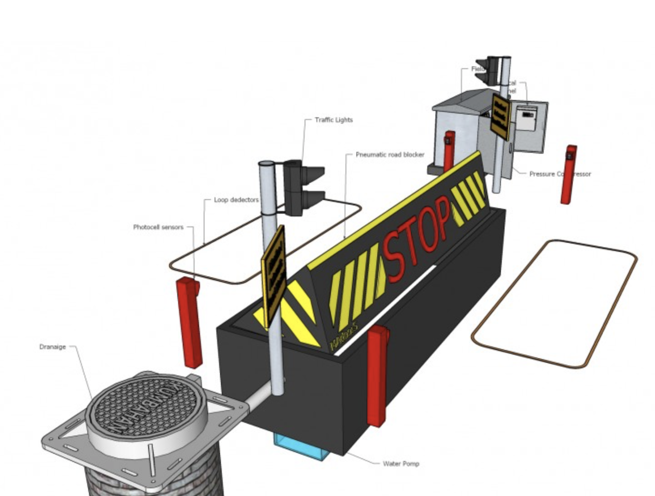
The Madoors USA Pneumatic Road Blocker Barrier is an automatic compressed-air-operated road blocker system that operates faster than hydraulic systems — with normal opening and closing times of 2 to 4 seconds, emergency air evacuation opening in 1 second, and emergency closure in 1 second using spare air pressure tanks. Certified to M50, K12, and PAS 68 crash test standards — stopping a 7,500 kg vehicle at 80 km/h in bomb-laden vehicle terrorist attack scenarios — and described as the world's only K12 PAS 68 barrier system operating with a crash test report using pneumatic air pressure, the Madoors USA Pneumatic Road Blocker is manufactured in one piece up to 6 meters long, compatible with UPS backup power providing 5 complete opening and closing cycles during power failure, and equipped with photocell sensors, loop detectors, submersible internal drainage pump, and traffic light and safety warning sign integration.
TECHNICAL SPECIFICATIONS
The Madoors USA Pneumatic Road Blocker operates on compressed air transmitted to pneumatic pistons — raising and lowering the barrier plate through air pressure actuation rather than hydraulic fluid pressure. Compressed air provides faster actuation response than hydraulic oil — achieving the standard 2 to 4 second cycle time and the 1-second emergency response times that define the operational performance advantage of the pneumatic system over hydraulic alternatives.
Normal operating cycle time is 2 to 4 seconds for complete barrier raise or lower — providing rapid, responsive access control at high-security vehicle entrances. Emergency air evacuation system opens the barrier in 1 second for emergency vehicle passage and evacuation scenarios. Emergency closure system using spare air pressure tanks closes the barrier in 1 second in response to immediate hostile vehicle threat detection — the fastest available road blocker emergency deployment response.
Power supply options are 220V AC and 380V AC — with UPS system compatibility providing continued automatic barrier operation during mains power failure. The air pressure stored in the reserve tanks provides energy for 5 complete opening and closing cycles without any electrical power — maintaining full security barrier functionality during power outages at critical security installations.
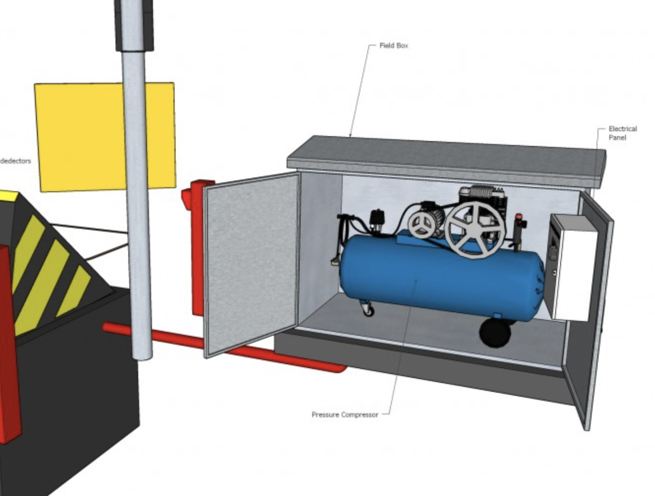
The barrier is manufactured in one piece up to 6 meters in length — with no joints, seams, or segmentation across the full 6-meter barrier width. Reciprocating compressor units are used for 3-meter barrier systems. Screw-type compressor systems — providing higher airflow capacity and efficiency — are used for barrier systems longer than 3 meters. Compressor selection is matched to the specific barrier length and required cycle rate of each installation.
Crash test certification: M50 — stopping a 7,500 kg vehicle at 80 km/h at the M50 impact rating. K12 — the highest available US K-rating classification. PAS 68 — the internationally recognized UK and global vehicle security barrier standard. The system is described as the world's only K12 PAS 68 barrier operating with a crash test report using pneumatic air pressure actuation.
Installation is ground-embedded — the barrier is installed by excavating into the ground and burying the mechanism below the road surface, with the barrier plate flush with the road surface in the lowered position. An internal submersible pump manages rainwater ingress — pumping accumulated water from the barrier pit to the external drainage area, maintaining reliable barrier mechanism operation in wet weather conditions.
KEY FEATURES
Faster Than Hydraulic — 2 to 4 Second Normal Cycle
The pneumatic air pressure actuation system provides faster response than hydraulic systems — achieving 2 to 4 second normal operating cycle times for the full barrier raise and lower travel. Pneumatic actuation speed advantage over hydraulic systems is the primary operational performance advantage of the pneumatic road blocker for high-throughput, high-security vehicle access control points where maximum cycle speed directly supports both security response capability and authorized vehicle throughput efficiency.
1-Second Emergency Opening — Air Evacuation System
The emergency air evacuation system opens the barrier in 1 second — the fastest available emergency opening response for any road blocker system. One-second emergency opening is the critical life-safety capability for evacuation scenarios where immediate barrier clearance for emergency vehicles is the overriding priority. Air evacuation opening speed is achieved by rapidly venting the air pressure from the raising pistons, allowing the barrier to descend to the flush ground position under its own weight in the minimum possible time.
1-Second Emergency Closure — Spare Air Pressure Tanks
The emergency closure system uses pre-charged spare air pressure tanks to raise the barrier to the fully closed blocking position in 1 second — providing the fastest available emergency threat response for immediate hostile vehicle attack scenarios. Pre-charged spare tanks ensure that the 1-second emergency closure capability is available immediately without waiting for the compressor to build pressure — the air energy is stored and immediately deployable at the moment the emergency close command is issued.
M50, K12 & PAS 68 Crash Certified — 7,500 kg at 80 km/h
The barrier is certified to M50, K12, and PAS 68 — confirming independent crash test performance stopping a 7,500 kg vehicle at 80 km/h in bomb-laden vehicle terrorist attack scenarios. This multi-standard certification covering the American M50 and K12 ratings and the internationally recognized PAS 68 standard satisfies the procurement requirements of government, military, and critical infrastructure security authorities across North America, Europe, the Middle East, and Asia-Pacific.
World's Only K12 PAS 68 Pneumatic Road Blocker
The Madoors USA Pneumatic Road Blocker is the world's only K12 PAS 68 certified barrier system that operates on compressed air pressure and holds a crash test report confirming this performance — combining the speed advantage of pneumatic actuation with the highest available certified hostile vehicle mitigation performance. This unique combination provides security engineers with a barrier option that delivers both maximum crash protection and maximum operational speed — previously only separately achievable in hydraulic and electromechanical systems.
Single Piece Up to 6 Meters — No Joints or Gaps
One-piece construction up to 6 meters eliminates the intermediate joints, potential penetration gaps, and mechanical complexity of segmented multi-piece barrier systems. A single continuous barrier plate across the full 6-meter width provides uniform structural integrity and crash performance across the entire barrier surface — with no joint position vulnerability that a vehicle could exploit to concentrate impact force at a mechanically weaker connection point.
UPS Compatible — 5 Reserve Cycles During Power Failure
UPS system compatibility and 5-cycle reserve capacity from the air pressure tanks provide complete barrier operational continuity during mains power failure — maintaining both the emergency closure capability and the authorized vehicle access management capability without any electrical supply. This dual-layer power independence — UPS backup for full motorized operation and tank reserve for pneumatic emergency operation — provides the most comprehensive power failure protection available for road blocker systems.
Reciprocating & Screw Compressor — Length-Matched Selection
Reciprocating compressor units for 3-meter systems and screw-type compressors for longer systems provide the airflow capacity and pressure delivery matched to the specific barrier length and cycle rate requirement of each installation — ensuring that the compressor system provides adequate air supply for both normal operating cycles and full spare tank charging at the specific barrier dimensions of each project.
Photocell & Loop Detector Safety — No Operation Over Vehicle
Photocell and loop detector sensors prevent the barrier from rising when a vehicle is detected on or over the barrier plate — maintaining safe operation and preventing vehicle damage from unintended barrier rise under a stationary vehicle. The barrier operates only when sensors confirm that no vehicle is present on the barrier — implementing the fundamental safety logic required for automatic road blocker systems operating in the presence of normal vehicle traffic.
Traffic Light Integration — Green Down, Red Rising
Traffic lights integrated with the barrier control system provide clear visual status communication to approaching vehicle operators — green light when the barrier is completely flush with the ground and the road is open for authorized passage, and red light before the barrier begins to rise from the ground. This pre-rise red signal provides approaching vehicles with advance warning of barrier activation before the physical barrier appears above the road surface — the critical safety interval that prevents vehicle contact with the rising barrier.
Ground-Flush Closed Position — No Surface Obstruction
When the barrier is fully lowered, it is completely flush with the road surface — presenting no raised element, step, or obstruction to vehicle tires, snowplows, sweeping equipment, or any other ground-contact vehicle equipment during authorized passage. The flush closed position allows normal vehicle traffic flow over the barrier without speed restriction or equipment protection requirements.
Submersible Internal Pump — All-Weather Reliable Operation
The internal submersible pump manages rainwater accumulation in the barrier pit — automatically pumping water to the external drainage area and maintaining the barrier mechanism environment free from water accumulation that would impair barrier travel, damage compressor and electrical components, or cause freezing in cold climate installations. Internal pump integration is standard on all Madoors USA Pneumatic Road Blockers as part of the all-weather reliable operation specification.
ASSEMBLY & INSTALLATION SEQUENCE
Site Assessment & Barrier Length Selection
Installation position, road width, required barrier length — up to 6 meters — compressor type selection — reciprocating for 3m, screw for longer — power supply configuration, UPS connection, and safety system requirements are confirmed.
Ground Excavation & Pit Construction
The barrier pit is excavated to the specified depth and plan dimensions. Drainage channel and submersible pump outlet routing are constructed within the pit. Pneumatic supply conduits, electrical power conduits, and control wiring conduits are installed before pit concrete works are completed.
Barrier Mechanism & Piston Installation
The barrier plate mechanism and pneumatic pistons are installed in the prepared pit. Flush road level alignment and barrier travel geometry are verified.
Compressor Installation & Air System Connection
The specified compressor unit — reciprocating or screw type — is installed at the specified position. Pneumatic supply lines connecting the compressor, spare air pressure tanks, and barrier pistons are installed and pressure-tested. Spare tank pre-charge pressure is verified.
Electrical & UPS Connection
220V or 380V AC power supply is connected to the compressor and control system. UPS system connection is made and verified. Five-cycle reserve operation from tank air pressure during simulated power failure is tested.
Sensor, Traffic Light & Safety System Installation
Photocell sensors and loop detectors are installed and calibrated. Traffic light system — green for flush position, red for pre-rise — is installed and verified. Safety warning signs are installed at the specified positions.
Emergency System Testing
Emergency air evacuation 1-second opening is tested and timed. Emergency closure using spare tanks 1-second raise is tested and timed. Both emergency modes are verified as operational from the tank reserve without compressor activation.
Operational Testing & Certification Handover
Complete operational testing across normal cycle, emergency open, emergency close, power failure reserve, photocell and loop detector safety logic, and traffic light sequencing is conducted. M50, K12, and PAS 68 crash test certification documentation is compiled into the project handover package.
DEPLOYMENT SCENARIOS & USE CASES
Madoors USA Pneumatic Road Blockers are specified for any high-security vehicle access control point requiring the fastest available road blocker response with K12 PAS 68 certified crash protection.
- Dam and water infrastructure facility vehicle entrance barriers
- Power plant and energy facility vehicle access control
- Military institution and base vehicle entrance barriers
- Hotel and hospitality facility high-security vehicle access
- Shopping center and public venue vehicle attack prevention
- Government building and ministry vehicle entrance barriers
- Embassy and diplomatic compound vehicle access blockers
- Airport perimeter and airside vehicle access road blockers
- Nuclear facility and critical infrastructure vehicle barriers
- Petrochemical plant and refinery vehicle access control
- Border crossing and checkpoint pneumatic road blockers
- Court complex and justice facility vehicle access barriers
- Stadium and arena event vehicle attack prevention barriers
- Banking and financial institution vehicle access control
- Counter-terrorism facility vehicle entrance protection
- Category: Road Blocker