Please provide your technical specifications and project requirements for the Motorized Road Blocker. Our engineers will review your application and provide a detailed manufacturing quote, including exact pricing and lead times.
Motorized Road Blocker
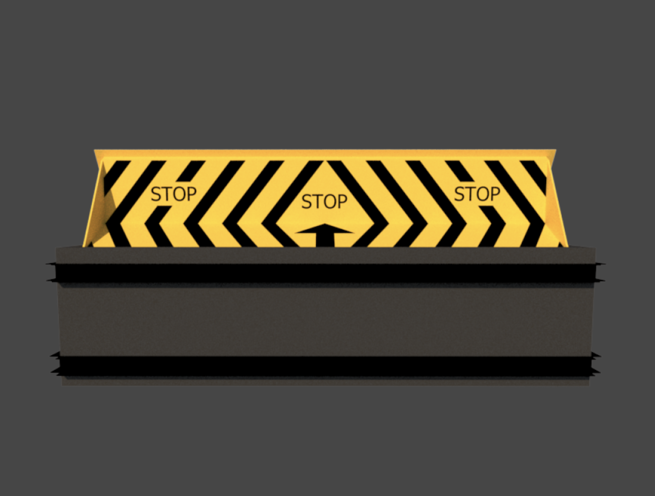
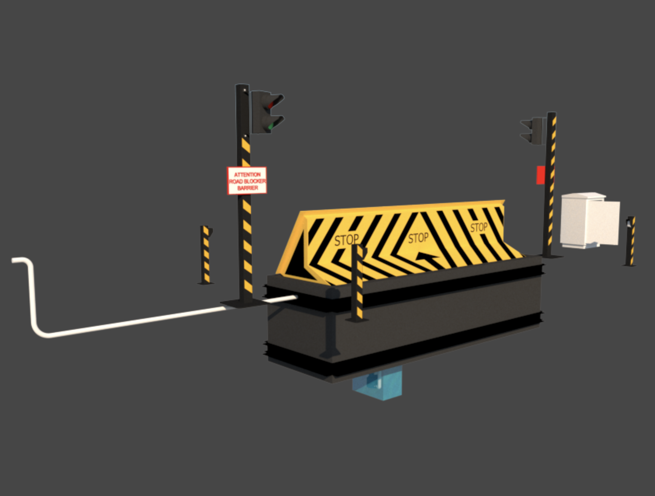
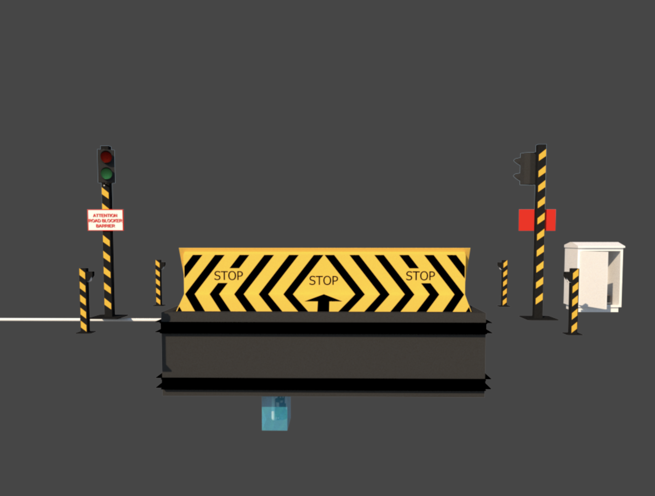
The Madoors USA Motorized Road Blocker is a crash-tested, electric motor and reducer-driven vertical rising barrier system engineered to prevent unauthorized vehicle access at military bases, airports, government facilities, and high-security restricted zones — combining certified crash resistance against high-speed vehicle impacts with efficient, sensor-managed authorized vehicle throughput in a maximum 2-second opening cycle. The motorized mechanism raises and lowers a heavy-duty durable metal barrier plate vertically from the ground, controlled by remote control, keypad, access control system, or direct open/close button — with loop-type metal mass detector and photoelectric photocell sensor systems providing vehicle detection, safety monitoring, and accident prevention throughout every access control cycle.
Integrating with surveillance cameras, alarm systems, intercoms, and broader security management infrastructure, the Madoors USA motorized road blocker provides a high level of security while maintaining efficient traffic flow for authorized vehicles — combining the physical stopping capability of a crash-rated barrier with the operational responsiveness of a fast-cycle, sensor-managed access control system.
TECHNICAL SPECIFICATIONS
The Madoors USA Motorized Road Blocker operates through an electric motor and reducer unit that drives a lifting arm apparatus to raise and lower the durable metal barrier plate vertically from the flush ground position to the raised blocking position. The speed controller allows opening and closing speed to be adjusted to any specified level — with maximum operation speed of 2 seconds for the complete raise or lower cycle. This adjustable speed capability allows the cycle time to be matched to the specific traffic flow and security response requirements of each installation.
Two sensor types are available for vehicle detection and safety monitoring. Loop-type metal mass detectors embedded in the road surface detect vehicle presence by sensing the magnetic mass of the vehicle above the detector loop — providing reliable detection of all metal-bodied vehicles regardless of approach speed, lighting conditions, or weather. Photoelectric beam sensors — photocells — detect the presence of any object in the beam path through infrared beam interruption — providing personnel and obstacle detection at the barrier position for accident prevention during the barrier raise cycle.
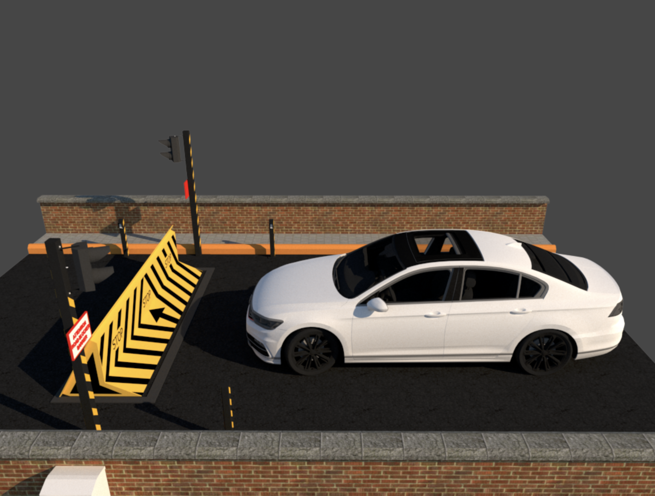
The access control sequence operates as follows. The vehicle approaches the barrier position. Vehicle detection sensors activate and trigger the security check process. Authorization is verified through the specified access control method — remote control, keypad, card reader, guard console, or integrated access control system. If authorized, the open command is issued, the motor and reducer activate, and the barrier lowers to the flush ground position for vehicle passage. After the vehicle has passed, the close button is pressed — sensors confirm no vehicle is present over the barrier — and the barrier rises to the blocking position, closing the road to further passage.
The motorized road blocker is crash-tested against high-speed vehicle impacts and rigorously tested to ensure safety — providing independently verified stopping performance against the vehicle attack scenarios relevant to the high-security facilities where the system is deployed.
KEY FEATURES
Crash-Tested — High-Speed Impact Resistance
The Madoors USA Motorized Road Blocker is crash-tested against high-speed vehicle impacts — providing independently verified physical stopping performance against the most credible vehicle attack scenarios at military, government, and critical infrastructure access points. Crash-tested certification confirms that the barrier withstands the specified vehicle mass and speed impact without structural failure or significant penetration — providing security engineers and facility managers with confidence in the barrier's actual performance under attack conditions.
Electric Motor & Reducer Unit — Reliable Vertical Drive
The electric motor and reducer unit provides precise, reliable vertical actuation of the barrier plate — with the reducer providing the mechanical advantage required to raise the heavy-gauge metal barrier plate rapidly from the ground without overloading the motor. Motor and reducer unit selection is matched to the specific barrier plate weight and required cycle speed to ensure reliable operation across the full daily duty cycle of high-security access control applications.
Maximum 2-Second Cycle — Adjustable Speed Controller
The adjustable speed controller allows the barrier opening and closing speed to be set at any level up to the maximum 2-second cycle time — providing the fastest available motorized road blocker response for immediate threat and high-throughput access control while maintaining the ability to configure slower speeds for lower-traffic or lower-urgency applications where rapid cycling is not required. Two-second maximum cycle time minimizes vehicle queuing at high-throughput access points.
Durable Metal Plate Construction — Heavy-Duty Performance
The durable metal plate barrier provides the structural mass and impact resistance required for crash-tested performance — manufactured from heavy-duty materials in Madoors USA fabrication facilities with the structural specification determined by the crash test performance requirement of the specific installation. Ground-mounted vertical operation presents the full plate face perpendicular to the vehicle approach direction, maximizing the contact area and structural stopping efficiency at the moment of impact.
Loop-Type Metal Mass Detector — Reliable Vehicle Detection
Loop-type metal mass detectors provide reliable vehicle detection through passive magnetic sensing of the vehicle's metal body mass above the detector loop — operating continuously regardless of ambient lighting, weather conditions, and detection angle without requiring direct line-of-sight between sensor and vehicle. Loop detector reliability makes this the preferred primary vehicle detection method for automated access control at barrier systems where consistent detection of all vehicle types is required.
Photocell Safety Sensor — Personnel & Obstacle Safety
Photoelectric photocell sensors provide complementary infrared beam detection for personnel, obstacles, and objects in the barrier operation zone — detecting any presence in the beam path that could be injured or damaged by barrier movement. Photocell safety sensing prevents the barrier from lowering onto persons crossing the barrier zone and prevents the barrier from raising while a vehicle is positioned over the barrier plate, maintaining personnel and vehicle safety throughout every access control cycle.
Comprehensive Access Control Integration
The motorized road blocker interfaces with remote controls, keypads, card readers, biometric readers, guard operator consoles, and any other access control device providing a compatible output signal to the PLC control system. This comprehensive interface compatibility allows the road blocker to be integrated into any existing or new facility security management infrastructure — from simple push-button guard control at a manned access point through to fully automated access control with CCTV verification and building management system integration.
Surveillance Camera Integration
Integration with surveillance cameras provides visual verification of vehicle identity and occupant authorization at the access control point — supplementing the credential-based authorization with visual confirmation and maintaining a recorded audit trail of all access events for security incident investigation and access management compliance documentation.
Alarm System & Intercom Integration
Alarm system connectivity provides automatic alert notification for unauthorized vehicle approach and barrier forced-entry attempt events — triggering security response before an intrusion is completed. Intercom integration provides two-way audio communication between vehicle operators and security personnel at the barrier position — enabling verbal identity verification, authorization confirmation, and guard-to-driver communication without the guard leaving the protected security post.
High Security with Efficient Traffic Flow
The combination of 2-second maximum cycle time, sensor-automated vehicle detection, and flexible access control integration provides the highest level of physical vehicle security while maintaining efficient authorized vehicle throughput — minimizing vehicle queuing and wait times at busy access points and providing fast, smooth authorized vehicle passage without compromising the barrier's crash-rated stopping performance against unauthorized vehicle attacks.
Professional Installation Required
Motorized road blockers must be installed by trained professionals to ensure safe and effective operation — with correct foundation specification, sensor calibration, PLC programming, and access control integration all requiring specialist knowledge and equipment. Professional installation ensures that the crash-tested performance, sensor safety functions, and access control integration all operate correctly from the first day of service.
OPERATIONAL CYCLE SEQUENCE
Vehicle approach — the vehicle approaches the road blocker position along the access road. Sensor activation — loop detectors and photocells detect vehicle presence and activate the security check sequence. Security check — authorization is verified through the installed access control method — remote control, keypad, card reader, or guard console decision. Access granted — the open command is issued to the motor and reducer system. Barrier lowers — the motor and reducer activate and the barrier plate lowers to the flush ground position within the specified cycle time. Vehicle passes — the authorized vehicle drives over the flush barrier position and through the access point. Close command — the close button is pressed or the automated close sequence is initiated. Sensor clearance check — sensors confirm no vehicle or obstacle is present over the barrier plate. Barrier raises — the motor raises the barrier plate to the blocking position, closing the road to further vehicle passage. Access complete — the barrier is secured in the raised blocking position, ready for the next access cycle.
ASSEMBLY & INSTALLATION SEQUENCE
Site Assessment & Specification
The installation position, road width, underground service clearance, required crash performance, cycle speed, sensor configuration, and access control interface requirements are confirmed.
Foundation Excavation & Pit Construction
Foundation excavation is completed to the specified depth for the barrier mechanism housing. Drainage provisions are installed. Electrical conduit for power supply, control wiring, and loop detector cable is installed before foundation concrete is placed.
Barrier Mechanism & Housing Installation
The barrier plate mechanism and housing are installed in the prepared pit. Motor and reducer unit mounting, barrier plate travel geometry, and flush road level alignment are verified.
Electrical & PLC Connection
Motor power supply and PLC control system are connected. Loop detector cable loops are connected to the control system. All access control interface wiring is completed.
Sensor Calibration & Safety Testing
Loop detector sensitivity and vehicle detection response are calibrated. Photocell beam alignment and obstacle detection response are tested and verified. Barrier halt and hold on obstacle detection are confirmed.
Speed Controller Calibration & Cycle Testing
Opening and closing speed is set to the specified maximum 2-second cycle time or lower speed as required. Complete operational cycle testing across all access control inputs and sensor safety responses is conducted.
Integration Testing & Handover
Surveillance camera, alarm system, and intercom integration are tested and verified. Professional installation completion records and operational commissioning documentation are compiled into the project handover package.
DEPLOYMENT SCENARIOS & USE CASES
Madoors USA Motorized Road Blockers are specified for any high-security vehicle access control point requiring crash-tested motorized barrier performance with integrated sensor safety and access control system compatibility.
- Military base and installation main vehicle access control
- Airport perimeter and cargo facility vehicle access barriers
- Government building and ministry vehicle entrance barriers
- Embassy and diplomatic compound vehicle access control
- Critical national infrastructure perimeter vehicle barriers
- Prison and correctional facility vehicle entrance control
- Petrochemical plant and refinery vehicle access barriers
- Nuclear facility and power station vehicle entrance control
- Port and maritime terminal vehicle access road blockers
- Banking and financial institution vehicle access control
- Shopping center and public space vehicle security barriers
- Counter-terrorism facility vehicle entrance protection
- Court complex and justice facility vehicle access control
- Stadium and arena event vehicle access management
- Border crossing and customs vehicle access control
- Category: Road Blocker