Name:
Jersey Concrete Barrier
Part Number:
MDR-8-16
Please provide your technical specifications and project requirements for the Jersey Concrete Barrier. Our engineers will review your application and provide a detailed manufacturing quote, including exact pricing and lead times.
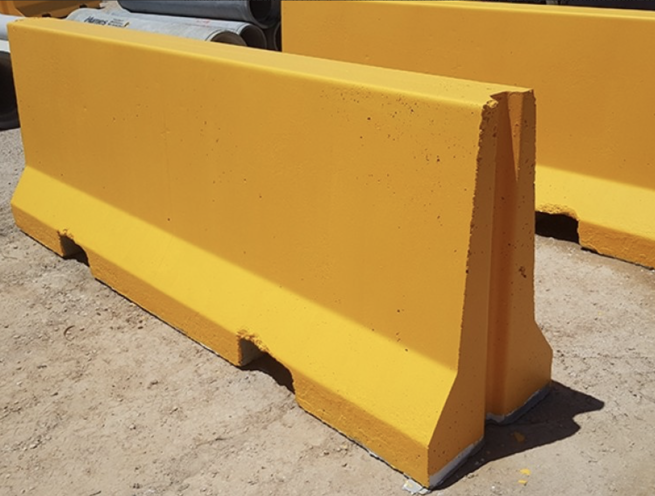
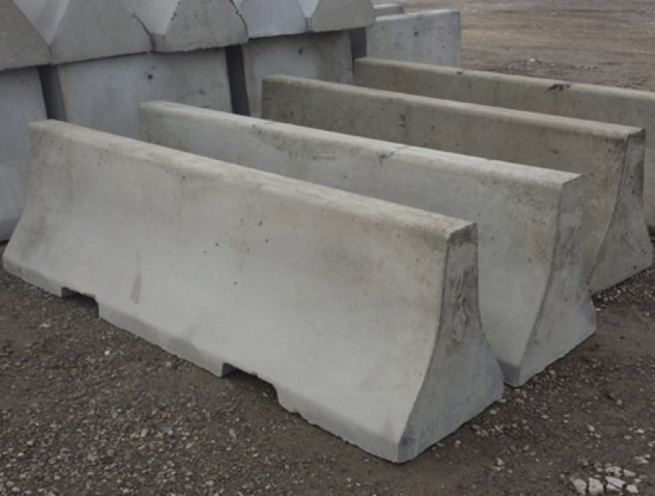
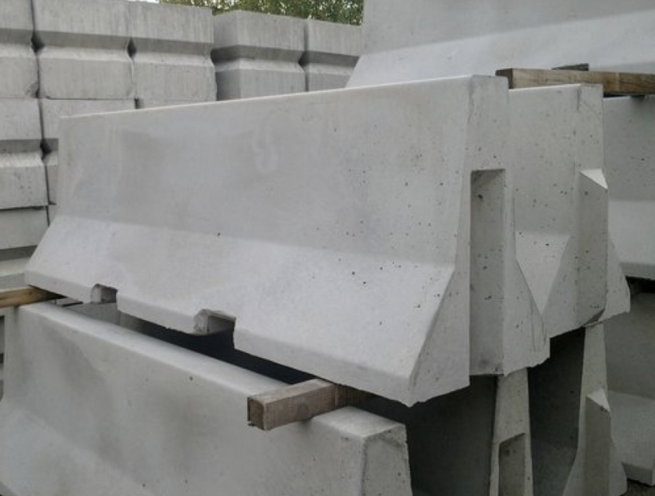
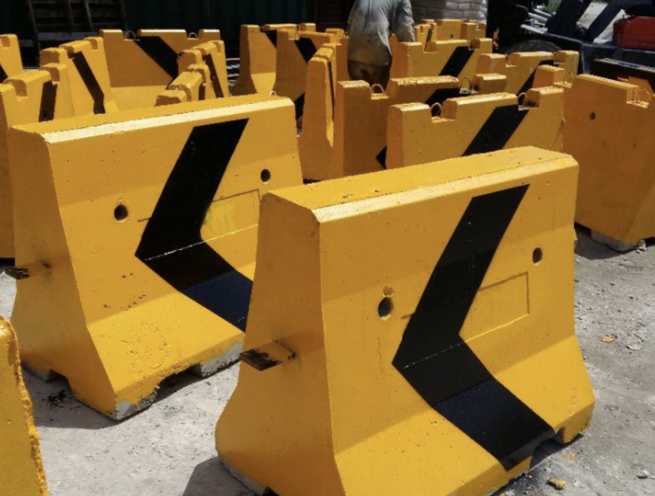
The Madoors USA Jersey Concrete Barrier is a precast concrete traffic and security barrier system used for road lane division, parking lot separation, construction zone worker protection, unauthorized entry prevention, military and security perimeter establishment, and vehicle speed reduction at guardhouse and checkpoint approaches. The distinctive Jersey profile — with a lower sloped face designed to deflect an impacting vehicle upward and redirect it rather than allowing it to overturn or cross into adjacent lanes — minimizes vehicle damage and prevents vehicle override in collision scenarios while providing a robust, low-maintenance physical barrier suitable for both temporary and permanent installation.
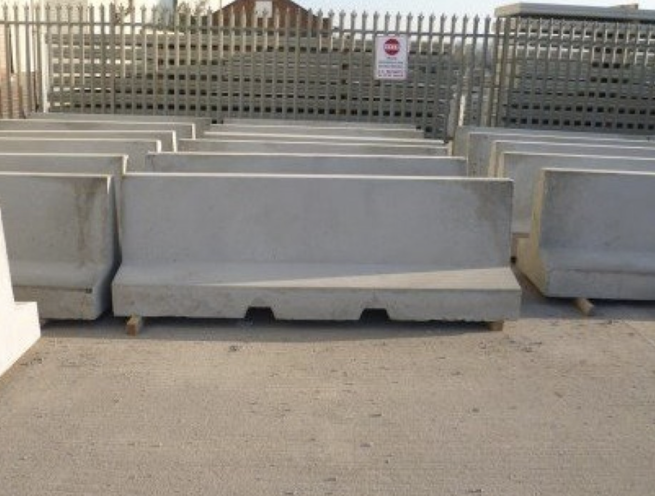
Standard dimensions are 60 cm high and 120 cm long, with forklift slots at the bottom for easy portability and repositioning during construction and traffic management operations. Custom dimensions are available for project-specific requirements. Available in a variety of colors and finishes, the Madoors USA Jersey barrier provides maximum durability and minimum maintenance across the full range of transportation, construction, military, and security applications.
TECHNICAL SPECIFICATIONS
The Madoors USA Jersey Concrete Barrier is manufactured as a precast concrete unit — cast in controlled factory conditions to ensure consistent concrete quality, dimensional accuracy, and surface finish across all units in a supply. Standard dimensions are 60 cm height and 120 cm length — covering the most common Jersey barrier application dimensions in road construction, parking management, and security perimeter establishment. Custom heights and lengths are available for project-specific requirements where standard dimensions do not match the application geometry.
The Jersey profile geometry features a lower sloped face at the traffic-facing side — with a gentle lower slope that deflects an impacting vehicle's tire and wheel upward on contact, transferring the vehicle's lateral kinetic energy into vertical lift rather than allowing it to continue laterally into the barrier. This upward deflection and redirection response minimizes vehicle damage at low-to-moderate impact speeds, prevents vehicle override of the barrier at the typical approach angles of accidental collision events, and redirects the vehicle back into its travel lane rather than across the barrier line.
Forklift slots at the bottom of each barrier unit allow standard forklift tines to engage the unit for lifting, transport, and repositioning without requiring specialist handling equipment or crane operations. This forklift portability is the primary operational advantage of the precast concrete Jersey barrier for construction zone and temporary traffic management applications where the barrier line must be repositioned frequently as construction progresses.
Color and finish options allow the barrier to be specified in any required color — including standard safety colors, corporate or institutional colors, and custom finishes for specific architectural or visibility requirements.
KEY FEATURES
Jersey Profile — Vehicle Deflection & Redirection
The defining geometric feature of the Jersey barrier is the lower sloped face profile — specifically engineered to deflect an impacting vehicle upward and redirect it back into its travel lane rather than allowing it to penetrate through or override the barrier. This deflection geometry minimizes vehicle damage at accidental collision speeds, prevents barrier override, and protects the area beyond the barrier from vehicle intrusion in road construction, parking, and security applications.
Road Lane Division & Traffic Separation
The primary transportation application of the Jersey barrier is road lane division — physically separating opposing traffic lanes on divided highways, controlling traffic lane geometry through construction zones, and creating temporary or permanent physical separation between traffic lanes of different speed or directional characteristics. The physical barrier prevents inadvertent lane crossing and provides a clear visual delineation of lane boundaries that painted lines alone cannot achieve.
Construction Zone Worker Protection
Jersey barriers deployed at construction zone boundaries provide the primary physical protection layer between construction workers and passing traffic — absorbing and deflecting vehicle impacts that would otherwise reach personnel working in the construction zone. The barrier profile redirects impacting vehicles back toward the traffic lane rather than into the construction zone, protecting workers from the secondary vehicle path after initial impact.
Unauthorized Entry Prevention
Jersey barriers placed at diagonal or perpendicular angles to road approaches at irregular intervals create a vehicle slalom course that prevents high-speed unauthorized vehicle approach while allowing authorized vehicle passage at controlled low speeds. This slalom configuration is the standard vehicle speed reduction and unauthorized entry prevention layout at military guardhouse entrances, government facility checkpoints, and security perimeter vehicle access points.
Vehicle Speed Reduction at Guardhouse Approaches
Staggered Jersey barrier placement at guardhouse and checkpoint approaches forces approaching vehicles to reduce speed significantly to navigate the slalom layout — providing the vehicle speed reduction required for safe access control operations at manned security checkpoints where guard personnel must approach vehicles for inspection at close range. Speed reduction through barrier slalom is more reliable than speed bump systems for larger vehicles and provides a longer deceleration zone than discrete speed bumps.
Military & Security Perimeter Establishment
Jersey barriers are widely adopted for military and security perimeter establishment — providing a rapidly deployable, relocatable, physical vehicle exclusion barrier that denies vehicle access across the perimeter line. Multiple units placed end-to-end create a continuous barrier line, while individual or grouped units placed at strategic positions create vehicle routing controls and access points. Perimeter establishment from precast Jersey barriers requires only forklift or crane placement — no foundation works, no concrete curing time, and no civil engineering.
Blast Protection — Perimeter Stand-Off
In military and security applications, Jersey barriers provide blast stand-off protection — placing a physical mass barrier between approaching vehicles and the protected building or facility at the distance required to reduce the blast overpressure from a vehicle-borne IED to acceptable levels at the facility facade. The concrete mass of each Jersey barrier absorbs and attenuates blast energy, with multiple barriers in series providing progressive blast attenuation.
Forklift Slots — Easy Portability & Repositioning
The forklift slots cast into the bottom of each barrier unit allow standard forklift tines to engage without additional rigging — enabling rapid, single-machine repositioning of the barrier line as construction progresses, traffic management requirements change, or security perimeter geometry is adjusted. Forklift portability without crane requirement allows barrier repositioning to be completed quickly by the forklift operator without specialist rigging personnel.
Maximum Durability — Minimum Maintenance
Precast concrete construction provides the maximum durability available for an outdoor exposed barrier — requiring no surface treatment maintenance, no corrosion protection, and no mechanical component servicing throughout the service life of the unit. Minimum maintenance means that large-scale Jersey barrier deployments at military bases, highway construction projects, and security perimeters can be maintained at operational effectiveness without dedicated maintenance programs.
Custom Dimensions — Project-Specific Configurations
Custom heights and lengths are available for any project-specific requirement that the standard 60 cm × 120 cm dimensions do not satisfy — covering taller barriers for enhanced vehicle stopping capability, shorter barriers for pedestrian channel guidance, and non-standard lengths for specific geometric fitting requirements at installation locations where standard unit lengths do not divide evenly into the required barrier line dimensions.
Color & Finish Options
A variety of colors and finishes allows the Jersey barrier to be specified in high-visibility colors for construction zone applications, standard grey for transportation infrastructure, institutional colors for government and military facilities, or custom finishes for commercial and architectural applications where the barrier must complement the surrounding design environment.
DEPLOYMENT CONFIGURATIONS
Straight Perimeter Line
End-to-end placement of Jersey barriers in a continuous straight line — the standard configuration for road median barriers, construction zone boundaries, parking lot boundaries, and military perimeter barrier lines. Provides continuous physical vehicle exclusion across the full line length.
Slalom Vehicle Speed Control
Diagonal or perpendicular placement at staggered intervals across the road approach — the standard configuration for military guardhouse approaches and security checkpoint speed control. Forces approaching vehicles to reduce speed for slalom navigation while maintaining authorized vehicle passage capability.
Checkpoint Access Control
Jersey barriers arranged to create a defined vehicle entry channel — with barriers on both sides directing vehicles through the checkpoint position and preventing vehicles from bypassing the manned inspection point. Access channel width is set to allow one vehicle at a time to proceed to the checkpoint position.
Blast Stand-Off Line
Multiple barriers placed in series at the required stand-off distance from the protected building — providing progressive blast energy attenuation from a vehicle-borne IED detonating at or beyond the barrier line. Barrier line depth and density are determined by the blast engineering calculation for the specific explosive mass and stand-off distance.
ASSEMBLY & DEPLOYMENT SEQUENCE
Barrier Line Layout Planning
The barrier deployment geometry — straight line, slalom, access channel, or blast stand-off configuration — is determined from the road layout, security requirement, and vehicle approach analysis. Unit count, placement intervals, and orientation angles are confirmed.
Forklift Transport & Placement
Barrier units are transported to the deployment location and placed in the confirmed configuration using standard forklift equipment through the forklift slots. No specialist lifting equipment is required. Unit alignment, spacing, and angular orientation are verified at each position.
End-to-End Connection (Perimeter Line Configuration)
For continuous perimeter line configurations, adjacent units are positioned end-to-end with minimal gap — creating a continuous barrier line without significant gaps between units that vehicles could exploit. Barrier line continuity is inspected across all unit-to-unit joints.
Repositioning as Required
When barrier line repositioning is required — as construction progresses, traffic management layouts change, or security perimeter geometry is adjusted — individual units are engaged with forklift tines and repositioned to the new specified configuration. No foundation breaking or anchor removal is required.
DEPLOYMENT SCENARIOS & USE CASES
Madoors USA Jersey Concrete Barriers are deployed across the full range of transportation, construction, security, and military applications requiring portable, durable, low-maintenance concrete barriers.