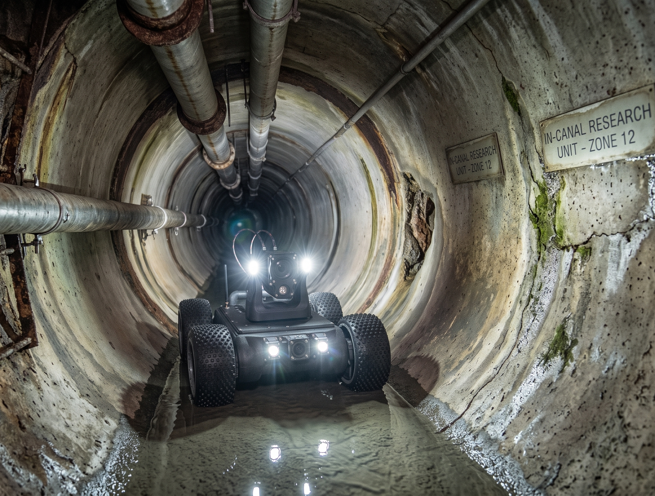
Please provide your technical specifications and project requirements for the In-canal Research Robots. Our engineers will review your application and provide a detailed manufacturing quote, including exact pricing and lead times.
In-canal Research Robots
The Madoors USA CR-70 In-Canal Research Robot is a fully steerable industrial pipe camera robot inspection system with a pan-tilt camera head providing constantly upright picture, endless rotation, and a panning range of -20° to +110° — inspecting pipes and areas from 100 to 300mm diameter with 100 to 200 meters of continuous cable enabling access where push rod camera systems cannot reach. With integrated laser for crack width measurement and defect dimension determination, 800×600 pixel daylight-viewable touch screen display with virtual keyboard, predefined inspection standard protocols, video recording and photo capture, and a lightweight compact portable design for plant and wind turbine inspections, the Madoors USA CR-70 delivers comprehensive pipe and canal inspection from every viewing angle and position for industrial pipe inspection, drainage inspection, wind turbine inspection, and any confined access inspection application requiring a fully steerable robotic camera at distances up to 200 meters.
TECHNICAL SPECIFICATIONS
The Madoors USA CR-70 camera head provides pan-tilt motion with constantly upright picture maintenance — the camera electronics continuously correct the image orientation as the robot navigates bends, inclines, and rotational pipe positions, ensuring that the operator always sees a correctly oriented image regardless of the robot's physical orientation within the pipe. The endless rotation capability allows the camera to rotate continuously in both directions without cable twist limitation — providing complete 360-degree circumferential pipe wall inspection at any position along the pipe run.
The panning range of -20° to +110° from the horizontal provides downward looking capability at -20° for inspection of the pipe invert and debris accumulation, and upward looking capability to +110° for inspection of the pipe crown and overhead surfaces. This comprehensive angular range allows every surface of the pipe interior to be examined without repositioning the robot — the camera head reaches any inspection angle from the centered robot position.
The inspection range covers pipes from 100mm to 300mm diameter — the robot dimensions and wheel configuration are appropriate for this size range, providing the clearance for robot passage and the camera field of view for complete circumferential inspection within these diameter limits.
The cable reel provides 100 to 200 meters of continuous cable — enabling the CR-70 to reach inspection points at distances that exceed the practical limit of push rod camera systems, which typically cannot maintain steering control beyond 30 to 50 meters. The continuous cable maintains both power supply and video signal transmission throughout the full 200-meter inspection range.
The fully steerable robot allows the operator to maintain centered positioning within the pipe and navigate 90-degree bends — the steering capability directly prevents the robot from contacting the pipe wall during navigation and allows passage through the direction changes that are present in all real-world pipe installations.
The integrated laser measurement system projects a laser reference onto the pipe wall surface — the known laser geometry allows the camera image processing to calculate the actual dimensions of cracks, joints, and defects from the image, providing quantitative measurement data alongside the visual inspection image. This dimensional measurement capability directly improves the quality of defect reporting and damage severity assessment.
The control panel is multi-functional and portable — the 800×600 pixel touch screen display is daylight-viewable for outdoor inspection operations, the virtual keyboard provides text input for inspection record annotation, and the intuitively operable control elements allow the operator to manage robot steering, camera pan/tilt, laser, recording, and inspection protocol functions from a single compact portable unit.
KEY FEATURES
Constantly Upright Picture — Any Robot Orientation
The constantly upright picture maintenance throughout all robot orientations is the critical image quality feature for pipe inspection navigation — when the robot rolls on a curved pipe surface or tilts on an inclined section, the image automatically corrects to maintain the correct up/down orientation for the operator. Without this correction, the operator must interpret a rolling or inverted image while simultaneously navigating the robot, which creates both navigation difficulty and inspection quality reduction. The constant upright picture directly maintains full operator situational awareness and inspection quality throughout all robot orientations.
Endless Rotation — Complete 360° Circumferential Inspection
The endless rotation capability without cable twist limitation provides complete 360-degree circumferential pipe wall inspection from any robot position — the camera rotates continuously past all pipe wall positions at each inspection location without requiring robot repositioning or dealing with rotation limits. This endless rotation directly ensures that no pipe wall area is missed at any inspection point throughout the inspection run.
-20° to +110° Pan Range — Every Pipe Surface Covered
The pan range from -20° downward to +110° upward covers the complete pipe interior surface from invert to crown and beyond — providing the comprehensive inspection coverage of every pipe wall surface from a single centered robot position. This complete angular coverage directly eliminates the inspection blind spots that limited pan range cameras create at the pipe crown and invert positions.
100 to 200-Meter Cable — Beyond Push Rod Range
The 100 to 200-meter cable range provides inspection access to pipe sections at distances that completely exceed the practical range of push rod camera systems — the CR-70 reaches the mid-section of long straight pipe runs, the far end of drainage systems accessible from a single manhole entry, and the internal components of wind turbines at depths that push rods cannot reach with maintained steering control. This extended range directly enables inspection of the previously uninspectable pipe sections that have the highest risk of undetected defect accumulation.
Fully Steerable — 90-Degree Bend Navigation
The full steerability that maintains centered positioning in the pipe and navigates 90-degree bends directly enables inspection of complete pipe systems from a single entry point — the steerable robot follows the pipe routing through all direction changes without the operator needing to reposition the robot from additional access points. This bend navigation capability is the essential operational feature for inspecting real-world pipe systems where 90-degree junctions and direction changes are standard construction features.
Integrated Laser — Crack Width & Defect Measurement
The integrated laser crack width measurement system provides quantitative defect dimension data alongside the visual inspection image — the laser reference allows the control panel software to calculate actual crack widths, joint displacements, and defect dimensions from the camera image geometry. This measurement data directly upgrades the inspection report from a qualitative visual description to a quantitative engineering assessment with measured defect dimensions for structural condition evaluation and repair specification.
Predefined Inspection Standards — Standardized Protocol Compliance
The predefined inspection standard protocols loaded in the control panel allow inspection operators to conduct standardized coded inspections in compliance with national and international pipe inspection standards — each defect is coded according to the applicable standard during the inspection, providing the coded defect database required for infrastructure condition assessment and maintenance prioritization. This standardized protocol compliance directly supports the regulatory and asset management reporting requirements of utility and infrastructure operators.
800×600 Pixel Daylight-Viewable Touch Screen — Field Usability
The 800×600 pixel touch screen display that is daylight viewable provides the image quality and outdoor usability required for field inspection operations — the daylight-viewable specification ensures that the inspection image and control panel display are clearly visible in direct sunlight at outdoor manhole and access point positions without the operator shielding the screen. The touch screen virtual keyboard allows text annotation of the inspection record without requiring external keyboard hardware.
Lightweight Compact Design — Plant & Wind Turbine Portability
The lightweight compact design specifically identified as appropriate for plant inspections and wind turbine internal inspections directly addresses the portability requirement of these two specific applications — plant inspection requires the system to be carried through the facility to multiple inspection access points, and wind turbine inspection requires the system to be transported up the turbine tower to the hub and blade root inspection positions. The lightweight compact design directly enables these portable applications without the handling difficulty of heavier camera robot systems.
INSPECTION APPLICATIONS
Sewer and Drainage Inspection
Municipal sewer pipe condition assessment, defect coding to national standards, crack and joint measurement, root intrusion documentation.
Industrial Process Pipe Inspection
Process plant pipe internal condition, corrosion and scale assessment, weld and joint inspection, contamination documentation.
Water Supply Pipe Inspection
Water main internal condition assessment, joint and lining inspection, tuberculation and biofilm documentation.
Wind Turbine Internal Inspection
Blade root and hub internal structural inspection, crack and defect measurement, corrosion assessment at inaccessible internal positions.
Building Services Pipe Inspection
HVAC ductwork, building drain, and service pipe inspection at distances and bends inaccessible to push rod cameras.
ASSEMBLY & OPERATIONAL SEQUENCE
Equipment Setup at Access Point
CR-70 robot, cable reel, and control panel are positioned at the pipe access point — manhole, cleanout, or inspection opening. Cable is connected between the cable reel and the robot.
Control Panel Initialization
The touch screen control panel is powered on. Inspection standard protocol is selected from the predefined options. Inspection record header — location, date, pipe details — is entered via the virtual keyboard.
Robot Introduction & Camera Verification
The CR-70 robot is introduced into the pipe at the access point. Camera upright picture, pan-tilt function, and endless rotation are confirmed on the touch screen display.
Laser Calibration
The integrated laser measurement system is activated and calibrated for the pipe diameter at the inspection start position.
Inspection Navigation
The operator steers the robot through the pipe run — maintaining centered positioning, navigating bends, panning the camera to inspect all pipe wall surfaces, and rotating for circumferential inspection at defect positions. Video recording and photo capture are activated for all defects and notable features.
Laser Measurement at Defects
At each identified defect, the laser measurement system is used to measure crack widths and defect dimensions — the measured values are recorded in the inspection database.
Record Completion & Data Export
The complete inspection video, photos, defect database, and laser measurements are saved to the control panel memory. Data is exported to the PC for inspection report generation and asset management system upload.
DEPLOYMENT SCENARIOS & USE CASES
Madoors USA CR-70 In-Canal Research Robots are deployed across the full range of pipe and confined space inspection applications.
- Municipal sewer and drainage pipe inspection
- Water supply main internal condition inspection
- Industrial process and chemical plant pipe inspection
- Power station cooling water pipe inspection
- Oil and gas pipeline internal condition inspection
- Wind turbine blade root and hub internal inspection
- Building drainage and service pipe inspection
- Airport and transport hub drainage pipe inspection
- Military and government facility pipe infrastructure inspection
- Hydroelectric dam drainage and inspection gallery robots
- Mining facility pipe and tunnel inspection
- Pharmaceutical and food facility pipe inspection
- Municipal stormwater drainage inspection systems
- Any pipe or confined space from 100 to 300mm diameter requiring 200-meter range fully steerable robotic camera inspection with laser measurement
- Category: Bomb Disposal Robotics