
Please provide your technical specifications and project requirements for the Hydraulic Rising Bollard. Our engineers will review your application and provide a detailed manufacturing quote, including exact pricing and lead times.
Hydraulic Rising Bollard
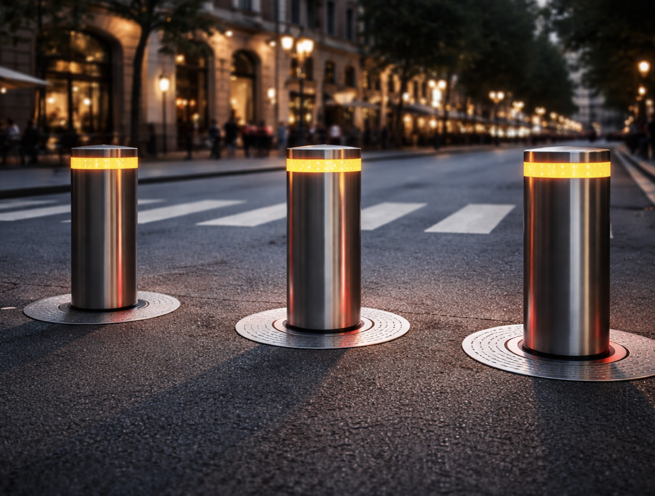
The Madoors USA Hydraulic Rising Bollard is an electro-hydraulically powered, automatically retractable high-security bollard system engineered for high-security vehicle access control at army installations, government buildings, industrial facilities, and commercial premises — available in single units and multiple-unit configurations with a common hydraulic drive unit, in standard blocking heights of 500mm and 850mm above surface level, and designed to K12 hostile vehicle mitigation standards. With a standard raise and lower time of 3 seconds — reducible to 1.5 seconds for high-speed security response requirements — and PLC/microprocessor control compatible with card readers, biometric readers, radio controls, key switches, loop detectors, photocells, and flashing light safety accessories, the Madoors USA hydraulic rising bollard provides exceptional flexibility in both appearance and security functionality.
Available in a standard diameter of 275mm with aesthetically designed shapes and colors for pedestrian zone, fuel pump forecourt, hotel, event center, golf club, exhibition center, and town center applications — alongside high-security configurations for army, government, and critical infrastructure perimeter access control — the Madoors USA bollard range serves the complete spectrum from decorative urban access management through to K12 crash-rated hostile vehicle mitigation.
TECHNICAL SPECIFICATIONS
Madoors USA Hydraulic Rising Bollards are available in the following standard configurations. Diameter: 275mm standard, with alternative diameters available on request. Blocking height above surface: 500mm for commercial applications and 850mm for high-security applications. Raise and lower time: standard 3 seconds, reducible to 1.5 seconds for high-response security installations. K12 hostile vehicle mitigation standard design — finite element analysis available on request.
Both high-security and commercial bollard types share the same structural construction — bollard wall thickness, underground construction depth, self-lubricating sealing and guide ring (manufactured from special plastic types), hydraulic piston specification, flange thicknesses and diameters, hydraulic connections, and installation and drainage procedures are all identical between the high-security and commercial variants. The only difference is blocking height — commercial bollards at 500mm versus high-security bollards at 850mm.
The hydraulic drive unit is housed in an installation cabinet positioned close to the bollard or bollard group. The drive unit powers all bollards in the group from a single hydraulic supply, with the central control panel managing the raise, lower, and group operation functions for all units simultaneously. In the event of mains power failure, bollards can be lowered manually — maintaining safe and accessible operation at the protected access point regardless of electrical supply status.
The bollard body is designed with self-lubricating sealing and guide ring components manufactured from special plastic materials — providing long-term, low-friction guide performance in the underground installation sleeve without requiring periodic lubrication maintenance of the moving components. Drainage provisions are incorporated in the underground installation to manage groundwater and surface water ingress at the bollard sleeve position.
KEY FEATURES
K12 Hostile Vehicle Mitigation Standard
Both high-security and commercial Madoors USA hydraulic rising bollards are designed to K12 hostile vehicle mitigation standards — providing the highest available vehicle impact resistance certification level for rising bollard systems. K12 certification confirms the bollard's ability to stop a 6,800 kg vehicle traveling at 80 km/h, satisfying the procurement requirements of the most demanding government, military, and critical infrastructure vehicle access control specifications. Finite element analysis documentation is available on request for engineering compliance and procurement purposes.
500mm & 850mm Blocking Heights
Two standard blocking heights serve different application requirements. The 500mm commercial height provides effective vehicle access management for pedestrian zones, fuel pump forecourts, hotel and event center entrances, and commercial building vehicle control points. The 850mm high-security height provides the blocking height required to defeat vehicle underbody clearance and prevent vehicle passage at army, government, and critical infrastructure perimeter access points where maximum vehicle stopping reliability is the governing design requirement. Both heights are available in the same 275mm diameter body with identical underground construction.
Same Structural Specification — High Security & Commercial
The identical structural specification shared between the high-security and commercial bollard variants means that commercial bollards provide the same underground construction integrity, hydraulic piston performance, and mechanical durability as the high-security bollards — with the only difference being the above-ground blocking height. This consistency simplifies mixed-specification installations where different blocking heights are required at different positions within the same facility perimeter.
3-Second Standard Raise/Lower — 1.5-Second Option
The standard 3-second raise and lower cycle time provides fast, responsive bollard operation for normal high-traffic access control applications. The 1.5-second raise option is available for high-security installations where maximum response speed to unauthorized vehicle approach is a critical operational requirement — such as military base vehicle control points, government building entrances, and counter-terrorism access control positions.
Single & Group Configurations — Common Drive Unit
Bollards are available as single units for individual vehicle lane control or in groups of multiple units for wider road blocking applications. Multiple bollards in a group share a single hydraulic drive unit housed in the installation cabinet, reducing the total equipment count and installation cost for multi-bollard installations while providing synchronized group operation from a single control panel — allowing the full road width to be blocked and unblocked simultaneously from a single operator action.
Central Control Panel — All Units Managed Together
The central control panel manages all bollards in the installation from a single operator interface — allowing road sections, compound access zones, or full perimeter lines of bollards to be raised and lowered as a coordinated group rather than requiring individual unit control. Central panel management supports both manual operator-controlled access and fully automated access control system integration.
PLC/Microprocessor Control — Universal Access Control Integration
The PLC/microprocessor control electronics integrate with the full range of access control interfaces — card readers, RFID systems, biometric readers (fingerprint and hand shape), radio controls, on/off switches, and key switches. This universal integration capability allows the hydraulic rising bollard to be incorporated into any existing or new access control infrastructure without compatibility constraints, from simple key switch control at residential applications through to biometric multi-factor authentication at government and military access points.
Safety Accessories — Loop Detectors, Photocells & Lights
Loop detectors, photocell safety sensors, flashing lights, and red/green traffic signal lights all integrate directly into the bollard control electronics — providing vehicle detection for automated bollard control, obstruction detection for safety during bollard rise, and visual warning signals for approaching vehicle operators. Safety accessory integration is straightforward through the PLC control system without requiring separate control interfaces or additional wiring infrastructure.
Manual Lowering — Power Failure Operation
In the event of mains power failure, bollards can be lowered manually without electrical supply — maintaining access at the protected location and preventing bollards from remaining in the raised position as an unintended obstruction to authorized emergency vehicle access. Manual lowering capability is a standard safety feature of all Madoors USA hydraulic rising bollard installations.
Self-Lubricating Sealing & Guide Ring
The underground guide system uses self-lubricating sealing and guide rings manufactured from special plastic materials, providing long-term smooth bollard travel without requiring periodic lubrication maintenance of the underground sliding components. Self-lubricating guide performance eliminates the maintenance access requirement for underground components that would otherwise require drainage, disassembly, and re-lubrication at regular service intervals.
Aesthetic Design — Multiple Shapes & Colors
The bollard body is available in multiple shapes and colors — providing the aesthetic flexibility required for pedestrian zone, town center, and commercial building applications where the bollard must complement the surrounding urban design rather than presenting an institutional security appearance. Decorative bollard options maintain full K12 structural performance within aesthetically refined body profiles suited to premium architectural environments.
Integrated Drainage — All-Weather Reliability
Drainage provisions incorporated in the underground installation manage groundwater and surface water ingress at the bollard sleeve position, preventing water accumulation that could impair bollard travel, damage hydraulic components, or cause bollard freezing in cold climate installations. Drainage integration is part of the standard installation design for all Madoors USA hydraulic rising bollard systems.
ASSEMBLY & INSTALLATION SEQUENCE
Site Survey & Configuration Planning
Installation positions for all bollard units, the hydraulic drive unit cabinet, electrical supply routing, and control panel position are confirmed. Road width, vehicle lane count, and required blocking height — 500mm commercial or 850mm high-security — are determined. Group configuration and central control panel requirements are confirmed. Access control interface devices are specified.
Excavation — Bollard Sleeves & Drive Unit Cabinet
Excavation is completed at each bollard position to the specified sleeve depth and diameter, and at the hydraulic drive unit cabinet position. Drainage channels and drainage outlets are constructed at each bollard sleeve position during excavation works. Hydraulic supply line conduits and electrical wiring conduits are installed between the bollard sleeve positions and the drive unit cabinet before backfill.
Bollard Sleeve & Flange Installation
The bollard sleeve and flange assembly is installed in the excavated pit at each bollard position and set to the correct depth for flush surface alignment of the bollard top in the raised and lowered positions. Sleeve level, alignment, and drainage outlet connection are verified before concrete surround is placed.
Hydraulic Drive Unit Cabinet Installation
The hydraulic drive unit cabinet is installed at the specified position close to the bollard group. Hydraulic supply and return lines are connected from the cabinet to each bollard sleeve through the pre-installed conduits. The hydraulic system is filled, bled, and pressure-tested.
Bollard Body Installation
The bollard bodies are installed into the sleeves. Hydraulic piston connection, guide ring engagement, and bollard travel through the full raise and lower range are verified for smooth, friction-free movement at each bollard position.
Electrical & Access Control Connection
Mains electrical supply is connected to the drive unit cabinet. Access control interface devices — card readers, biometric readers, radio controls, key switches — are installed and wired to the PLC control system. Loop detectors are installed in the road surface and connected to the control electronics.
Safety Accessory Installation
Photocell safety sensors, flashing lights, and red/green traffic signal lights are installed at the specified positions and connected to the PLC control electronics. Safety sensor detection response — bollard halt on obstruction detection during rise — is tested and calibrated.
Control System Programming & Group Configuration
The PLC control system is programmed for the specified control logic — automatic, semi-automatic, or access-controlled. Group synchronization for simultaneous raise and lower of all bollards in the group is configured and tested. All access control interfaces are tested across the full range of credential and command types specified for the installation.
Raise/Lower Speed Calibration & Final Testing
Raise and lower cycle time is adjusted to the specified 3-second standard or 1.5-second high-response setting via hydraulic flow control. Full operational testing across all control modes, safety sensor responses, manual lowering, and power failure operation is completed. K12 finite element analysis documentation is compiled for the project record where requested.
DEPLOYMENT SCENARIOS & USE CASES
Madoors USA Hydraulic Rising Bollards are specified for any vehicle access control point requiring retractable, flush-profile, hydraulically powered bollard systems across commercial, institutional, and high-security applications.
- Government building and ministry vehicle entrance bollards
- Military base and army installation access control bollards
- Embassy and diplomatic compound vehicle access bollards
- Critical national infrastructure perimeter bollard systems
- Airport perimeter road and terminal entrance bollards
- Hotel and event center vehicle access management bollards
- Town center and pedestrian zone vehicle exclusion bollards
- Fuel pump forecourt vehicle access control bollards
- Golf club and exhibition center vehicle access bollards
- Shopping center and retail park vehicle access bollards
- University and educational campus vehicle control bollards
- Hospital and healthcare facility vehicle access bollards
- Stadium and arena event vehicle access control bollards
- Industrial facility and factory perimeter access bollards
- Port and maritime terminal vehicle access bollards
- Category: Automatic Rising Bollard