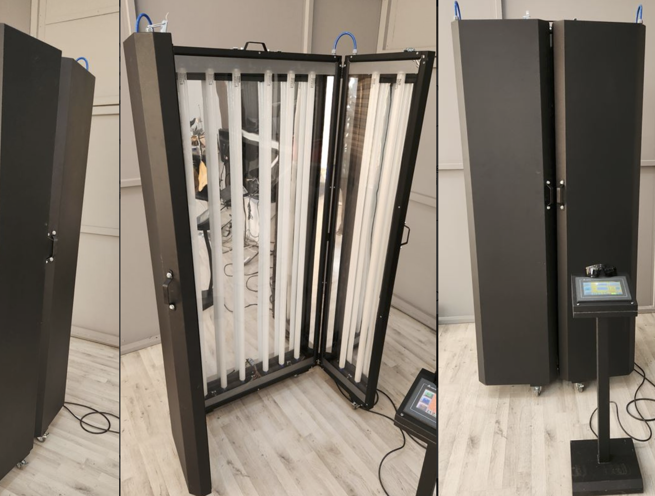
Full Body Portable UVA PUVA Phototherapy Unit
The Madoors USA MT-2019 Series Full Body Portable UVA/PUVA Phototherapy Unit is a mobile UV treatment cabin equipped with ten 100-watt UV tubes in narrowband UVB 311nm or UVA configuration — providing full body phototherapy treatment for psoriasis, pruritus, acne vulgaris, vitiligo, atopic dermatitis, and vitamin D deficiency. A polished high-purity aluminum reflector maximizes UV distribution to the patient, transparent acrylic plates protect the tubes, gentle electronic starters extend tube longevity, a key switch prevents unauthorized activation, a modern control panel allows individual patient dose limit pre-setting to prevent accidental overdosing, and lockable rubber castors provide the mobility required for daily clinical use and easy transportation between treatment rooms.
The programmable sectional treatment system guides the patient through 1, 2, 3, or all 4 body sides — instructing the patient to rotate at each stage when the correct dosage has been achieved for each body section — with tubes positioned close to the ground to ensure effective treatment of the lower legs.
TECHNICAL SPECIFICATIONS
The MT-2019 Series cabin houses ten UV tubes at 100 watts each — total installed UV power of 1,000 watts — in either narrowband UVB at 311nm or UVA wavelength configuration. Narrowband UVB at 311nm is the clinically preferred wavelength for phototherapy treatment of psoriasis, vitiligo, and atopic dermatitis — providing the therapeutic UV waveband with minimal erythema-producing radiation outside the 311nm therapeutic window. UVA configuration is used for PUVA treatment — psoralen and UVA — and for conditions responding to UVA wavelengths.
The polished high-purity aluminum reflector is mounted behind the UV tubes and shaped to direct the UV radiation toward the patient standing in the cabin — increasing the effective UV irradiance at the patient's skin surface compared to an unrefected tube arrangement. Maximized reflector efficiency directly reduces the required exposure time for a given treatment dose, improving patient throughput and treatment efficiency.
Transparent acrylic plates cover all ten UV tubes — protecting the tubes from patient contact and accidental breakage during patient rotation and movement within the cabin while maintaining full UV transmission to the patient. The acrylic plates also protect the tubes from skin care products and perspiration that would contaminate and degrade unprotected tube surfaces.
Gentle electronic starters eliminate the high-voltage starting spike of conventional magnetic ballast starters — reducing the thermal and electrical stress on the tube cathodes at each start cycle and directly extending the operational service life of the UV tubes. Extended tube life reduces the consumable replacement cost of the phototherapy unit across its clinical service life.
The key switch activation prevents the cabin from being switched on without the authorized key — preventing unauthorized patient self-treatment, child access, and accidental activation that could result in uncontrolled UV exposure.
KEY FEATURES
Narrowband UVB 311nm or UVA — Clinically Therapeutic Wavelength
Narrowband UVB at 311nm is the specific wavelength clinically demonstrated to provide the maximum therapeutic benefit for the primary phototherapy indications — psoriasis, vitiligo, and atopic dermatitis — with minimal production of erythema and DNA damage from the non-therapeutic wavelengths present in broadband UVB sources. The 311nm wavelength selection is the international clinical standard for phototherapy unit specification. The UVA configuration provides the wavelength required for PUVA therapy and UVA-responsive conditions.
Polished High-Purity Aluminum Reflector — Maximum UV Distribution
The polished high-purity aluminum reflector provides the highest available UV reflectivity — directing reflected UV radiation from the rear surface of the tube array toward the patient to supplement the direct radiation from the tube faces. This reflector-augmented irradiance directly increases the UV dose rate delivered to the patient's skin surface per unit time — reducing the treatment exposure duration required for a given therapeutic dose and allowing the treatment protocol to be completed more efficiently.
Sectional Body Treatment — 4-Side Rotation Prompting
The programmable 4-side sectional treatment capability addresses the clinical requirement for uniform whole-body UV exposure — the patient is guided to rotate to face each side of the cabin in sequence, with the control panel prompting rotation when the correct dose for each body section has been accumulated. This systematic rotation ensures that all body surfaces — front, back, left side, and right side — receive the prescribed dose uniformly, eliminating the treatment failure from incomplete rotation or inconsistent side exposure times that unguided patient rotation would produce.
Ground-Level Tube Positioning — Lower Leg Coverage
The positioning of UV tubes close to the ground ensures that the lower legs receive effective UV treatment dose — the area of the body that is furthest from the central tube array height and that is most commonly under-treated by cabin systems where the lowest tube is positioned at mid-shin height or above. Ground-level tube positioning directly addresses one of the most common clinical complaints about UV cabin treatment — inadequate lower leg response due to insufficient UV dose at the ankle and lower shin areas.
Individual Dose Limit Pre-Setting — Overdose Prevention
The individual patient dose limit pre-setting on the modern control panel allows the treating clinician to program the maximum UV dose for each patient's treatment session based on their skin phototype, treatment history, and prescribed protocol — the cabin automatically terminates the treatment at the programmed dose limit regardless of the patient's own actions. This dose limit control directly prevents accidental overdosing that would cause erythema, blistering, and patient discomfort, and maintains the incremental dose escalation required by standard phototherapy protocols.
Key Switch Activation — Unauthorized Access Prevention
The key switch prevents the cabin from being activated without the treatment key — ensuring that only authorized clinical staff can initiate a treatment session. This authorization control prevents patients from self-initiating treatments outside prescribed protocols, prevents access by children and unauthorized persons, and maintains the clinical governance of the phototherapy treatment program.
Lockable Rubber Castors — Clinical Mobility
The lockable rubber castors allow the cabin to be moved freely between treatment positions within the clinical environment — rolled to the treatment area, locked in position for treatment, and then unlocked and moved to storage or cleaning positions. This mobility is the essential practical feature for phototherapy units in multi-purpose clinical spaces where the cabin must be moved for other clinical activities between treatment sessions.
UV Goggle Storage — Integrated Accessory Management
The insert pocket storage for UV goggles in the cabin lid maintains the patient eye protection within the cabin system — eliminating the risk of misplaced or forgotten goggles that would require treatment delay and providing organized, hygienically separated storage for each cabin's accessories. Integrated accessory storage directly improves clinical workflow efficiency and patient safety compliance.
TREATMENT INDICATIONS
Psoriasis — Narrowband UVB at 311nm is a first-line phototherapy treatment for moderate to severe plaque psoriasis. The whole-body sectional treatment capability of the MT-2019 addresses the widespread body surface area involvement characteristic of moderate to severe psoriasis. The programmed dose escalation protocol directly supports the standard phototherapy dosing approach for psoriasis management.
Vitiligo — Narrowband UVB at 311nm is the most effective single phototherapy modality for vitiligo repigmentation. The uniform whole-body coverage of the MT-2019 cabin treats generalized vitiligo affecting large body surface areas simultaneously — an advantage over targeted phototherapy devices limited to focal vitiligo lesions.
Atopic Dermatitis — Narrowband UVB is a recognized second-line treatment for moderate to severe atopic dermatitis unresponsive to topical therapy. Whole-body treatment addresses the widespread distribution of atopic dermatitis.
Pruritus — Phototherapy with UVB provides symptomatic relief of generalized pruritus from various causes including chronic kidney disease, polycythemia vera, and idiopathic pruritus.
Acne Vulgaris — UVA and UVB phototherapy provides adjunctive treatment benefit for acne vulgaris through bactericidal effects on Cutibacterium acnes and anti-inflammatory mechanisms.
Vitamin D Deficiency — UVB phototherapy stimulates cutaneous vitamin D synthesis — providing a therapeutic option for vitamin D deficiency in patients who cannot tolerate or absorb oral supplementation.
ASSEMBLY & INSTALLATION SEQUENCE
Unpacking & Castor Assembly
The MT-2019 cabin is unpacked and lockable rubber castors are confirmed attached and functional — locked for stationary use and unlocked for mobility.
UV Tube Installation & Acrylic Plate Fitting
All ten 100-watt UV tubes are confirmed correctly seated in the lamp holders. Transparent acrylic plates are confirmed correctly fitted over all tube positions. Electronic starters are confirmed connected.
Reflector Position Verification
The polished high-purity aluminum reflector is confirmed correctly positioned behind the tube array for maximum UV distribution toward the treatment area.
Control Panel Programming
Key switch operation is tested. Individual patient dose limit pre-setting and 1, 2, 3, and 4-side treatment programs are confirmed programmable and functional. Patient rotation prompt system is tested through a complete 4-side treatment cycle.
UV Output Verification
UV irradiance at the patient treatment position is measured with a calibrated UV meter — confirming the specified narrowband UVB 311nm or UVA output at the correct irradiance level for dose calculation accuracy.
Safety Systems Testing
Key switch unauthorized activation prevention is confirmed. Dose limit auto-termination at the programmed limit is tested. Tube protection acrylic plate integrity is confirmed.
Clinical Handover & Staff Training
Clinical staff training on patient dose programming, treatment side sequencing, rotation prompting, UV goggle distribution and storage, and emergency stop procedure is completed.
DEPLOYMENT SCENARIOS & USE CASES
Madoors USA MT-2019 Full Body Portable Phototherapy Units are specified for any clinical setting requiring whole-body narrowband UVB or UVA phototherapy.
- Dermatology clinic whole-body UVB phototherapy
- Hospital dermatology department phototherapy unit
- Private dermatology practice portable phototherapy
- Psoriasis treatment center whole-body UVB cabin
- Vitiligo treatment clinic narrowband UVB unit
- Atopic dermatitis phototherapy clinic unit
- Rheumatology clinic psoriatic arthritis skin treatment
- Physiotherapy and rehabilitation center UV cabin
- Mobile dermatology service portable phototherapy
- Medical spa and aesthetic clinic UV treatment cabin
- General practice phototherapy satellite service unit
- Community health center phototherapy provision
- Military medical facility dermatology treatment unit
- Hospital ward mobile phototherapy service provision
- Any clinical setting requiring portable whole-body UVB or UVA phototherapy treatment capability