Please provide your technical specifications and project requirements for the Fire Extinguishing Robots. Our engineers will review your application and provide a detailed manufacturing quote, including exact pricing and lead times.
Fire Extinguishing Robots
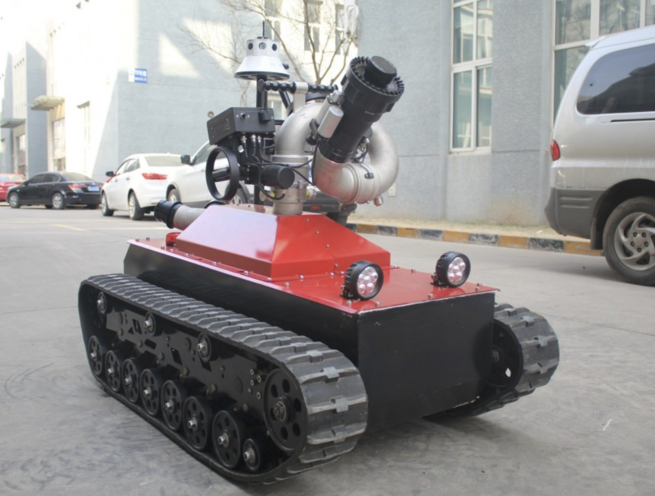
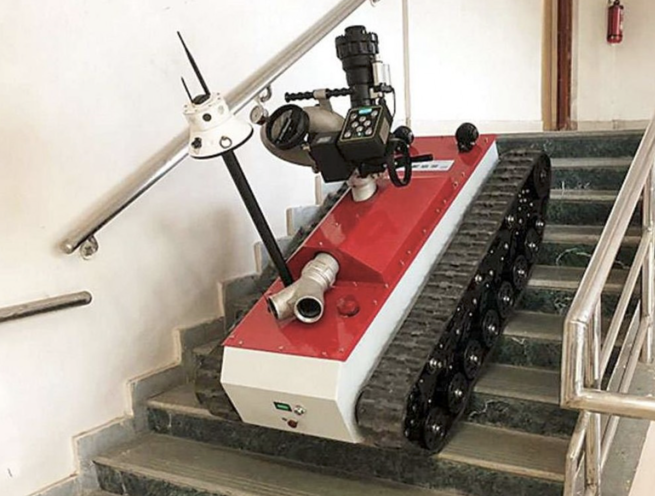
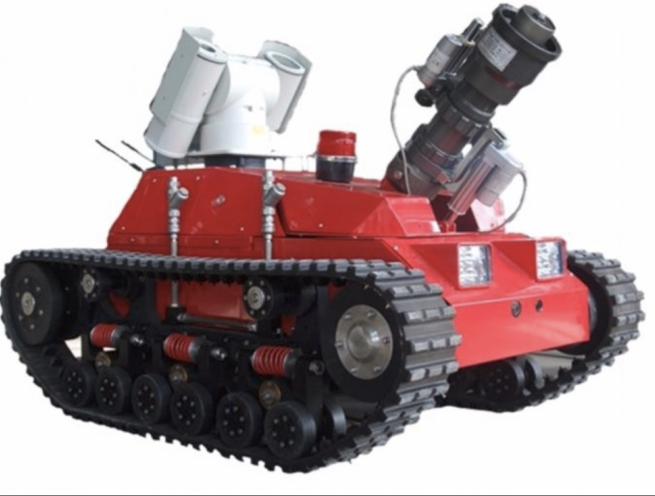
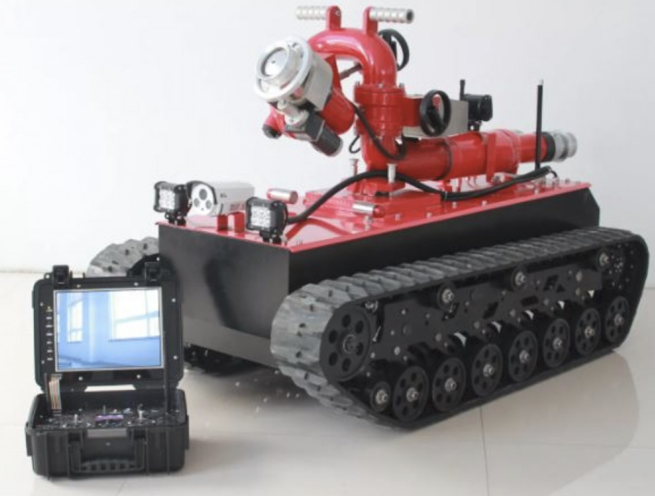
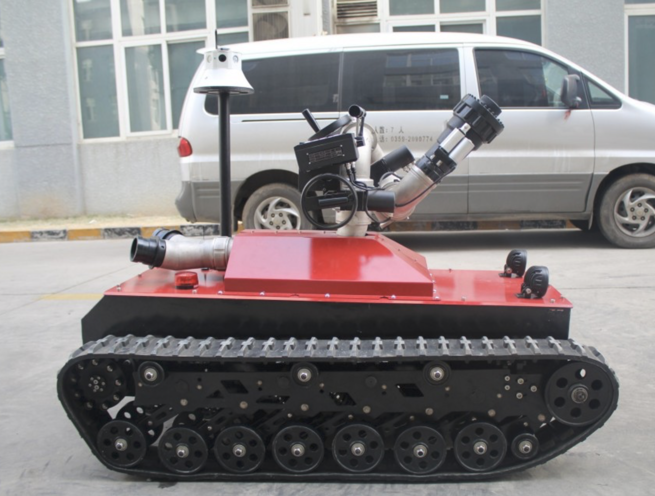
The Madoors USA FFR-1923 Fire Extinguishing Robot is a remotely controlled, highly modular firefighting robot designed in direct collaboration with professional firefighters to execute the most dangerous physical tasks at industrial fire and explosion incidents — removing firefighters from the highest-risk situations at nuclear power plants, chemical facilities with inflammable and noxious materials, oil refineries, and petroleum and gas tank fires where large-scale industrial fires create fatal accident risk, massive corporate asset damage, threats to surrounding neighborhood populations, and significant ecological impact. The FFR-1923 is designed as a tool rather than an autonomous firefighter — a trained firefighter operates the robot by remote control, maintaining human decision-making while the robot performs the lifting, dragging, carrying, and dangerous physical tasks that would expose humans to unacceptable risk.
The highly modular configuration allows the FFR-1923 to change form in less than 30 seconds without additional tools — adapting from heavy hose transportation to equipment carrying to human victim rescue within a single incident response as the mission requirement changes.
TECHNICAL SPECIFICATIONS
The Madoors USA FFR-1923 is developed through direct collaboration with professional firefighters who provided operational input on the dangerous situations, specific hazards, and mission requirements that engineering teams alone could not identify without field experience. This firefighter-informed design approach ensures that the robot's capabilities, reconfiguration speed, and operational characteristics directly address the specific needs of real industrial fire and explosion incidents rather than theoretical performance specifications.
The modular design system allows mission-specific configuration changes to be completed in under 30 seconds without tools — the fastest available reconfiguration time for a firefighting robot of this scale. This reconfiguration speed is critical at active incidents where the mission requirement changes dynamically and waiting for configuration changes would create response delays during time-critical rescue and suppression operations.
Remote piloting by a trained firefighter operator maintains human judgment and decision-making authority over all robot actions — the FFR-1923 amplifies the firefighter's capability to act in dangerous environments without exposing the firefighter to the hazards of direct physical presence. The robot executes the physical tasks — lifting, dragging, carrying, and operating in high-temperature, toxic, and explosive atmospheres — while the firefighter maintains command from a safe remote position.
Applications specifically address the industrial hazard scenarios that create the greatest firefighter casualty risk — nuclear power plant fires where radiation exposure accompanies the thermal and explosion hazards, chemical facility fires where toxic and flammable material release creates atmospheric hazards that standard firefighting protective equipment cannot address indefinitely, oil refinery and petroleum tank fires where the hydrocarbon fuel load creates extreme thermal environments and explosion risk, and any large-scale industrial incident where the combination of fire, explosion, and hazardous substance release makes direct firefighter presence life-threatening.
KEY FEATURES
Firefighter-Collaborated Design — Real Incident Experience Integration
The FFR-1923 was developed with direct input from professional firefighters who explained the specific dangerous situations, hazard types, and operational requirements that the engineers did not know about without field experience. This collaboration ensures that every design decision — reconfiguration method, mission capability, remote control interface, and physical performance — is based on validated operational need rather than assumed requirements. The result is a robot that professional firefighters can actually use effectively in real incident conditions.
Highly Modular — Under 30-Second Reconfiguration Without Tools
The ability to reconfigure the FFR-1923 in less than 30 seconds without additional tools at an active incident site is the defining operational advantage of the modular design — the robot can change from a hose carrier to a victim rescue configuration to an equipment carrier within a single incident response without requiring workshop time, specialist tools, or a return to base for reconfiguration. This rapid reconfiguration directly extends the operational utility of a single robot unit across the full range of mission requirements at a complex incident.
Human Victim Rescue Capability
The ability to carry human victims to safety — through fire, smoke, and collapse hazards that prevent firefighter access — addresses the most critical life safety mission of any fire incident. The FFR-1923 can access areas where fire conditions or structural collapse have made firefighter entry impossible, locate and extract victims, and carry them to the safe perimeter. This victim rescue capability directly saves lives that would be lost without robotic access to the fire interior.
Tool Philosophy — Human Control, Robot Execution
The fundamental design philosophy that the FFR-1923 is a tool rather than an autonomous firefighter — with humans controlling all decisions and the robot executing the physical tasks — provides the operational confidence and regulatory acceptance required for deployment at real incidents. Autonomous robots making independent decisions at fire incidents introduce unacceptable risk of incorrect action in complex, rapidly changing environments. The FFR-1923 tool philosophy ensures that the firefighter operator's experience and judgment govern every action, while the robot provides the physical capability to act where the firefighter cannot safely go.
Industrial Hazard Access — Nuclear, Chemical, Petroleum & Refinery
The specific design for the most hazardous industrial fire environments — nuclear radiation, toxic chemical atmospheres, hydrocarbon explosion risk, and extreme thermal exposure — addresses the incident types where firefighter casualty risk is highest and where robotic substitution for direct human action provides the greatest safety benefit. Each of these environments presents combinations of hazards that exceed the protection capability of standard firefighting personal protective equipment for extended operations — the FFR-1923 operates indefinitely in these environments without the physiological and equipment time limits that constrain human firefighter operations.
Reduces Corporate Asset Damage & Ecological Impact
The faster fire suppression enabled by FFR-1923 deployment — accessing and suppressing fire in areas too dangerous for human firefighters — directly reduces the duration of the fire event and the total damage to corporate assets, surrounding property, and the ecological environment. Large-scale industrial fires that cannot be quickly suppressed because direct firefighter access is impossible cause disproportionately greater total damage than fires where suppression can proceed rapidly — the FFR-1923 closes the access gap that allows industrial fires to escalate beyond initial control.
OPERATIONAL MISSIONS
Heavy Hose Transportation
The FFR-1923 transports heavy fire suppression hoses through fire and collapse zones to positions where water and foam can be delivered to the fire seat — eliminating the need for firefighters to carry hose through the hazard zone. This mission capability is particularly valuable at petroleum tank fires and refinery incidents where the distance and hazard severity between the safe firefighter position and the fire seat requires hose to be advanced through extreme heat and explosion risk.
Equipment Carrying
Firefighting equipment — monitors, nozzles, foam concentrate, and rescue tools — is transported to the operating position by the FFR-1923 without exposing firefighters to the hazards of the equipment delivery route. This equipment delivery mission extends the effective range of firefighter operations beyond the safe access boundary.
Human Victim Rescue
Human victims in the fire interior are located and carried to safety by the FFR-1923 — the robot accesses collapse, fire, and toxic environments where firefighter entry is not possible and extracts victims for handover to medical teams at the perimeter. This is the highest life-safety priority mission of the FFR-1923.
Dangerous Task Execution
Any dangerous task at the incident — opening valves, closing isolation systems, placing foam monitors, removing obstacles, and any other physical task at the fire interior — is executed by the FFR-1923 under the remote control of the firefighter operator, substituting robotic action for direct human exposure at the point of maximum hazard.
DEPLOYMENT SCENARIOS & USE CASES
Madoors USA FFR-1923 Fire Extinguishing Robots are deployed at any industrial fire and explosion incident where direct firefighter access creates unacceptable casualty risk.
- Nuclear power plant fire and emergency response operations
- Chemical facility fire response with toxic atmosphere conditions
- Oil refinery fire suppression and victim rescue operations
- Petroleum and gas tank fire response and suppression
- Industrial explosion site search and rescue operations
- Hazardous material facility fire and leakage response
- Large-scale industrial fire hose and equipment advancement
- Petrochemical plant fire suppression operations
- Gas processing facility fire and explosion response
- Mining facility fire and rescue robot deployment
- Power generation facility fire response operations
- Pharmaceutical manufacturing facility fire response
- Military ammunition depot fire and explosion response
- Airport fuel depot fire suppression operations
- Any industrial incident where direct firefighter access creates life-threatening hazard exposure
- Category: Bomb Disposal Robotics