Please provide your technical specifications and project requirements for the Explosion-proof (Ex-proof) Doors. Our engineers will review your application and provide a detailed manufacturing quote, including exact pricing and lead times.
Explosion-proof (Ex-proof) Doors
The Madoors USA Explosion-Proof Door range covers automatic and manual blast-resistant overhead doors, sliding doors, and hinged doors engineered to withstand very high explosion pressure loads — both from the outside and the inside — with standard protection against positive explosive pressures of 5.0 bar (72.5 psi / 500 kN/m²) and higher blast loads available through project-specific engineering. By installing explosion-resistant doors in high-risk industrial, petrochemical, military, and government facility areas, the consequences of an explosion are limited — reducing both material damage and the risk of injury and loss of life beyond the protected door boundary.
Madoors USA Industrial Explosion-Proof Doors provides total security solutions — combining explosion resistance with acoustic insulation, fire resistance, bullet resistance, and forced entry prevention in a single certified door assembly where project requirements demand multi-hazard protection from one door. Full in-house calculation capability using advanced structural analysis programs allows project-based development of explosion-resistant doors for any specific blast load, post-impact functionality requirement, deformation limit, or rebound effect specification.
TECHNICAL SPECIFICATIONS
Madoors USA Explosion-Proof Doors are available in overhead door, sliding door, and hinged door configurations — providing the appropriate operational format for each specific industrial or security application. All configurations are engineered for bidirectional blast resistance — withstanding explosion pressure loads from both the outside and inside of the door — covering both external blast scenarios where the explosion source is outside the protected space and internal explosion scenarios where the explosion originates within the protected room or zone.
Standard blast protection covers positive explosive pressures of 5.0 bar, 72.5 psi, and pressure loads of 500 kN/m² — the most common blast resistance specification for petrochemical plant control rooms, industrial process area blast doors, and industrial explosion hazard facility personnel doors. Higher blast loads beyond the standard 5.0 bar specification are available through project-specific engineering — with Madoors USA's consultants conducting full structural calculation of the door design for the confirmed blast pressure scenario using advanced calculation programs.
Project-based door development covers the following additional blast performance parameters beyond basic pressure resistance. Post-impact functionality — the ability of the door to continue operating normally after sustaining the design blast load. Deformation limits — the maximum allowable door panel deflection under the design blast load, which may be constrained by clearance requirements to adjacent equipment or structural elements. Rebound effects — the negative phase pressure following the positive overpressure peak, which applies load to the door in the opposite direction and must be accounted for in the door's structural design to prevent rebound failure.
The door can withstand both dynamic and static pressure loads, and can be designed for resistance to fragment and projectile impact on the door during and after an explosion — providing combined blast overpressure and fragmentation protection in a single door assembly.
Multi-hazard combination options include acoustic insulation integration for sound attenuation alongside blast resistance, fire resistance classification for combined blast and fire protection, bullet resistance certification for combined ballistic and blast protection, and forced entry prevention for combined security access control and blast resistance.
KEY FEATURES
Standard 5.0 Bar / 72.5 psi / 500 kN/m² Blast Resistance
The standard Madoors USA explosion-proof door specification provides blast resistance against positive explosive pressures of 5.0 bar — the most widely specified blast resistance level for petrochemical, chemical processing, oil and gas, and industrial facility explosion hazard door applications. This standard specification covers the blast loading scenarios generated by vapor cloud explosions, process equipment failures, and similar industrial explosion events without requiring project-specific engineering for the majority of standard industrial blast door applications.
Higher Blast Loads — Project-Specific Engineering
For applications requiring blast resistance beyond the standard 5.0 bar specification, Madoors USA's experienced consultants conduct full structural calculation of the door using advanced calculation programs — developing a project-specific door design that meets the exact blast pressure, duration, and impulse requirements of the confirmed explosion scenario. This project engineering capability removes any upper blast load limitation from the Madoors USA door range, allowing certified explosion-resistant doors to be designed for the most demanding military ammunition depot, explosive storage, and high-energy industrial blast scenarios.
Bidirectional Blast Resistance — Inside & Outside Explosion
All Madoors USA explosion-proof doors are engineered for bidirectional blast resistance — withstanding explosion pressure loads applied from both the outside and inside of the door. This bidirectional capability covers the full range of explosion scenarios encountered in industrial and military facilities, where the explosion may originate on either side of the door depending on the process layout, storage arrangement, or attack direction.
Overhead Door, Sliding Door & Hinged Door Configurations
Three door operation configurations cover the full range of industrial and security opening types. Overhead doors for vehicle access, large equipment openings, and industrial bay entrances where vertical opening clearance is required. Sliding doors for space-constrained openings where swing door operation is not possible. Hinged doors for standard personnel and equipment access openings where swing door geometry is operationally appropriate. All three configurations are available with blast resistance to the standard 5.0 bar specification and above.
Full In-House Structural Calculation Capability
Madoors USA maintains full in-house capability to calculate the complete structural design of explosion-resistant doors using advanced calculation programs — covering blast pressure loading, dynamic response analysis, deformation prediction, rebound effect analysis, and post-impact functionality verification. This calculation capability allows project-based door development for any specific blast scenario without dependence on external engineering consultants, and provides clients with complete engineering documentation for blast door procurement, regulatory compliance, and facility safety case submissions.
Post-Impact Functionality — Door Operation After Blast
For applications where the door must remain operational after sustaining the design blast load — such as emergency escape routes, blast relief doors, and operational continuity access points — Madoors USA engineers the door design to the specified post-impact functionality requirement, ensuring that the door can be opened, closed, and operated normally after the blast event without requiring repair or replacement.
Deformation Limit Control
Where clearance requirements to adjacent equipment, piping, or structural elements constrain the maximum allowable door panel deflection under the design blast load, Madoors USA's calculation program analysis determines the door panel stiffness, support system, and frame anchorage required to limit deformation within the specified tolerance — preventing post-blast door contact with adjacent elements that could cause secondary damage or operational failure.
Rebound Effect Design
The negative phase pressure following the blast overpressure peak applies load to the door in the direction opposite to the primary overpressure — potentially causing door failure in the rebound direction if the structural design addresses only the positive phase loading. Madoors USA's full dynamic analysis accounts for rebound effects in the door design, ensuring structural integrity throughout the complete blast loading cycle including both the positive and negative pressure phases.
Fragment & Projectile Impact Resistance
In addition to blast overpressure resistance, the door can be designed to withstand the impact of fragments and projectiles generated during and after an explosion — providing protection against the high-velocity debris that accompanies explosion events in industrial and military environments. Fragment resistance can be combined with blast overpressure resistance in a single door construction.
Total Security Solution — Multi-Hazard Combination
Madoors USA explosion-proof doors can be combined with acoustic insulation, fire resistance, bullet resistance, and forced entry prevention in a single certified door assembly — providing a complete, multi-hazard security solution from a single door specification. This combination capability eliminates the need to install multiple separate door systems for different hazard types at the same opening, reducing cost, simplifying installation, and providing a single certified document trail covering all protection requirements.
Experienced Consultants — Widely Varying Sectors & Projects
Madoors USA's explosion-proof door consultants bring extensive experience across widely varying industrial, petrochemical, military, and government sectors and specific blast door applications — providing clients with practical guidance on the most suitable door configuration, blast resistance specification, and multi-hazard combination for each specific project, backed by full calculation capability to verify the engineering basis of every recommendation.
PRODUCT CONFIGURATIONS
Explosion-Resistant Overhead Door
Vertically operating overhead door providing blast resistance for vehicle access openings, large equipment bays, and industrial facility entrances. Available in manual and automatic motorized operation. Blast resistance from 5.0 bar standard to higher loads on project specification.
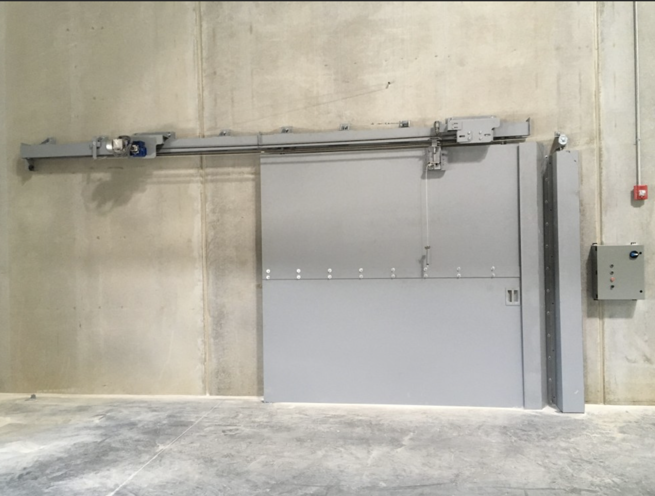
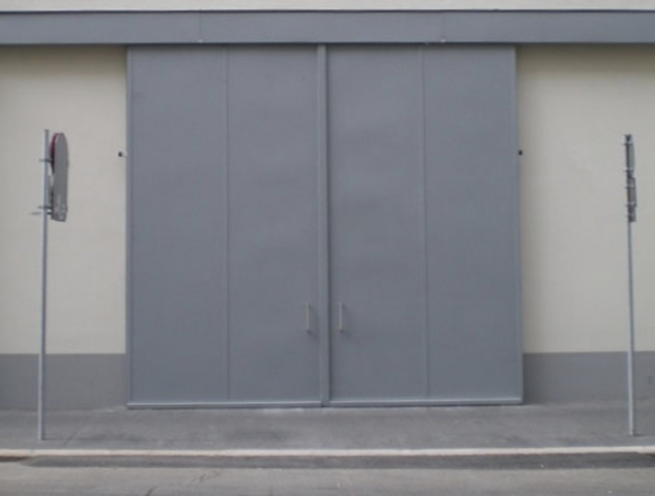
Explosion-Resistant Sliding Door
Horizontally sliding blast-resistant door for space-constrained openings and large industrial access points where overhead door operation is not possible. Available in manual and motorized configurations with blast resistance matching the overhead door range.
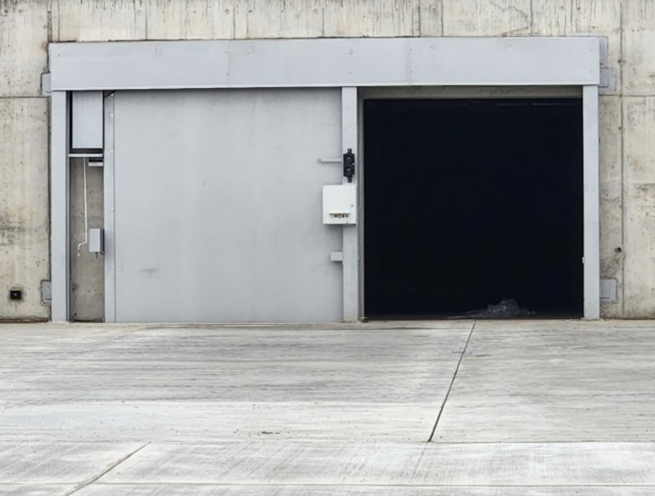
Explosion-Resistant Hinged Door
Single and double leaf hinged blast-resistant personnel and equipment access doors. Available in manual and automatic motorized operation. Standard specification to 5.0 bar with project-specific higher blast loads available. Combination options include acoustic insulation, fire resistance, bullet resistance, and forced entry prevention.
ASSEMBLY & INSTALLATION SEQUENCE
Blast Scenario Assessment & Door Specification
The explosion scenario is defined — explosion type, stored substance, process conditions, facility geometry, standoff distance, and required blast pressure resistance. Standard 5.0 bar specification or project-specific higher blast load requirement is confirmed. Door type — overhead, sliding, or hinged — and any multi-hazard combination requirements are specified.
Full Structural Calculation (Project-Specific)
For blast loads beyond the standard specification or where post-impact functionality, deformation limits, or rebound effects are additional requirements, Madoors USA conducts full structural calculation of the door using advanced programs. Calculation documentation is prepared for client and regulatory review.
Structural Opening Preparation
The structural opening in the blast-rated wall is prepared to the confirmed frame dimensions. Anchor positions for blast-rated frame-to-wall connections are prepared to the structural calculation specification.
Frame Installation & Blast-Rated Anchorage
The explosion-resistant door frame is installed and anchored to the surrounding blast wall structure at all specified fixing positions using blast-rated anchors torqued to the structural calculation specification.
Door Panel Installation
The explosion-resistant door panel is installed in the frame — hung on hinges for hinged doors, fitted to the track for sliding doors, or attached to the lifting mechanism for overhead doors. Panel alignment, clearance, and seal contact are verified.
Motorized Drive & Control System Installation (Motorized Variants)
Drive systems and control panels are installed and commissioned. Emergency manual override is tested and verified.
Multi-Hazard System Integration (Where Specified)
Acoustic seal systems, fire-resistant intumescent elements, ballistic liners, and forced entry hardware are installed and verified for correct function alongside the blast resistance construction.
Certification Documentation Handover
Full blast resistance calculation documentation, test certifications, multi-hazard combination certificates, and installation records are compiled into the project handover package.
DEPLOYMENT SCENARIOS & USE CASES
Madoors USA Explosion-Proof Doors are specified for any facility opening where explosion overpressure protection — in standard or project-specific configuration — is required for personnel protection and facility damage limitation.
- Petrochemical plant control room and instrument room blast doors
- Oil and gas processing facility personnel protection blast doors
- Chemical storage and handling facility explosion-proof doors
- Pharmaceutical manufacturing explosion hazard facility doors
- Military ammunition depot blast-resistant doors
- Nuclear facility blast-protected access doors
- Power station control room and substation blast doors
- Offshore platform hazardous zone explosion-proof doors
- Industrial vapor cloud explosion hazard facility doors
- Airport fuel storage facility blast-resistant doors
- Government secure facility blast-rated access doors
- LNG terminal and cryogenic facility blast doors
- Research laboratory explosion zone blast-resistant doors
- Wastewater treatment biogas zone explosion-proof doors
- Mining facility explosive atmosphere blast-resistant doors
- Category: Sliding Gate