Explosion Blast Proof Concrete Portable Bunker
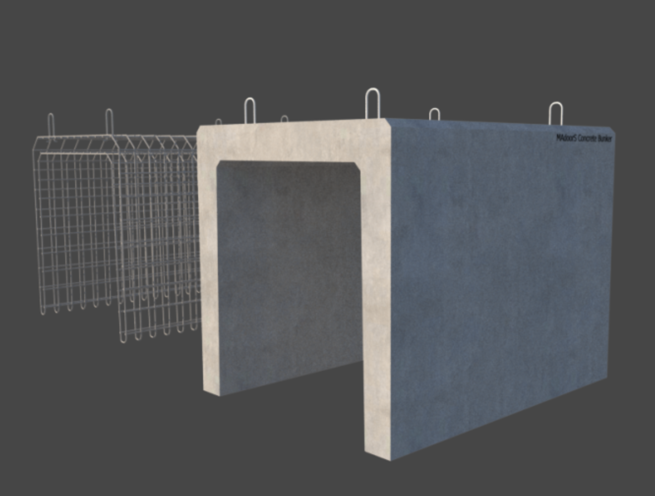
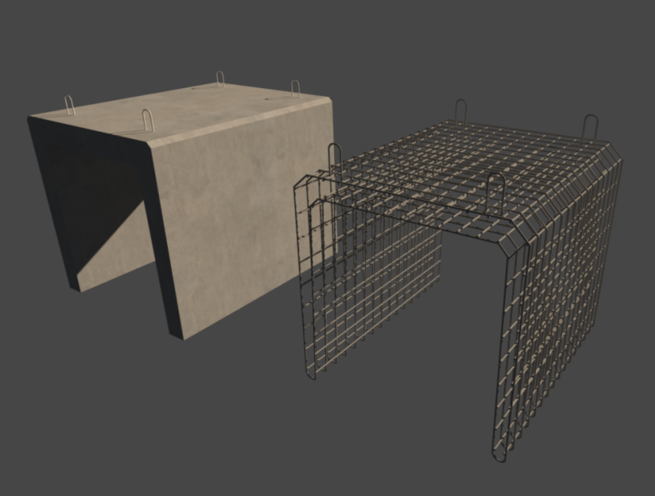
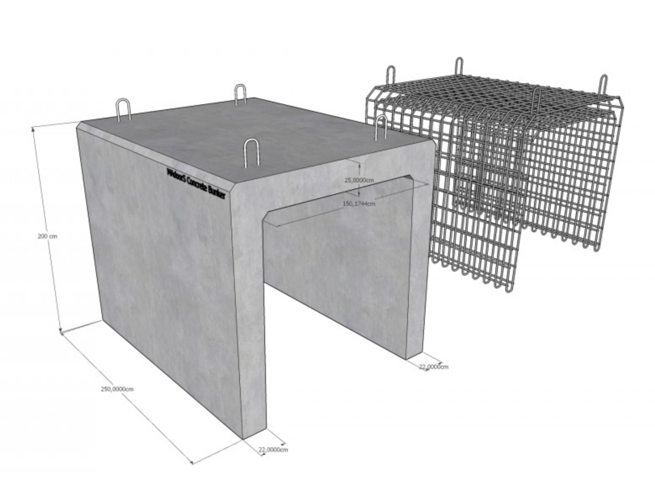
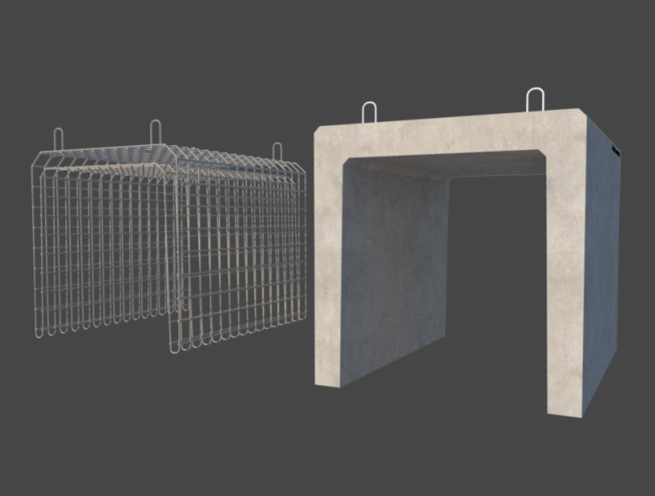
The Madoors USA Explosion Blast Proof Concrete Portable Bunker is a certified, transportable, blast-resistant and bulletproof concrete shelter system designed to provide emergency escape and life safety protection in the most extreme threat environments — certified bulletproof to BR7 and tested to withstand burst pressures of up to 7 bar. Built to ASTM standards with 12.7mm ribbed iron internal reinforcement at 420 MPa breaking stress, special concrete additives for enhanced hardness and explosion resistance, standard 25cm concrete wall thickness, and four 16mm diameter transport hooks per unit, the Madoors USA concrete portable bunker is portable, crane-deployable, and fully modular — with multiple units connectable to form larger shelter structures for extended occupancy capacity.
Radiation-proof construction is available through lead plate integration in the concrete wall — as concrete thickness increases, radiation absorption increases, with lead plates providing enhanced radiation attenuation without the weight penalty of simply increasing wall thickness. This radiation shielding capability makes the bunker suitable for nuclear, radiological, and CBRN emergency scenarios in addition to conventional blast and ballistic threat environments.
TECHNICAL SPECIFICATIONS
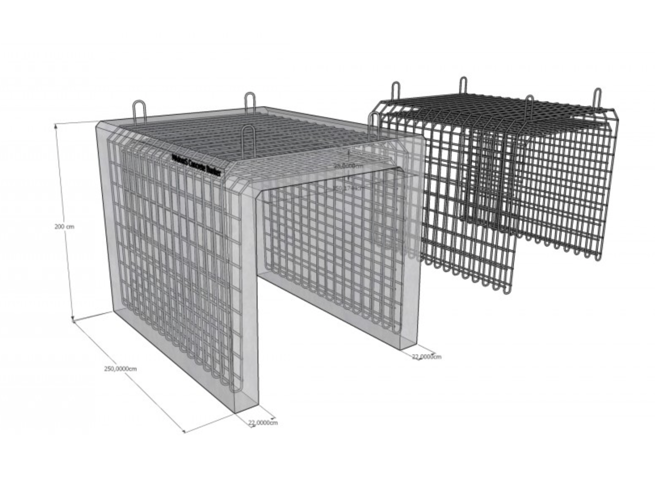
The Madoors USA Concrete Portable Bunker is constructed with the following structural specification. Internal reinforcement: 12.7mm ribbed iron conforming to ASTM A615 M with a breaking stress of 420 MPa — the American standard reinforcement specification providing verified tensile performance under blast dynamic loading. Steel mesh reinforcement: ASTM A615 M compliant mesh throughout the wall section.
Concrete mix: standard concrete with special additives incorporated to increase hardness and resistance to explosion pressure and ballistic impact beyond the performance of standard concrete mix design — providing enhanced energy absorption under dynamic blast loading and improved ballistic projectile arrest at the certified BR7 protection level.
Standard concrete wall thickness: 25 cm — providing the structural mass and concrete cover required for BR7 ballistic protection and 7-bar burst pressure resistance at a wall dimension that maintains portable, crane-deployable unit weights achievable with standard construction crane equipment.
Ballistic certification: BR7 — the highest standard EN 1522 protection level, providing protection against 7.62mm × 51 NATO rifle rounds and equivalent high-powered military rifle calibers. Blast pressure certification: tested to withstand burst pressures of up to 7 bar — covering the blast overpressure generated by large explosive detonations at combat-relevant standoff distances.
Transport hardware: four 16mm diameter lifting and transport hooks per unit — allowing crane lifting and mechanical positioning of each bunker unit without requiring additional rigging hardware or structural modification to the unit.
Radiation-proof option: lead plates embedded in the concrete wall during casting — providing gamma radiation attenuation in addition to the neutron moderation provided by the concrete hydrogen content. Lead plate thickness is determined by the required radiation shielding level for the specific application.
KEY FEATURES
BR7 Bulletproof Certified — Highest Ballistic Protection Level
The bunker is certified bulletproof to BR7 — the highest available EN 1522 ballistic protection level, covering 7.62mm × 51 NATO rifle rounds and equivalent military rifle calibers. BR7 certification confirms that the 25cm concrete wall construction with special additive mix and ASTM-compliant steel reinforcement defeats the primary ballistic threats encountered in military combat, terrorist attack, and armed assault scenarios — protecting occupants from direct rifle fire from any direction.
7-Bar Blast Pressure Resistance — Combat-Level Protection
The bunker is tested to withstand burst pressures of up to 7 bar — covering the blast overpressure generated by significant explosive detonations at combat-relevant standoff distances, including vehicle-borne IED explosions, artillery and mortar round detonations, and large improvised explosive device events. Seven-bar pressure resistance confirms structural integrity under severe blast loading conditions that would destroy conventional building shelters.
Special Concrete Additives — Enhanced Hardness & Explosion Resistance
Special additives incorporated into the concrete mix increase the hardness and explosion resistance of the concrete beyond standard mix performance — improving projectile arrest capability for ballistic protection and increasing the energy absorption under dynamic blast loading. These special additives provide the enhanced concrete material properties required to achieve BR7 ballistic certification and 7-bar blast resistance within the standard 25cm wall thickness.
ASTM A615 M Reinforcement — 420 MPa Breaking Stress
Internal reinforcement with 12.7mm ribbed iron and steel mesh conforming to ASTM A615 M at 420 MPa breaking stress provides the tensile reinforcement required to maintain structural integrity of the concrete wall under the combined static and dynamic loading of blast overpressure, ballistic impact, and seismic events — preventing catastrophic wall fracture and structural collapse under the design threat scenarios.
Radiation-Proof Construction — Lead Plate Integration
For nuclear, radiological, and CBRN emergency applications, lead plates are embedded in the concrete wall during casting to provide gamma radiation attenuation in addition to the neutron moderation provided by the concrete mass. This lead plate integration achieves the required radiation shielding performance within the standard wall thickness — avoiding the excessive weight increase that would result from achieving equivalent shielding through concrete thickness alone. As standard concrete wall thickness increases, radiation absorption increases proportionally — lead plate addition further enhances radiation attenuation per unit of wall thickness.
25cm Standard Wall Thickness — Portable Weight Balance
The 25cm standard wall thickness is engineered to balance the competing requirements of ballistic and blast protection performance — which increase with wall mass — and portable transportability — which decreases as unit weight increases. The 25cm specification achieves BR7 and 7-bar performance within a unit weight manageable by standard construction crane equipment, maintaining the portable and crane-deployable character of the system.
Four 16mm Transport Hooks — Crane Deployable
Four 16mm diameter lifting and transport hooks cast into each bunker unit allow crane lifting and mechanical positioning of the unit at the deployment site without requiring additional rigging hardware or structural modification. Four hooks provide balanced, stable lift geometry for safe crane handling of the heavy concrete unit mass.
Modular Connection — Scalable Shelter Structures
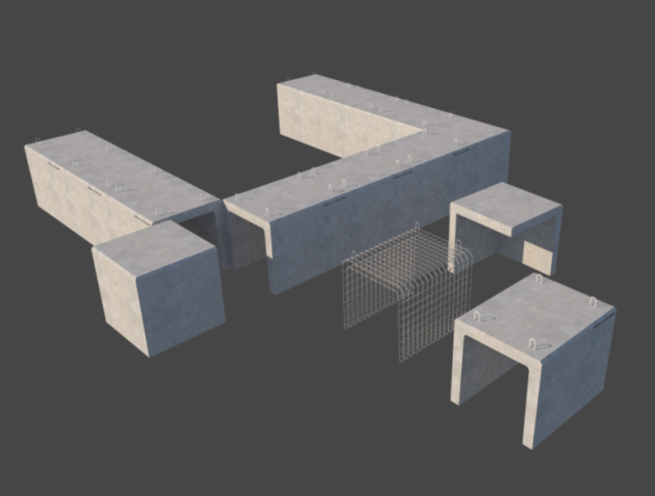
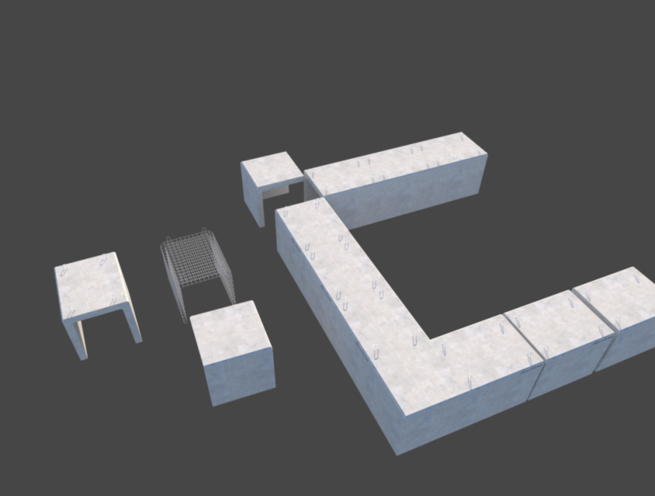
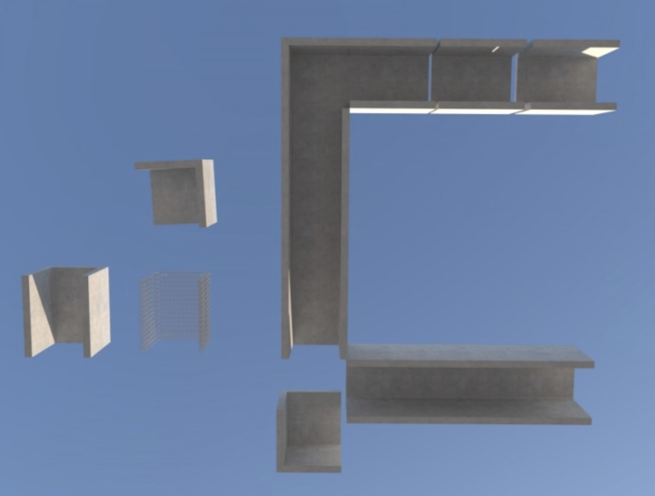
Multiple bunker units can be connected to one another to create larger shelter structures — expanding the total internal floor area and occupancy capacity beyond the single-unit configuration. Modular connection allows the shelter to be configured for the specific occupancy requirement of each deployment — from a single-unit individual or small-group shelter through to a multi-unit connected complex providing extended group protection.
Portable & Transportable — Rapid Deployment
Despite its concrete construction and heavy protection specification, the bunker is designed as a portable and transportable system — with crane lifting hooks, manageable unit dimensions, and standard transport vehicle compatibility allowing rapid deployment to any location accessible by crane and transport vehicle. Portable deployment allows the bunker to be pre-positioned at anticipated threat locations, moved to new positions as the threat environment changes, and recovered after the threat period for redeployment elsewhere.
Emergency Escape & Life Safety Application
The bunker is specifically designed for emergency escape and life safety shelter — providing an immediately accessible protected refuge for personnel when a threat event occurs without warning. The combination of BR7 ballistic protection, 7-bar blast resistance, and radiation-proof option addresses the full spectrum of life safety threats relevant to military operations, industrial emergency scenarios, and civil defense emergency planning.
ASSEMBLY & DEPLOYMENT SEQUENCE
Site Assessment & Unit Configuration
The deployment location, required occupancy capacity, threat profile — ballistic, blast, radiation, or combined — and transport route access for crane and vehicle are assessed. The number of bunker units required for the specified occupancy — single unit or multi-unit connected complex — is confirmed. Radiation-proof lead plate specification is confirmed for CBRN applications.
Unit Manufacturing & Quality Verification
Bunker units are manufactured to the confirmed specification with ASTM A615 M reinforcement, special additive concrete mix, standard 25cm wall thickness, four 16mm transport hooks, and optional lead plate integration. Concrete compressive strength, reinforcement position, and transport hook embedment are verified against specification before dispatch.
Transport to Deployment Site
Units are transported to the deployment site on standard flatbed transport vehicles. The 16mm transport hooks allow crane off-loading directly from the transport vehicle to the installation position.
Crane Positioning
Each unit is crane-lifted using the four 16mm transport hooks in a balanced four-point lift configuration and positioned at the specified location. Unit orientation, entry point alignment, and ground surface stability under unit weight are verified at each position.
Modular Connection (Multi-Unit Configurations)
For multi-unit shelter configurations, adjacent units are connected using the specified inter-unit connection system — creating a unified shelter structure with continuous internal access between connected units. Connection joint integrity and weather seal between units are verified.
Access, Ventilation & Services Fitout
Entry door, ventilation provisions, and any emergency services fitout — communications equipment, lighting, water, and food storage — are installed within the connected shelter structure. For radiation-proof configurations, ventilation filters appropriate to the radiation type are installed.
Operational Readiness Verification
Complete shelter structural condition, transport hook integrity, modular connection security, and access door operation are inspected. Operational readiness for immediate occupancy in an emergency event is confirmed and documented.
DEPLOYMENT SCENARIOS & USE CASES
Madoors USA Explosion Blast Proof Concrete Portable Bunkers are deployed across the full range of military, civil defense, industrial, and emergency protection applications.
- Military forward operating base emergency personnel shelters
- Combat outpost personnel life safety bunkers
- Military checkpoint blast and ballistic protection shelters
- Border security personnel blast protection bunkers
- Nuclear facility emergency personnel radiation shelters
- Industrial explosion hazard site personnel emergency shelters
- Petrochemical plant emergency blast protection bunkers
- CBRN emergency personnel protection shelters
- Government and embassy compound emergency shelters
- VIP compound and protected residence blast shelters
- Disaster relief emergency personnel protection bunkers
- Airport perimeter security personnel protection shelters
- Critical infrastructure emergency personnel shelters
- Military training facility blast protection bunkers
- Civil defense community emergency shelter deployment