Please provide your technical specifications and project requirements for the EMI/RFI Tempest Faraday Cage Doors. Our engineers will review your application and provide a detailed manufacturing quote, including exact pricing and lead times.
EMI/RFI Tempest Faraday Cage Doors
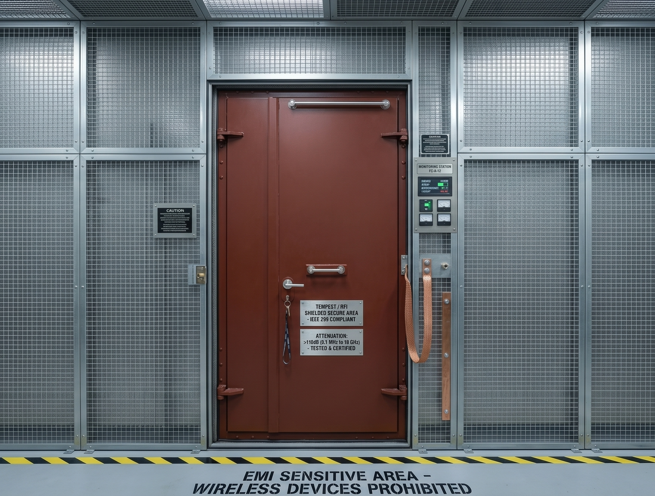
The Madoors USA EMI/RFI TEMPEST Faraday Cage Door is a specially engineered electromagnetic shielding door providing 60 to 100 dB RF shielding effectiveness across 100 MHz to 10 GHz — preventing electromagnetic and radio frequency emissions from leaking in or out of protected areas in compliance with NATO and US TEMPEST standards for Telecommunications Electronics Material Protected from Emanating Spurious Transmissions. Operating on the Faraday cage principle with continuous conductive frame and panel structure, copper or silver-coated mesh gaskets, and electrical continuity below 100 mΩ, the Madoors USA TEMPEST Door provides the electromagnetic signal containment required for military command centers, SCIF Sensitive Compartmented Information Facilities, cryptographic and classified communication rooms, embassy secure zones, intelligence centers, and secure data rooms where electromagnetic spying through intercepted signal emanations represents a critical information security threat. Available with optional ballistic protection, fire resistance, blast resistance, and acoustic isolation for comprehensive multi-threat protection.
TECHNICAL SPECIFICATIONS
The Madoors USA TEMPEST Faraday Cage Door achieves RF shielding effectiveness of 60 to 100 dB across the 100 MHz to 10 GHz frequency range — 60 dB represents attenuation of electromagnetic signals to one-millionth of their incident power level, and 100 dB represents attenuation to one ten-billionth. This shielding performance range covers the complete frequency spectrum of concern for TEMPEST applications — from the lower frequency emanations of computing and communications equipment through the microwave frequency bands used by modern surveillance and interception systems.
Electrical continuity below 100 mΩ across the complete door-to-frame interface is the fundamental electromagnetic shielding specification — the Faraday cage principle requires that the shielding enclosure maintains a continuous conductive path around the complete perimeter of any opening, and any resistance above the specified limit represents a conductive discontinuity that creates an electromagnetic leakage path. The 100 mΩ maximum electrical continuity specification confirms that the door-to-frame contact resistance is maintained at the level required for the specified shielding effectiveness throughout the door service life.
The continuous conductive frame and panel structure provides the Faraday cage geometry — the door panel and frame are both manufactured from conductive material with continuous conductive connection at all panel joints, frame connections, and installation interfaces. No non-conductive gap, joint, or discontinuity exists anywhere in the door and frame assembly that would allow electromagnetic signal passage.
Copper or silver-coated mesh gaskets are installed at all door-to-frame contact surfaces — the door perimeter gaskets, threshold contact, and hinge positions all use conductive mesh gaskets that maintain the continuous conductive path between the moving door panel and the fixed frame. Copper and silver are selected for their extremely low electrical resistance and their resistance to the contact oxidation that increases the contact resistance of standard metal-to-metal contacts over time. The mesh construction maintains the conductive contact under the compression variations caused by door panel thermal expansion and the mechanical loading of door operation cycles.
Optional ballistic protection — to EN 1522, NIJ, or UL 752 standards — can be incorporated into the TEMPEST door panel and frame for facilities requiring simultaneous electromagnetic shielding and ballistic protection. Optional fire resistance to REI30 through REI120 provides fire compartmentation alongside TEMPEST shielding. Optional blast resistance to the specified overpressure rating and acoustic isolation to the required STC rating are available for the most comprehensively protected facilities.
KEY FEATURES
60 to 100 dB RF Shielding — 100 MHz to 10 GHz
The 60 to 100 dB shielding effectiveness range across the full 100 MHz to 10 GHz frequency spectrum confirms TEMPEST-compliant electromagnetic containment for all contemporary electronic equipment emanation frequencies and all known electromagnetic interception techniques. The 100 dB upper specification represents the maximum available shielding effectiveness for door systems — providing the signal attenuation required for the most sensitive classified facilities where the lowest possible residual electromagnetic emission is the security requirement.
Faraday Cage Principle — Complete Electromagnetic Containment
The Faraday cage operating principle — the continuous conductive enclosure that prevents electromagnetic field penetration in either direction — is the fundamental physics that makes the TEMPEST door effective. Unlike absorption-based shielding that attenuates signals by converting electromagnetic energy to heat, the Faraday cage reflects and contains electromagnetic signals within the conductive boundary. This reflection principle provides consistent shielding effectiveness across the full frequency range without the frequency-dependent attenuation variation of absorption materials.
Below 100 mΩ Electrical Continuity — Gasket Contact Management
The below-100 mΩ electrical continuity specification with copper or silver-coated mesh gaskets is the engineering requirement that maintains the Faraday cage integrity at the door-to-frame interface throughout the service life — the gasket material and construction are selected to maintain the specified contact resistance through thousands of door operation cycles, the temperature cycling of the protected space, and the compression set of the gasket material over time. This maintained electrical continuity directly ensures that the 60 to 100 dB shielding effectiveness is sustained throughout the operational service life of the door.
NATO & US TEMPEST Standard Compliance
The NATO and US TEMPEST standard compliance provides the procurement credentials required for the most sensitive government, military, and intelligence facility applications — TEMPEST certification is the specific electromagnetic security standard that governs the procurement of shielding systems for classified information facilities in NATO member countries and US government installations. This compliance documentation directly confirms that the Madoors USA TEMPEST door meets the established international electromagnetic security standard.
SCIF Suitability — Sensitive Compartmented Information Facility
The SCIF application suitability confirms that the Madoors USA TEMPEST door meets the physical construction and electromagnetic shielding requirements of the US Intelligence Community's SCIF standard — the most stringent facility security specification for classified intelligence and cryptographic operations. SCIF suitability directly enables the door to be specified for the highest-classification government and intelligence facilities without the additional engineering review required for non-SCIF-certified products.
Multi-Threat Optional Configurations — Ballistic, Fire, Blast & Acoustic
The optional ballistic, fire-resistant, blast-resistant, and acoustic isolation configurations allow the TEMPEST door to serve as the single security door solution for facilities requiring electromagnetic shielding alongside physical and structural protection — eliminating the engineering challenge of achieving multiple protection standards from separate door systems at the same opening. This multi-threat configuration capability is the essential feature for embassy secure zones and military command centers where all four protection requirements are simultaneously present.
Copper & Silver Gaskets — Oxidation-Resistant Long-Term Continuity
The copper and silver-coated mesh gasket specification directly addresses the primary failure mode of electromagnetic door gaskets over time — contact oxidation at the gasket-to-frame and gasket-to-door-panel interfaces increases electrical contact resistance progressively, reducing shielding effectiveness below the specified level. Copper and silver resist oxidation better than most other conductive materials, and the mesh construction distributes the electrical contact across thousands of individual mesh contact points — reducing the impact of any individual contact oxidation event on the total contact resistance.
SHIELDING EFFECTIVENESS REFERENCE
60 dB
Signal attenuation to one-millionth of incident power. Standard TEMPEST requirement for protected areas with conventional classified communications equipment.
80 dB
Signal attenuation to one-hundred-millionth of incident power. Enhanced TEMPEST requirement for higher-classification facilities and more sensitive equipment.
100 dB
Signal attenuation to one ten-billionth of incident power. Maximum available shielding for the most sensitive cryptographic, intelligence, and signals intelligence facilities.
ASSEMBLY & INSTALLATION SEQUENCE
Electromagnetic Shielding Specification
Required shielding effectiveness in dB, frequency range, electrical continuity specification, optional multi-threat protection requirements — ballistic, fire, blast, acoustic — door dimensions, and TEMPEST certification standard are confirmed.
Conductive Frame Installation
The continuous conductive frame is installed in the structural opening — all frame-to-wall connections are made with the conductive continuity required for the complete Faraday cage geometry. Frame electrical continuity to the facility shielding enclosure is confirmed below 100 mΩ.
Copper/Silver Gasket Installation
Copper or silver-coated mesh gaskets are installed at all door-to-frame contact positions — door perimeter, threshold, and hinge locations. Gasket compression under door closing force and electrical continuity across the gasket contact are confirmed below 100 mΩ.
Door Panel Installation
The conductive door panel with continuous panel construction is hung on the frame. Door closing and latching confirmation of complete gasket compression at all contact positions is verified.
Electrical Continuity Testing
Four-wire resistance measurement of the electrical continuity across the complete door-to-frame interface at multiple positions is conducted — all measurements are confirmed below 100 mΩ.
RF Shielding Effectiveness Testing
RF shielding effectiveness testing using a calibrated signal generator and measurement receiver is conducted at the specified frequencies across 100 MHz to 10 GHz. Measured shielding effectiveness is confirmed at or above the specified 60 to 100 dB level.
TEMPEST Certification Documentation & Handover
RF shielding effectiveness test report, electrical continuity measurements, NATO/US TEMPEST standard compliance documentation, and optional multi-threat certification records are compiled into the project handover package.
DEPLOYMENT SCENARIOS & USE CASES
Madoors USA EMI/RFI TEMPEST Faraday Cage Doors are specified for any facility requiring certified electromagnetic shielding at personnel access points.
- Military command center TEMPEST-shielded access doors
- SCIF sensitive compartmented information facility doors
- Embassy and diplomatic mission secure zone TEMPEST doors
- Intelligence agency classified facility access doors
- Cryptographic room and signals intelligence facility doors
- Secure data center electromagnetic shielding doors
- Government classified communication room access
- NATO facility TEMPEST-certified shielded doors
- Military communications center access shielding doors
- Defense research and development classified facility doors
- Financial institution secure communications room doors
- National security agency and intelligence facility doors
- Military electronic warfare facility shielded access
- Secure government cloud and data facility access doors
- Any facility requiring NATO/US TEMPEST-compliant electromagnetic shielding door with Faraday cage continuity
- Category: Personnel Doors