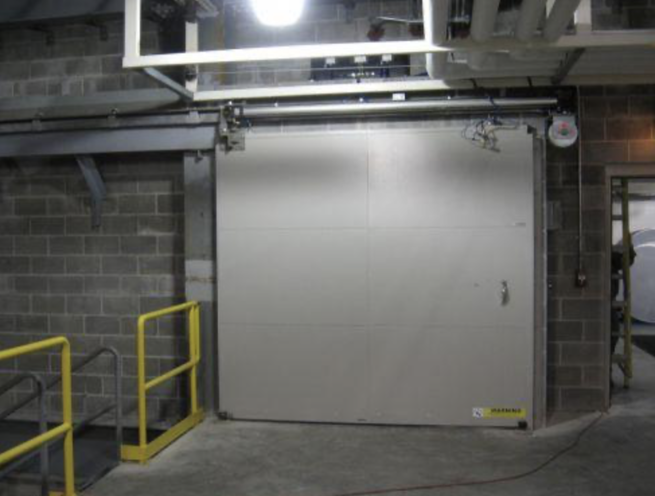
Please provide your technical specifications and project requirements for the Blast Resistant Doors Gates. Our engineers will review your application and provide a detailed manufacturing quote, including exact pricing and lead times.
Blast Resistant Doors Gates
The Madoors USA Blast Resistant Door and Gate range covers the complete spectrum of pressure and explosion resistant door systems — from single and double leaf steel swing doors rated to 3 bar through to armoured room hinged doors rated to 7 bar and top-hung motorized sliding doors engineered for blast pressures exceeding 30 bar. Every Madoors USA blast resistant door is uniquely designed, calculated, and manufactured to the specific customer requirement — with the stored substance type, quantity, facility layout, and required blast pressure rating all determining the precise door specification — supported by Madoors USA's full in-house capability for design, supply, installation, commissioning, and annual maintenance.
When hazardous substances are stored, personnel protection within the danger zone is the paramount safety requirement. Madoors USA blast resistant doors serve this requirement on two levels — reducing the risk of explosion propagation through the door opening, and ensuring that the door withstands the pressure load generated by an explosion event without failure, maintaining the protective barrier between the explosion source and the protected space. Special locking systems — specifically developed and manufactured by Madoors USA — absorb the enormous forces generated by blast overpressure loading, ensuring that the door remains sealed and structurally intact throughout the blast event.
TECHNICAL SPECIFICATIONS
The Madoors USA blast resistant door range is available in the following product types, each engineered and certified to the specific blast pressure and application requirements of the product designation.
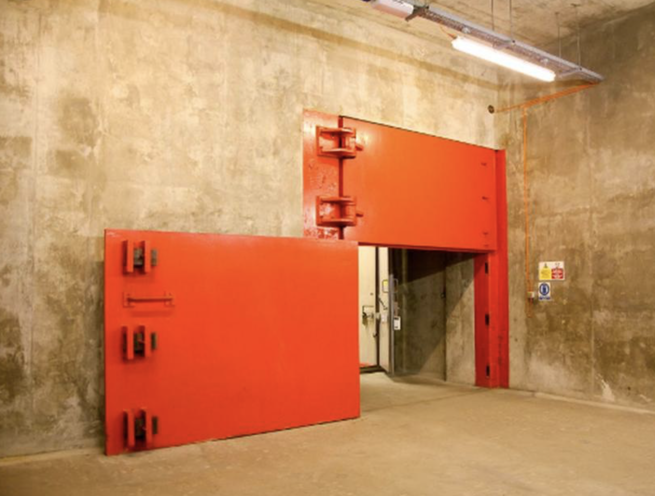
Blast Resistant Steel Swing Doors — single and double leaf configurations — for inside and outside explosion scenarios, rated to 3 bar blast pressure. Thermal insulation is available for combined blast and thermal resistance requirements. Emergency exit configuration with panic bar is available for installations where occupant emergency egress through the blast door is a life safety code requirement.
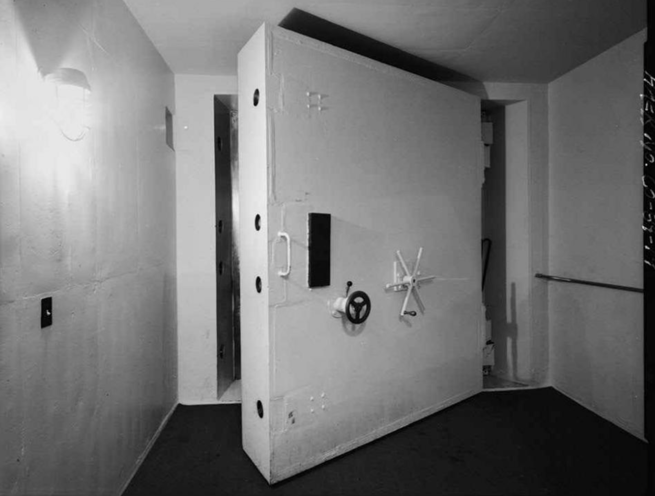
Blast and Fragment Unseated Hinged Steel Doors for Armoured Room Application — specifically engineered for armoured room blast door installations where both blast overpressure resistance and fragment retention are required simultaneously, rated to 7 bar blast pressure.
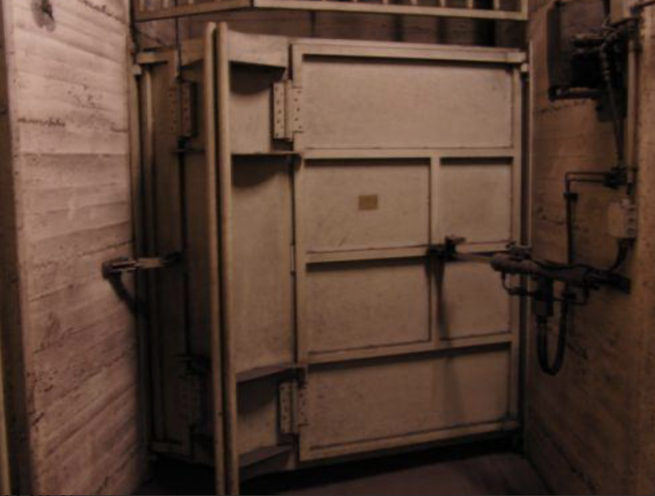
Blast Resistant Concrete Filled Steel Swing Doors — single and double leaf — providing enhanced blast mass through concrete-filled steel panel construction, combining the tensile strength of the steel outer structure with the compressive mass of the concrete fill for high blast pressure resistance.
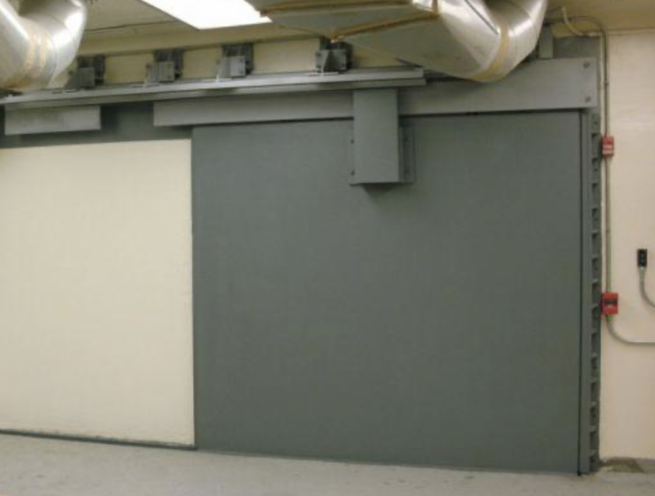
Blast Resistant Steel Sliding Doors — horizontal sliding configuration for openings where swing door operation is not possible due to space constraints or operational requirements.
Blast Resistant Motorized Steel Top Hung Sliding Doors — motorized horizontal sliding doors mounted on top-hung track systems for large opening blast protection, engineered for blast pressures exceeding 30 bar. PLC control system with interlocking, testing, and transfer management is available for defense project requirements.
Blast Resistant Motorized Steel Roller Sliding Doors — motorized roller-mounted sliding configuration for blast-resistant closure of large industrial and facility openings.
Blast Resistant Fixed Glass Windows — blast-rated fixed glazing panels for vision and light apertures in blast-resistant wall assemblies, matched to the blast pressure rating of the surrounding wall and door system.
All blast resistant doors and windows are designed, calculated, and manufactured to customer-specific requirements — with each project subject to individual engineering analysis and custom specification rather than standard catalogue selection.
KEY FEATURES
Complete Blast Pressure Range — 3 Bar to 30+ Bar
The Madoors USA blast resistant door range covers the complete spectrum of blast pressure requirements encountered across industrial, petrochemical, military, and defense facility applications — from 3 bar for standard hazardous substance storage facility blast doors through to blast pressures exceeding 30 bar for the most demanding defense project top-hung motorized sliding door installations. This complete pressure range coverage allows a single supplier to provide the entire blast door requirement for any facility regardless of the specific blast pressure specification.
Unique Project-Specific Design & Calculation
Every Madoors USA blast resistant door is uniquely designed and calculated for the specific customer requirement — with the door geometry, steel plate thickness, concrete fill specification, locking system design, hinge configuration, and frame anchorage all determined by the engineering analysis of the specific blast scenario, stored substance type and quantity, and facility layout. No standard catalogue specification is applied across different projects — each door is an engineered solution for the confirmed threat parameters of the specific installation.
Special Locking Systems — Madoors USA Developed
The locking systems used in Madoors USA blast resistant doors are specifically developed and manufactured by Madoors USA to absorb the enormous forces generated by blast overpressure loading on the door leaf. These proprietary locking systems maintain door closure integrity throughout the blast event, preventing the door from being forced open by overpressure or rebound loading — a critical performance requirement that standard commercial door hardware cannot satisfy at rated blast pressure levels.
Personnel Protection in Hazardous Substance Storage
Blast resistant doors serve the primary safety function of protecting personnel within the danger zone of hazardous substance storage facilities — both by reducing explosion propagation risk through controlled door sealing and by ensuring that the door withstands the blast pressure load if an explosion occurs, maintaining the protective barrier between the explosion source and personnel in the adjacent protected space.
Inside & Outside Explosion Capability
Madoors USA blast resistant swing doors are engineered for both inside explosion and outside explosion scenarios — with the door leaf, hinge, locking, and frame system configured for the correct load direction based on whether the protected space is on the explosion side or the pressure-relief side of the door. This dual-direction capability ensures that the correct structural configuration is applied for the specific explosion scenario at each installation location.
Thermal Insulation — Blast & Thermal Resistance
Combined blast and thermal resistant door configurations are available, providing simultaneous blast overpressure resistance and thermal insulation — suited to facilities where both explosion pressure and thermal hazard from fire or process heat must be controlled at the door opening. Thermal insulated blast resistant single and double leaf swing doors are available to 3 bar blast pressure as standard with higher pressure options available on project specification.
Emergency Exit with Panic Bar — Life Safety Compliance
Emergency exit blast resistant swing doors with panic bar provide certified blast resistance in a configuration that meets life safety code requirements for emergency egress — allowing the blast door to serve simultaneously as the primary explosion protection barrier and the emergency escape route for personnel in the protected space. Panic bar hardware is integrated into the blast-resistant door assembly without compromising the locking system's blast pressure absorption capability.
Armoured Room — Blast & Fragment Unseated Hinged Doors to 7 Bar
The blast and fragment unseated hinged steel door configuration for armoured room applications provides combined blast overpressure resistance to 7 bar and fragment containment — preventing blast fragments generated on the explosion side of the door from unseating the door leaf from its hinges and becoming projectiles in the protected space. This fragment unseating resistance is a critical performance requirement for armoured room blast doors where the door must remain physically in position and structurally intact throughout and after the blast event.
Concrete Filled Steel Swing Doors — Enhanced Blast Mass
Concrete-filled steel swing door panels combine the tensile strength of the steel outer shell with the compressive mass of the concrete fill, providing enhanced blast wave attenuation through increased panel mass — reducing the transmitted pressure wave into the protected space and providing higher blast pressure resistance than equivalent-thickness steel-only panel construction.
Motorized Top-Hung Sliding Doors — 30+ Bar Blast Pressure
Motorized steel top-hung sliding doors engineered for blast pressures exceeding 30 bar provide the highest blast pressure resistance available in the Madoors USA door range — designed and commissioned for defense project applications where extremely high blast overpressure loads are the governing design parameter. PLC control with interlocking, testing, and transfer management systems are provided for defense project requirements, ensuring that the door system integrates into the facility's automated safety and operational management infrastructure.
PLC Control — Interlocking, Testing & Transfer Management
For defense project and high-security industrial applications, Madoors USA provides PLC control system development covering door interlocking between adjacent blast zones, automated testing functions that verify door closure integrity without manual inspection, and transfer management system logic that controls personnel and material movement through blast-rated door openings in accordance with facility safety protocols.
Full Lifecycle Service — Design, Supply, Installation, Commissioning & Maintenance Madoors USA provides the complete blast resistant door project lifecycle — from initial engineering design and blast pressure calculation through supply, on-site installation, operational commissioning, and annual maintenance. This full lifecycle service capability ensures that blast door performance is maintained to the certified specification throughout the operational service life of the installation, with annual maintenance verifying locking system integrity, door seal condition, and structural connection status.
PRODUCT RANGE SUMMARY
Blast Resistant Steel Swing Doors — Single & Double Leaf
Blast pressure: up to 3 bar. Applications: hazardous substance storage, petrochemical and industrial facility blast zones. Options: thermal insulation, emergency exit with panic bar, inside and outside explosion configuration.
Blast & Fragment Unseated Hinged Steel Doors — Armoured Room
Blast pressure: up to 7 bar. Applications: armoured room blast doors, military secure room blast protection, high-security government facility blast doors.
Blast Resistant Concrete Filled Steel Swing Doors — Single & Double Leaf
Enhanced blast mass through concrete fill. Applications: high blast pressure hazardous storage, industrial explosion zone doors requiring maximum mass and blast wave attenuation.
Blast Resistant Steel Sliding Doors
Applications: space-constrained blast zone openings where swing door operation is not possible. Manual and motorized operation available.
Blast Resistant Motorized Steel Top-Hung Sliding Doors
Blast pressure: exceeding 30 bar. Applications: defense project large opening blast protection, military facility high blast pressure door systems. PLC control with interlocking, testing, and transfer management available.
Blast Resistant Motorized Steel Roller Sliding Doors
Applications: large industrial and facility openings requiring blast-resistant motorized roller sliding closure.
Blast Resistant Fixed Glass Windows
Applications: vision and light apertures in blast-resistant wall assemblies. Blast rating matched to surrounding wall and door system specification.
ASSEMBLY & INSTALLATION SEQUENCE
Blast Scenario Engineering & Door Specification
The design blast scenario is confirmed — explosion source type, stored substance, quantity, standoff distance, peak overpressure, and positive phase duration. Door type, blast pressure rating, leaf configuration, thermal resistance requirement, emergency exit function, and locking system specification are determined by engineering analysis. PLC control and interlocking requirements are confirmed for defense and high-security industrial projects.
Custom Engineering Design & Calculation
Each blast resistant door is uniquely designed and structurally calculated for the confirmed blast pressure rating — with steel plate thickness, concrete fill specification, hinge design, locking system configuration, and frame anchorage all determined by the project-specific engineering analysis. Design documentation is produced for client review and approval before manufacture commences.
Manufacturing
Door leaves, frames, locking systems, and hinges are manufactured to the confirmed engineering specification. Concrete filling is completed for concrete-filled door variants. Motorized drive systems and PLC control components are assembled for motorized sliding door variants. All manufactured components are inspected against the engineering drawings before dispatch.
Structural Opening Preparation
The structural opening in the blast-rated wall is prepared to the confirmed frame dimensions. Structural anchor positions for frame-to-wall connections are drilled and set to the blast-rated anchorage specification. For motorized top-hung sliding doors, overhead track mounting positions and structural support members are installed.
Frame Installation & Blast-Rated Anchorage
The blast-resistant door frame is installed in the prepared structural opening and anchored to the surrounding blast wall structure using blast-rated anchor systems at the specified fixing positions. Frame alignment, plumb, and level are verified. All anchor bolts are torqued to the blast-rated installation specification.
Door Leaf Installation & Locking System Assembly
The blast resistant door leaf is installed on the frame hinges — or on the track system for sliding door variants. The special locking system is assembled and adjusted for correct engagement force, bolt travel, and contact pressure against the frame sealing surface. Hinge clearance, door leaf alignment, and frame sealing contact are verified across the full door perimeter.
Motorized Drive & PLC Control Commissioning
For motorized sliding door variants, the drive system is connected to the facility electrical supply and the PLC control system is commissioned. Interlocking logic, testing function, and transfer management sequences are programmed and verified. Emergency manual operation is tested and confirmed functional.
Blast Door Operational Testing & Certification Handover
All door functions — opening, closing, locking, emergency exit, panic bar, and motorized drive — are tested and verified. Blast resistance engineering documentation, calculation reports, and certification are compiled into the project handover package alongside installation records, commissioning test results, and annual maintenance schedule.
DEPLOYMENT SCENARIOS & USE CASES
Madoors USA Blast Resistant Doors and Gates are specified for any facility where personnel protection, explosion containment, and structural integrity at door and gate openings under blast overpressure loading are required.
- Petrochemical plant and refinery blast zone door installations
- Chemical processing facility hazardous substance storage blast doors
- Oil and gas facility control room and instrument room blast doors
- Ammunition and explosive storage facility blast-rated doors
- Military command bunker and operations center blast doors
- Nuclear facility blast-resistant access and containment doors
- Defense project armoured room blast and fragment doors
- Industrial explosion hazard facility personnel protection doors
- Power station control room and substation blast-resistant doors
- Pharmaceutical and chemical storage facility blast doors
- Offshore platform hazardous zone blast-resistant doors
- Government secure facility blast-rated access doors
- Airport security and restricted area blast-resistant doors
- LNG terminal and gas storage facility blast door systems
- Research facility and laboratory explosion zone blast doors
- Category: Sliding Gate