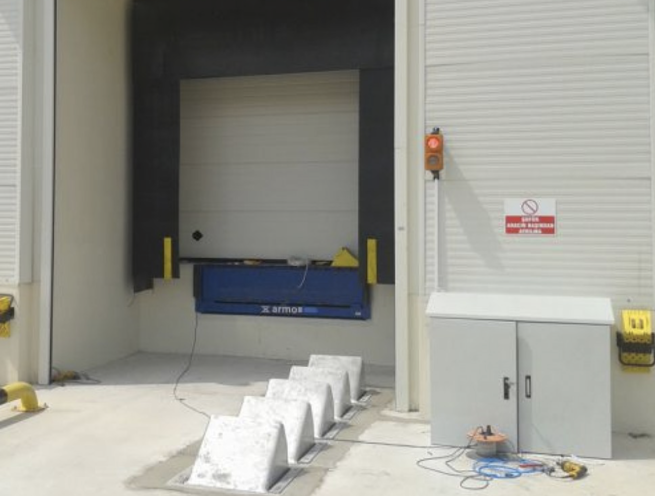
Automatic Vehicle Restraint Systems, Wheel Locking Chock Systems
The Madoors USA VR-450 Automatic Vehicle Restraint System is a ground-mounted, fully automatic pneumatic wheel and tire locking wedge system engineered to secure trucks, trailers, and container vehicles in position during loading and unloading operations at factory sites, warehouses, and logistics facilities — preventing unexpected vehicle departure, forklift falls between the loading bay and truck trailer, and fatal or material damage accidents caused by truck forward movement during active loading cycles.
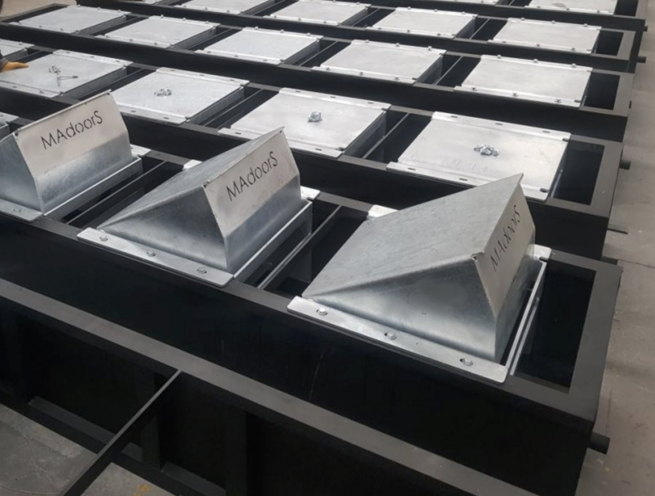
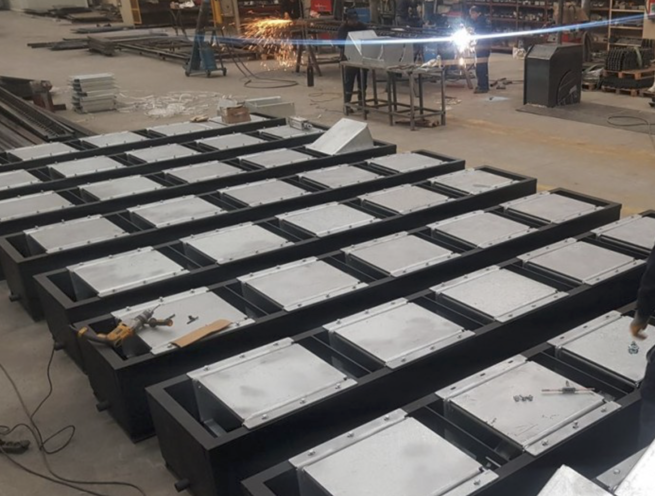
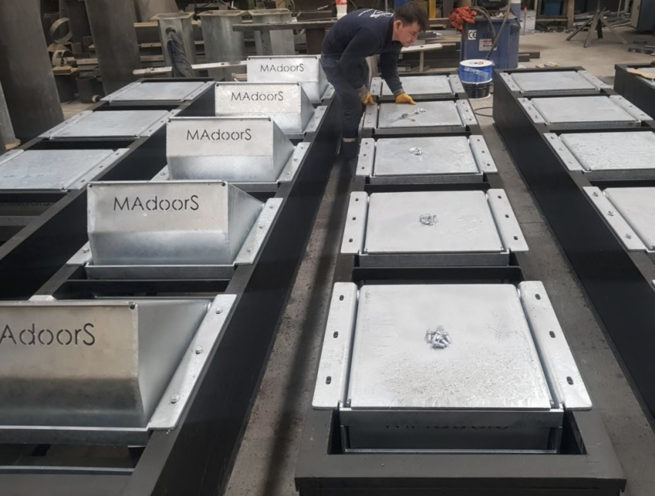
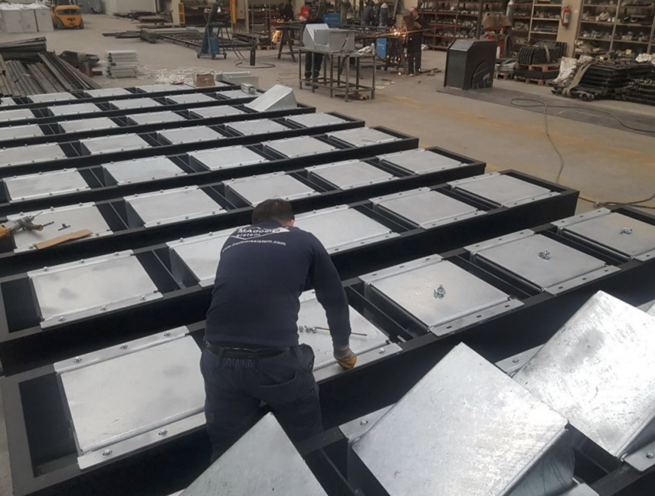
The VR-450 operates through a dual-pit configuration with 2 parallel pits per loading bay — one on each side of the truck — with a single row of wheel chocks installed in each pit. Pneumatic lifting of the wedges alongside the truck wheels locks the vehicle in position automatically from both sides simultaneously, providing balanced, secure wheel restraint that prevents forward, reverse, and lateral vehicle movement throughout the complete loading and unloading operation.
A three-way safety interlock between the VR-450 wheel restraint system, the dock leveler, and the sectional door makes it physically impossible for the truck to depart before loading and unloading is complete — the dock leveler can only operate when the truck is locked, the sectional door can only open when the truck is locked, and the VR-450 can only lock or unlock when the dock leveler is at rest and the sectional door is closed.
TECHNICAL SPECIFICATIONS
The Madoors USA VR-450 is a ground-mounted automatic air pressure vehicle restraint system. The installation consists of 2 parallel pits per loading bay, positioned on either side of the truck approach lane centerline, with 1 row of single wheel chocks installed in each pit. The dual-side pit configuration provides wheel restraint on both sides of the truck simultaneously — a key operational difference from single-side pit systems — ensuring balanced lateral restraint as well as forward and reverse movement prevention.
The pneumatic drive system lifts the wheel chock wedges from the pit floor to the wheel contact position alongside the truck tires when activated, locking the vehicle in place through mechanical wedge restraint. The pneumatic system provides rapid engagement and release response across high daily cycle rates at active loading facilities. The VR-450 operates on standard industrial air pressure supply infrastructure.
The three-way safety interlock governing the operational relationship between the VR-450, the dock leveler, and the sectional door functions as follows. The VR-450 can only be operated — locked or unlocked — when the dock leveler is in the standby rest position and the sectional door is closed. The sectional door can only be opened when the VR-450 is in the locked position confirming the truck is secured. The dock leveler can only be operated when the VR-450 is in the locked position confirming the truck is secured. This interlock sequence makes it physically impossible for the truck to be released and depart before the loading or unloading process is completed and the operator formally unlocks the system.
KEY FEATURES
Dual-Pit Bilateral Wheel Restraint — Both Sides Simultaneously
The VR-450 dual-pit configuration installs one pit on each side of the truck approach lane, providing wheel chock engagement on both sides of the truck simultaneously when the system is activated. This bilateral restraint provides balanced mechanical locking that prevents forward, reverse, and lateral vehicle movement — more comprehensive restraint than single-side systems that only engage one side of the truck wheel set.
Fully Automatic Pneumatic Operation
The VR-450 is fully automatic — chock engagement and release are controlled entirely through the system control interface without manual chock positioning, manual removal, or tool use. The pneumatic lifting mechanism raises the wheel wedges to wheel contact position on activation and retracts them to the pit floor on release, completing both operations rapidly without operator physical involvement with the chock hardware.
Three-Way Safety Interlock — Truck Departure Prevention
The three-way interlock between the VR-450, dock leveler, and sectional door creates a procedural and mechanical sequence that makes premature truck departure impossible. By requiring the VR-450 to be in the locked position before either the sectional door or the dock leveler can be operated, and by requiring both the dock leveler to be at rest and the sectional door to be closed before the VR-450 can be unlocked, the system ensures that the truck cannot be released at any point during an active loading or unloading operation — regardless of driver intent or operator error.
Fatal Accident Prevention — Forklift Gap Elimination
The primary life safety benefit of the VR-450 is the prevention of fatal and serious injury accidents caused by truck forward movement during forklift loading operations. When a truck moves forward while a forklift is entering or exiting the truck body, the forklift operator can fall into the gap created between the dock leveler and the truck trailer — a frequently fatal accident scenario at loading docks without wheel restraint. The VR-450 eliminates this gap creation risk by physically preventing all truck forward movement throughout the loading cycle.
Single Row Chocks Per Pit — Efficient Pit Geometry
Each pit contains a single row of wheel chocks, providing a compact pit geometry that minimizes the excavation depth and plan area required for installation while delivering effective single-side wheel restraint at each pit position. The bilateral dual-pit layout compensates for the single-row per pit configuration by providing engagement on both sides of the truck wheel set simultaneously.
Ramp Standby & Door Closed Interlock — Chock Operation Condition
The VR-450 can only be operated — engaged or released — when the dock leveler is confirmed in the standby rest position and the sectional door is confirmed closed. This condition prevents chock operation while loading equipment and personnel are positioned in the truck-dock interface zone, ensuring that wheel restraint changes only occur when the loading area is in a safe configuration for vehicle movement.
Easy to Use — Single Control Interface
The fully automatic VR-450 system is operated from a single control interface, providing a simple and clear operational procedure for loading dock operators. The automatic pneumatic mechanism eliminates the physical effort, tool use, and procedural complexity associated with manual wheel chock systems — supporting consistent safety compliance across all operators and all shifts without dependence on individual operator diligence in manual chock positioning.
Prevents Truck Forward Sliding & Trailer Gap Accidents
By locking the truck wheels in position from the moment the dock leveler is activated, the VR-450 prevents the forward sliding movement that creates the gap between the dock leveler platform and the truck trailer floor — the gap into which forklifts, pallet trucks, and personnel can fall during active loading operations. Elimination of this gap throughout the loading cycle is the direct mechanism through which the VR-450 prevents fatal and serious injury loading dock accidents.
COMPARISON: VR-450 VS WH-200
The Madoors USA VR-450 and WH-200 are both automatic pneumatic or hydraulic wheel restraint systems with three-way dock leveler and sectional door interlock, but differ in pit configuration and wheel engagement geometry.
The VR-450 uses 2 parallel pits — one on each side of the truck — with 1 row of chocks per pit, providing bilateral simultaneous wheel engagement on both sides of the truck wheel set. This dual-side configuration provides the most comprehensive lateral and longitudinal vehicle restraint and is the preferred specification for facilities handling the widest range of truck and trailer types.
The WH-200 uses 1 pit on one side of the truck with 2 rows of offset chocks in a single pit, providing single-side wheel engagement with offset row coverage to accommodate variable truck stopping positions. The two-row offset configuration in a single pit provides reliable wheel contact across a wider range of truck stopping positions than a single-row single-side system.
Both systems provide 60 tonnes of axle load resistance, three-way interlock operation, single control panel activation, and hot-dip galvanized rust-proof construction.
ASSEMBLY & INSTALLATION SEQUENCE
Loading Bay Assessment & Dual-Pit Position Planning
Loading bay floor dimensions, truck approach lane centerline, truck wheel track width, dock leveler specification, and sectional door control system interface points are assessed. Dual-pit positions — one on each side of the truck wheel track — are marked at the correct lateral spacing for the truck wheel set width profile of the vehicles expected at the facility.
Dual-Pit Excavation & Frame Installation
Pit excavations are completed at both marked positions simultaneously. Hot-dip galvanized pit frames are installed into both excavations and set to the correct depth for flush floor surface alignment. Frames are anchored to the surrounding floor structure and leveled to matching heights for balanced chock engagement.
Chock Mechanism & Pneumatic Drive Installation
Single rows of wheel chocks and the pneumatic drive mechanisms are installed within each pit frame. Chock travel, engagement height relative to wheel contact position, and retraction depth are set and verified for both pits. Pneumatic air supply connections are made to both pit drive mechanisms from the facility air supply infrastructure.
Electrical Connection & Control Panel Installation
Power supply connections are made to the pneumatic control valves and control panel. The single control panel is installed at the specified operator position. All electrical connections are verified for correct circuit integrity.
Three-Way Interlock Wiring & Logic Configuration
Interlock wiring is connected between the VR-450 control system, dock leveler control system, and sectional door control system. The three-way interlock logic is configured and all six interlock condition combinations are tested and verified for correct response — confirming that the dock leveler cannot operate with VR-450 unlocked, the sectional door cannot open with VR-450 unlocked, and the VR-450 cannot unlock with dock leveler active or sectional door open.
Bilateral Chock Engagement Testing
Both pit chock mechanisms are tested simultaneously for synchronized engagement and release. Balanced bilateral wheel contact and restraint force are verified across the expected range of truck stopping positions within the approach lane.
Full Operational Cycle Testing & Handover
Complete loading cycle operational testing is conducted — truck approach, VR-450 lock, sectional door open, dock leveler operation, dock leveler return to rest, sectional door close, and VR-450 unlock. All interlock sequences are verified under live operational conditions. Operator training and handover documentation are completed.
DEPLOYMENT SCENARIOS & USE CASES
Madoors USA VR-450 Automatic Vehicle Restraint Systems are specified for any loading dock environment where bilateral wheel restraint and three-way operational interlock are required for maximum loading cycle safety.
- Logistics and distribution center high-volume loading dock safety
- Manufacturing facility goods inward and dispatch dock restraint
- Warehouse and cold storage facility loading bay truck locking
- Supermarket and food distribution center loading dock safety
- Pharmaceutical manufacturing and distribution facility docks
- Automotive parts and components distribution center docks
- Chemical and hazardous materials facility loading restraint
- Airport cargo terminal truck loading dock safety systems
- Port container depot and freight terminal loading restraint
- E-commerce fulfillment center high-throughput loading dock safety
- Government and military logistics depot loading dock restraint
- Retail distribution center and cross-dock facility safety systems
- Printing and paper industry distribution facility loading docks
- Building materials and construction supply depot loading safety